Curated by Annabela Tournon, this exhibition displayed and analyzed the artistic-political production of the Mira group during the 1970s in Mexico, and featured original works recently donated by one of the group’s members, Arnulfo Aquino. Active between 1965 and 1982, the Mira group included, alongside Aquino, Melecio Galván, Eduardo Garduño, Rebeca Hidalgo, Crispín Alcázar, Silvia Paz Paredes, and Jorge Pérez Vega.
A first theme, The group’s migrations, deals with their beginnings, between 1966 and 1972, initially as Grupo 65, formed by students at the Escuela Nacional de Artes Plásticas of Academia de San Carlos, part of Universidad Nacional Autónoma de México (UNAM). They participated in the Arte Otro (Other Art) exhibition in 1968, which resulted in the establishment of a collective of the same name that would become an important driver of experimental art practices in Mexico, with Eduardo Garduño as one of its members. Before that, in 1967, Jorge Pérez Vega had been a participant in the Nuevos Grabadores group, where artists critical of the Taller de la Gráfica Popular tradition explored different techniques and collective working methods.
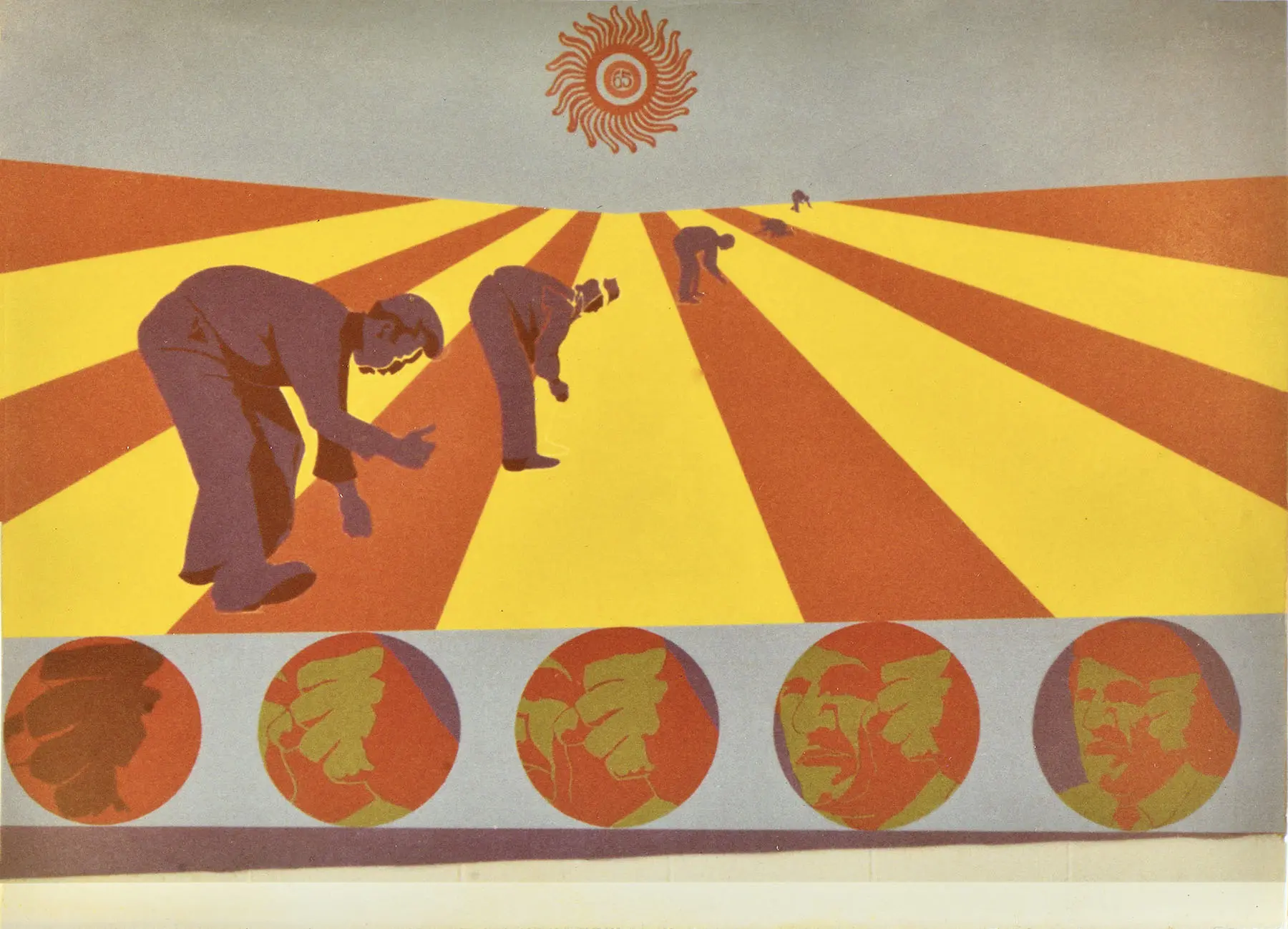
The highlights of this early period are the group’s graphic and mural productions, connected with protests in solidarity against the unjust treatment of the Latino population of the United States, especially the mural Los inmigrantes (The Immigrants)—reproduced here on the basis of contemporaneous photographic records—created by Arnulfo Aquino, Rebeca Hidalgo, Melecio Galván, and Jorge Novelo, during a California sojourn in the context of an educational project with immigrants in Merced County, featuring migrant fieldwork scenes, references to pre-Hispanic pilgrimages, and metonymic treatments of the ethnic identity of la raza, el pueblo, or the chicanos as well as geometrizing handling of the representation of the rural world.
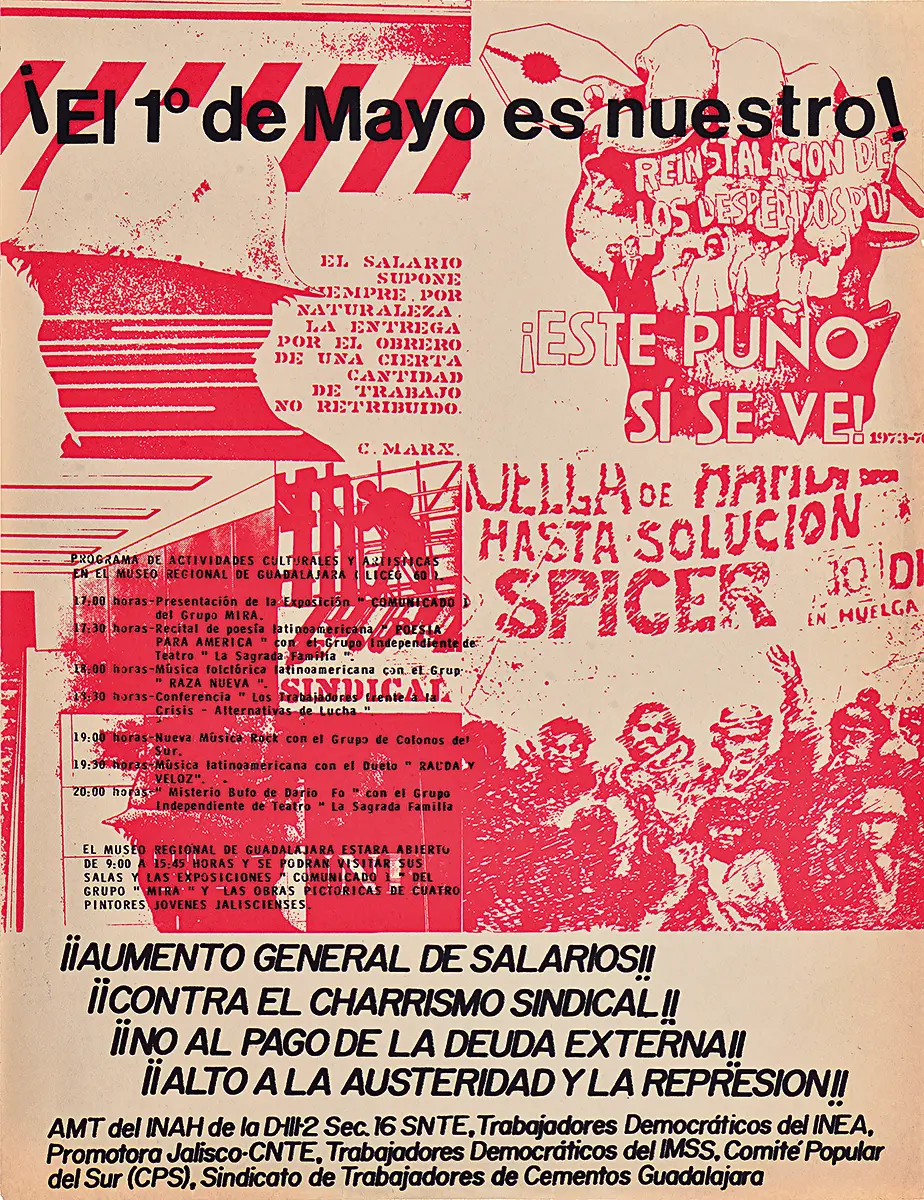
Already during this period, what would later become the Mira group experimented with graphic technics like silk-screening and Multilith printing, exploring planes and typographies with the superposition of inks and the application of color blocks—in contrasting combinations—or stain patterns, notions of active, modular, mobile murals, and the production of communication media like the daily Basta Ya.
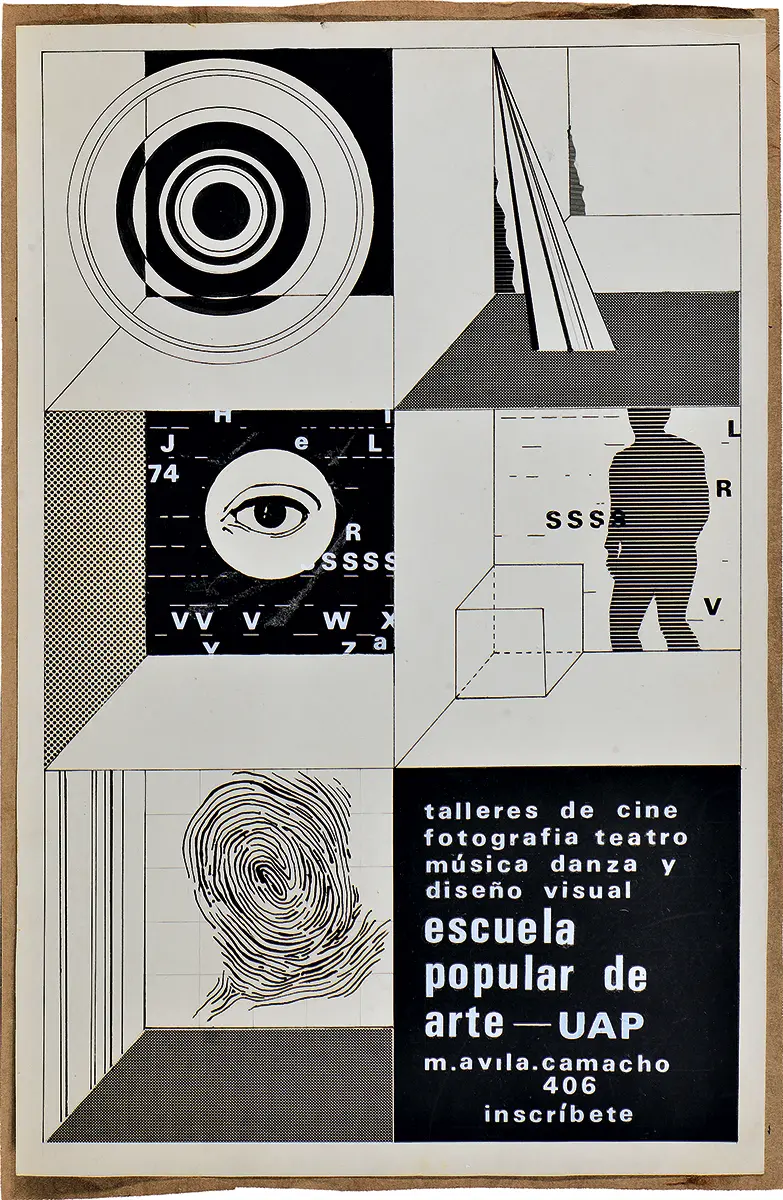
A second thematic grouping in the exhibition, Graphic Art in a Time of Political Crime (1972-1974), recounts the artist’s activities at Universidad Autónoma de Puebla, where, invited by poet Óscar Oliva, a university official at the time, they established the Escuela Popular de Arte (People’s Art School.) From that platform, they drove the creation of nearly 200 posters in support of democratic struggles across Latin America and the opening of spaces for political opposition in Mexico, fostering among their students the production of works that explored abstraction, geometry, design, the handling of color, and new readings of visual aspects of national history (emblems and heroes). The group also created a full-length feature film, Vendedores ambulantes (Street Peddlers), in collaboration with actual street peddlers, which in 1974 received an award at the Oberhausen Festival, in Germany. Shortly afterward, the group resigned from the Escuela Popular de Arte, in protest of the criminalization of student activism and the unsolved murder of six students shot during a rally.
The exhibition’s final thematic section is Mira, the Front and the Construction of 68, which covers the group’s actions between 1977 and 1982, undoubtedly the period of the greatest strength and critical presence. In September of 1977, two new members were added, Salvador Paleo and Saúl Martínez, and the group adopted the Mira name. From the Art and Ideology Workshop (TAI, in its Spanish acronym), Alberto Híjar joined the Mexican Front of Culture Worker’s Groups that year, and so did the collectives that had participated in the 10th Paris Biennial: Mira, Proceso Pentágono, and Suma. The exhibition records that Mira participated in the Front until 1979 with posters, catalogs, documents, and emblematic exhibitions that brought them together with other collectives and artists who shared their critical political positions, such as América en la Mira (America in the Crosshairs, 1978). The Mira group also presented a critical display, without artworks, at the 77-78 Salon of the Museo de Arte Moderno (MAM) in Mexico City.
When the Mira group adopts that moniker in order to construct a graphic-arts project, it experiments with series of ink drawings that were a unit unto themselves, within a three-part complex, and in 1978 it presented the project Graphic Communiqué #1 (Violence in Mexico City): 1) Problems of the city (migrants, services, infrastructure, working conditions); 2) Power structures (politicians and their rituals, simultaneous with violence); 3) social movements and alternatives (testimonies of repression events and the resources of collective organization, unionism, and labor strike, among others).
Finally, the exhibition also featured the original mock-up and various subsequent editions of the publishing project La Gráfica del 68 (The Graphic Arts of 68), produced by the Mira group in 1981 based on its own archives and collections, all of them expressive and communicative operations of metaphorical and representational processes about the violence of 1968 in Mexico.
* Courtesy: MUAC, UNAM.
EUGENIA MACÍAS
Ph.D. in History of Art and researcher at the Arkheia Documentation Center, Contemporary Art University Museum, UNAM, Mexico.