After many group projects intervening natural and urban landscapes in several countries around the world, artist and architect Miguel Braceli (Valencia, state of Carabobo, 1983) presented his first solo exhibition in Venezuela, his native country, at Espacio Monitor, in Centro de Arte Los Galpones. This exhibition brought together, in three sections, essential images, and elements that make reference to those interventions in vast, open landscapes: a large installation in space, a sampler of models and materials that are part of the artist’s “books”, a selection of photographs, and a space devoted to presenting the various actions as registered in the video. Braceli himself is responsible for the conceptualization and mise en scène, in collaboration with curator Miguel García.
The selection of works on exhibit harkens back to Braceli’s actions in countries like Argentina, Bolivia, Colombia, Costa Rica, Chile, the United States, Venezuela, and Spain. Characteristic—and indispensable—in all of these actions is the participation of many people, as collective actions are what produce the large-scale transformation of the landscape. Indeed, the idea is to create, between all participants, linkages or structures in the specific space, be it large sheets of plastic material (polyethylene bands), fabric, thread, or ropes, which effectuate the shift in the landscape. This has a number of implications. On the one hand, as an architect, Braceli makes space the body of his work, in terms, paradoxically, not of the material construction of a space for shared experience but, on the contrary, of its immaterial aspect—air, surroundings—as the element that makes possible the shaping of a new territory transformed by collective gestures or designs. As an artist, on the other hand, he formally creates a large-scale, dynamic “drawing” on the landscape, thanks to the lines generated by the large sheets of fabric or plastic materials carried by the rows of participants in their continuous motion, which establishes connecting threads. From either of the two points of view, the result is a transformation of the space. According to the sites selected, the conceptual implications may vary, since each context determines its own shifts in meaning.
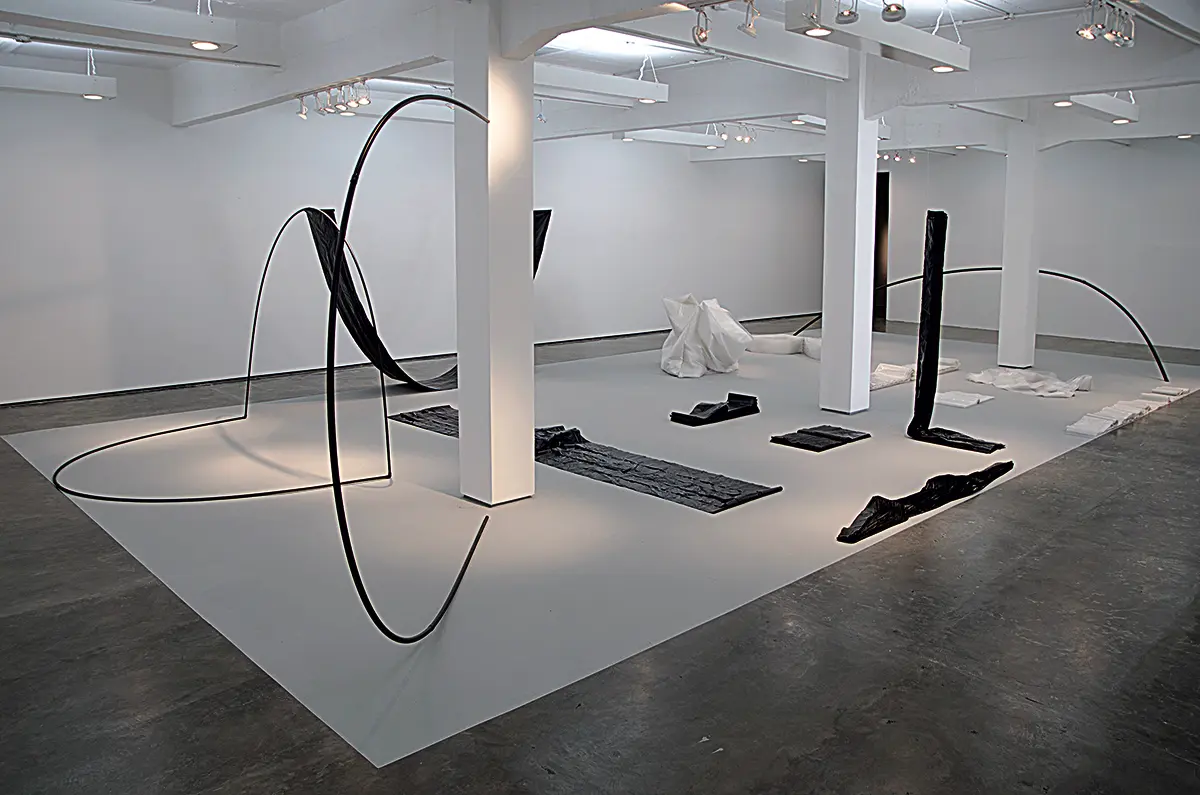
At the same time, scale is an important element in all of Braceli’s interventions. In his on-site works, this is in evidence not only in the vastness of the locations—Caracas Square or the President’s Building at Universidad Central de Venezuela; Irazú volcano, in Costa Rica, or the sand dunes of Santa Cruz, in Bolivia, among many others—but also in the participation of large masses of people. These are monumental actions. This aspect is somehow transferred to the exhibition at Espacio Monitor. The title of the show already signals it: 1:1, which is to say, an exact relationship between reality and its representation. The result can be seen in the large space installation that occupies the gallery’s central room, as well as in the videos presented on a scale proportional to reality. This exhibition was conceived, in that sense, under the same relational criteria that dominate the artist’s actions. It is not a “sampler” of the materials used in the landscape interventions, but of a large spatial composition where those materials given their location, size, distribution, and shapes, are arranged into an installation—one that forms a large drawing in space—at a 1:1 scale.
This exhibition provides an account of the line of research that Miguel Braceli has been developing with his constructions and ephemeral interventions on the landscape, and it also denotes the pedagogical intention of his systematic ways of composing the various materials in space. Some of Braceli’s work as a teacher has involved, precisely, moving outside the classroom, with the body’s experiences and its relationship with space as a starting point. Ultimately, an interesting relationship between space, artwork, and audience was also established on this occasion.
Miguel Braceli has received in recent times important recognitions that expand his options in terms of new international sites for his work. Only in 2018, he was given the AICA 2017 Award for his international projection, which included other awards and prizes won in Spain the previous year; he won the Leslie King-Hammond Graduate Award of the Maryland Institute College of Arts, where he will be working towards an M.F.A. degree until 2020. He was also the recipient of a Fulbright Fellowship to continue his activities in the United States and published Coreotopías, a book presenting his work in various Latin American landscapes, with essays by Félix Suazo, Lorena González, and Gerardo Zavarce.
SUSANA BENKO