Marylee Coll’s exhibition at Beatriz Gil Galería, Testigos del desarraigo (Witnesses to the Uprooting), is a narrative of the processes of exile that are so frequent in contemporary societies, and very specifically in Venezuela. Coll’s works are the result of ten years of observations and detailed explorations of the interior of Caracas’ homes where their inhabitants’ have put their possessions up for sale prior to their departure. Back in 2013, Coll exhibited a photo series depicting porcelain figures on sale in private homes, framing it as a configuration of minimal figurine monuments that can provide emotional company for their owners. On this occasion, she expands the spectrum into other planes. Testigos del desarraigo could be understood as an extended, sharp-eyed visual essay unfolding in sixty images that activate socio-anthropological and emotional reflections as well as processes of deconstruction from the standpoint of aesthetics, when it comes to incorporating objects into contemporary art. Objects become bodies, but also memories, witnesses to uprooting, cartographies of oblivion, markers of what stays and remains.
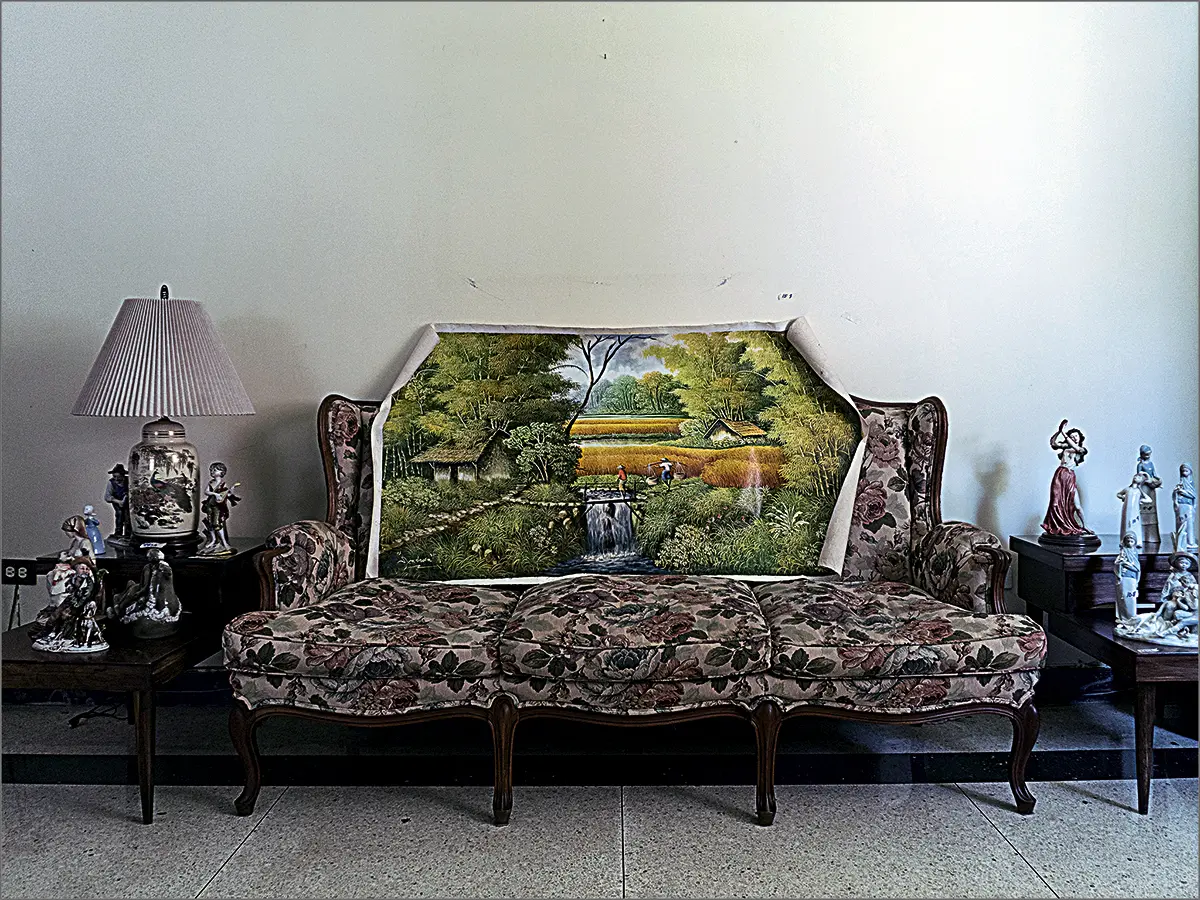
At a first level, Coll designs a program of socio-anthropological readings of the objects. Each image contains an inventory of things that surround everyday life and accompany existence over the years: framed paintings, family photographs, dinnerware and utensils, bedsheets, tablecloths, old sewing machines, posters, pillows, lamps, footlockers, maps of Venezuela, items of clothing. These objects make it possible for us to reconstruct the social experience that defined their context: gatherings, celebrations, day-to-day steps. In the words of curator Ruth Auerbach in her introductory essay, “the extensive cartography of objects captured by Coll in these intimate and extemporaneous spaces shapes a map of multiple relationships based on the affinities and correspondences we perceive between the patrimonial possessions represented and the consequences of a cruel, contingent circumstance.” There we can see a phenomenological contribution to our understanding of the object that ceases to be an inanimate thing to become a fragment of a life already gone. Secondly, there is an emotional vision of objects that belong to a living space and are left behind as a family leaves. Those who migrate are forced to decide what to take and what not to take with them, and such decisions involve both emotions and necessities. Sometimes we leave behind dear objects that are nevertheless not needed; sometimes we can’t part with them, even if it is only a photo album of a pained portrait of mom. But this map of affective relationships is what takes us to the trace, to the remainder, to what people can forego, to what will become a true witness to uprooting. This is a deconstructive gesture that ultimately blurs the contours of memories and strips them of their initial utilitarian or ornamental values. Memories thus become shadows, and, despite their seeming immateriality in such condition, they redefine the critical density of the object and produce a new narrative of uprooting.
The photographic approach in these images is always frontal, and the composition is structured in a similarly dual plane, which activates the possibility of thinking the artworks not as the photographs of objects but as portraits of them as carriers, in their alienated condition, of a personality or dignity that gives them a certain expressive character. This is to say, the objects cast aside their ornamental or utilitarian status and becomes carriers of meaning. But the element that agglutinates this consideration of the “group portrait of objects” is the construction of the space they occupy. Coll photographs domestic spaces: “This story of transience, displacement, and resilience is accompanied by chipped walls, mansions invaded by nature, books and magazines crestfallen on the floor, unhanged paintings, abandoned photographs, cardboard boxes, and packing paper,” Auerbach observes. The images are portraits of the objects but also portraits of the places that hold them. Circulating around this notion of the space where the objects are posed is a voyeuristic interpretation in the observer’s gaze; the observer becomes yet another witness, bringing to bear his or her own perceptions of experiences of alienation and uprooting. Obviously, there is a loss of possessions that are put up for sale, but there is also an addition of meaning for viewers who create their own stories around what those objects and their owners were in the past. This is not only a poetics of the object but also one of the place and of memory, which is to say of the contexts or sites that contain those objects: abandoned spaces become metaphors of countries in situations of neglect, of populations in constant flight, of migration and diasporas—of what we bring with us and what we leave behind, all of which gives shape to emotional geography in our memory.
MARÍA LUZ CÁRDENAS