The exhibition by the young visual artist Mario Morales titled Serendipity consists of twenty-seven acrylic works on wood that, as the title suggests, allude to fortuitous events that foreshadow good fortunes.
The title suggests the encounter of fortunate discoveries while following a predetermined path. Morales feels as if he had stumbled upon a form of expression that perfectly fits his sensibility, which translates into a spontaneous expressive burst of happiness and aesthetic success.
Consequently, in this exhibition Morales has made an important leap, abandoning the realm of geometric abstraction to delve into the kinetic field.
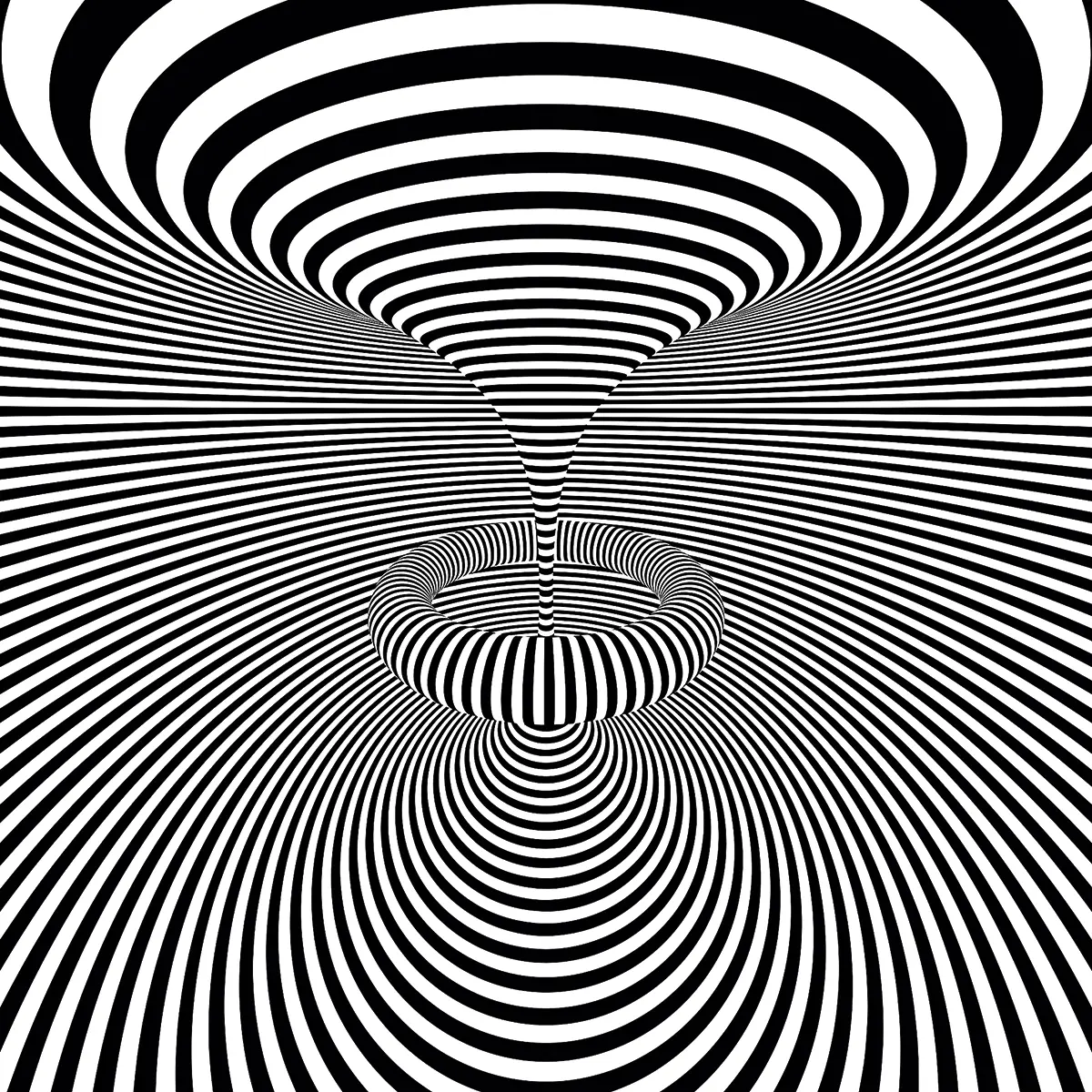
This is Morales’s second solo show. It took him two years to develop it. It features masterfully rendered creations that showcase a maturity equivalent to that of a consolidated artist whose mastery of the medium becomes the basis of the work. This is no small achievement in this day and age because it allows us to appreciate the practice of trade and dominion of a technique that stands in stark contrast to a perfectionist, machine-made renderings.
Morales acknowledges leaving his interest in geometric art behind as he ventures into an unreal and multifaceted world with dizzying twists and turns created expressly to play with viewers; tricking them into deceptive visions with designs that alternate rigor with a measured use of color.
In reviewing Morales’s artistic career, we can observe that his incursion into geometric art was prompted more by a personal impulse than by the teachings of an art studio or art school. His fascination resided in the exploration of combinations of straight and sinuous lines and forms and their interaction with lights and shadows. The boom of geometric art in Chile occurred during the 1970s when a great number of artists passionately pursued this artistic approach. Then the movement experienced a decline as a result of the repressive political environment that prevailed in the country. During this dark period in the history of Chile, art was influenced first by left-wing parties and then by the military government. And geometric art was not part of the agenda of either of the two factions.
In this kinetic approach chosen by Morales, the seemingly moving shapes lead to immersive explorations that successfully result in uniquely beautiful forms and colors that are enjoyed by a large public. It is a result also achieved by other artists from earlier generations who have been recognized by Morales on several occasions: Matilde Pérez, Getulio Alviani, Victor Vasarely, Bridget Riley, Gustavo Poblete, and Carmen Herrera.
Kinetic art implies the development of images that give the impression of a movement that is actually not there, through the use of elements like light and shadows, form, and color. It is not easy to create without first researching the effects of light, the behavior of half-shades, and the combination and effect of colors on any given surface. Those artists who in the past made kinetic art their form of expression did not have at their disposal the elements and techniques available today. While the current information technology allows creating images more easily, there is a remarkable difference between a work created by a computer and one rendered by an artist’s hand.
Morales is a meticulous, detailed-oriented individual and a tireless explorer—as demonstrated by marked differences between the works of two very distinct exhibitions. His great achievement has been succeeding in the development of a solid carrier as a self-taught artist.
ERNESTO MUÑOZ