Invisible is the title of the exhibition by Marie Orensanz presented at the Galería Ruth Benzacar during the months of August and September of 2018.
traspasar a través de lo visible
ver más allá... de la materia
lo que vemos no es solamente lo que vemos…
lo complejo del ser humano es una suma de vivencias
descubrir o recrear motivar... completar... respetar
somos un fragmento de pasado y de futuro...
[piercing through the visible
looking beyond… matter
what we see is not only what we see…
complexity in human beings is the sum of experiences
discovering or recreating, motivating… completing… respecting
we are a fragment of the past and of the future..]
M.O. Montrouge 2018
This brief paragraph that introduces visitors to the exhibition confirms the permanent presence of words in Marie Orensanz’s work. In this sense, this introductory text offered clues about the meaning of this compelling proposal exhibited in Buenos Aires by the Argentine-French artist.
The museography for this exhibition required the large space of the gallery to be totally empty. The group of works included a dozen pieces created with metal or resin—to simulate rusty iron—and others pieces on steel with carved words rendered with Orensanz’s usual circular calligraphy, along with a few of her marble fragments of formulas and signs.
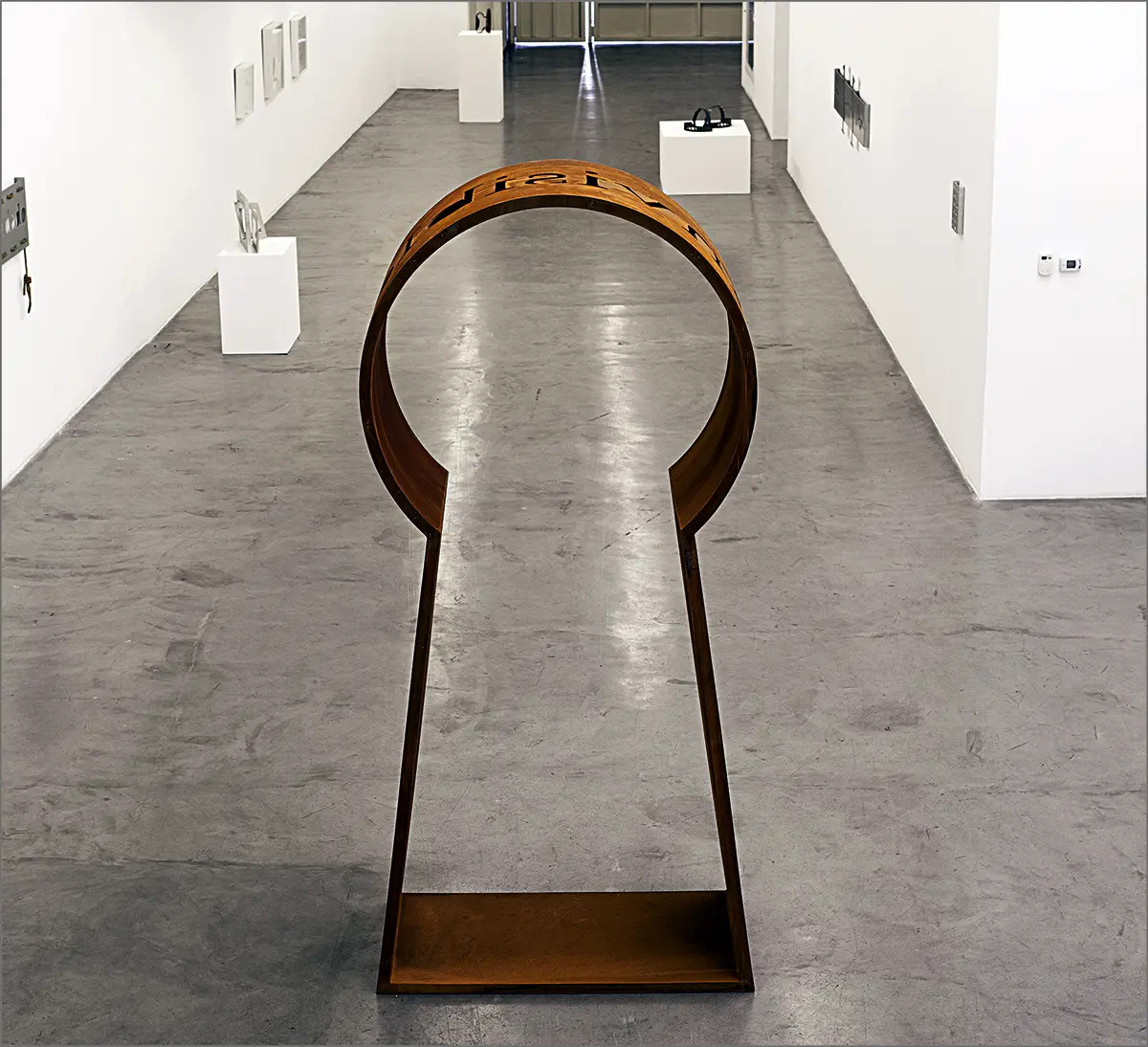
It was an installation that had to be walked from the right to the left of the exhibition space until reaching a monumental final piece, a large keyhole created with Corten steel that not only consisted of a silhouette but also allowed a person to stand inside and included the word “invisible” carved in its upper section. Several of the words cut out in several pieces are infinitive verbs that suggest actions. One of the maxims most used by Orensanz, “thinking is revolutionary,” was once again present in this exhibition as a reminder of the origin of human action in the internal-external world.
A spatial assessment of the large exhibition hall was part of the overarching concept of the show, insofar as the group of works responded to an invitation to also physically explore the dialog between words—a suggestion for bringing to life the language carved in the pieces. This essential perceptive component reminds me of the 1968 installation at the Galería El Taller, in Buenos Aires, in which Orensanz presented white painted primary wood structures; geometrically based abstract forms with human-liked mobility in their constructive design, displayed on the floor in a dialogue with the general space, ready to be actively experienced by visitors. This very suggestion is also at the core of the current exhibition: the active participation of viewers as part of the exhibition experience and in front of every piece, to generate a mood that is susceptible to the meaning of the words contained in the pieces.
In one of the works, three empty frames have the expression “The environment conditions people,” cut out in them. While the meaning of the verb “condition” can have a negative meaning, this exhibition project actually calls for expanding the awareness of visitors. In this manner, every piece proposes an experience that is hard to avoid, as their transformative power can only be accessed through the “invisible” word—which is no other thing than the guiding principle in art.
The work titled … Era…, created with polyamide, is the first piece that visitors encounter on the right. It is the copy of an old rusty iron with its bottom part facing the viewers and where the word “era,” past tense of the verb “be” in the third person, has been carved. The subject of gender has always been present in this artist’s production in a personal and precursory manner. While this piece could be insinuating the action of ironing—an activity associated with the history of women—it may instead just be alluding to the increasingly uncommon use of this appliance in contemporary life. But, in general terms, it is evident that Marie Orensanz’s approach to art, her thinking, and methods, are based on a female view of the world. In addition to the intellectual elements that have characterized her work, her latest proposals now include the corporal element in a tacit way, in addition to emotional and affective receptions that are parallel that definition of thinking only understood as rational. The inscription atrapados (trapped) contains traps with serrated edges. Another piece includes the once childish phrase “each tends to his/her own game,” symbolized by two characters of the number one with their backs to each other. The general meaning could perhaps be referring, for instance, to the political-economic system that dominates part of the world. An aluminum plaque has been sewn with a rope that continues below the metal piece in the shape of a hanging rope, and the carved word is “acordado” (agreed).
But the exegesis of the group seems to demonstrate that the same artist who practices this half critical and half compassionate take on human actions, also includes positive qualities in her texts about human actions, like “discovering, recreating, motivating… completing… respecting,” where the artistic creation—as a way to rework political, social, or economic situations and readings---of reality becomes an open path to explore. The three first verbs seem to foreshadow the possibility of transmutation.
Lastly, there is an inherent element of performance in the main piece, given the somehow magical quality that allows the person standing inside the keyhole of the giant lock to read the word “invisible” in the upper section of the piece. It can only be read by those who decide to enter the work. This person is alone in an imaginarily diminutive space that allows only one individual at the time to enter and exit. The word “invisible” is perhaps the key to a solution that is not the only individual but also tangibly general. It perhaps draws from something even older, like the ancient Greek aphorism “know yourself,” attributed to several philosophers from that millenary culture, the cradle of Western civilization.
MERCEDES CASANEGRA