The grand gallery of The Bronx Museum imposes silence. Manuel Mendive’s works are powerful in themselves and establish a different baroque gaze. There’s no hyper-saturation or the explosion of colors in them. The predominance of green hues produces a relaxing sensation, a feeling of being somewhat exposed, like in a walk in the forest. In the range of colors used by Mendive, there is also a grayish tone that moderates all situations, and there are also touches of pure white and points of light in his night scenes. Knowing how far advanced we are into the first quarter of the Twenty-First Century, we wonder about the current validity of art that is ritualistic, naïf-surrealizing in its character, primitive, figurative, organic, and narrative. To a large extent, these are the qualities that characterized the early eras of Latin American art, when artists naturally looked at their roots and/or when they sought to reflect about their origins, rather than following Europe’s precepts and movements. In every instance, the answer is: it is valid, provided it is authentic. When artistic gestures are superficial, regardless of the style, they have no validity.
Visiting an exhibition of works by Manuel Mendive, one breathes authenticity: it feeds our gaze, and we discover a virtuosity that is closely tied to fantasy and to the organic, the latter represented by human bodies, animals, and plants. The organic element is key in the work of this Cuban artist who paints and also hammers out mixed techniques, actions, sculptures, drawings, chairs, and objects, among other creations.
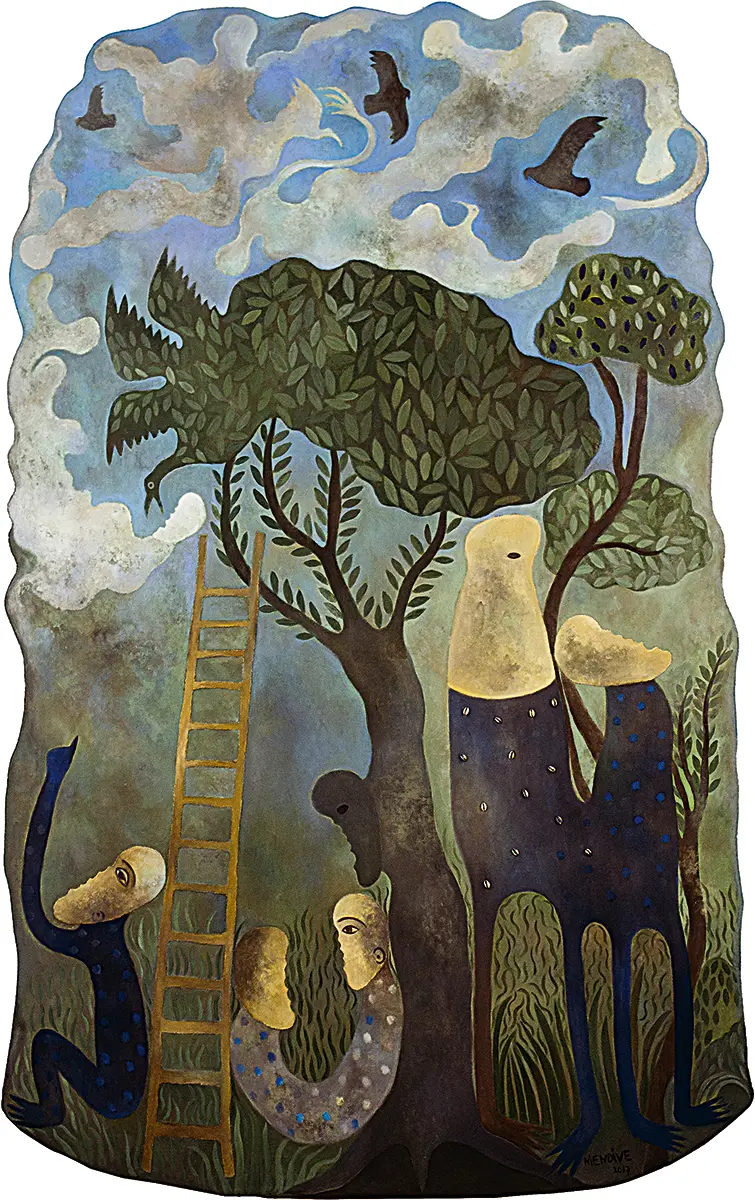
One of the aspects that best identify Mendive’s work is the correlation between what he paints and the shapes or contours of the surfaces on which he paints. Many will say, “but it is just acrylic paint on wood-mounted canvas, like so many others.” And it is true, the combination has existed for centuries. But unlike those precedents, the presences that Manuel Mendive brings forth in his works differentiate themselves in their contours, in the semi-nullification of the use of everyday objects he paints and/or those whose function he alters, as in the case of the chairs he makes into pedestals for sculptural objects and the chairs he uses as supports for his painting of poetic allegories.
The large two-dimensional works situated on the walls of the exhibition space have irregular contours. The bottom part is straight, semi-straight, or somewhat curved. As the sides begin from that bottom part up, they also curve. The lateral edges can occasionally be straight, or they are activated into non-symmetrical waves until they reach the upper portion of the painting, where the waves continue. The works on exhibit with the title Fragmentos de paisaje (Landscape Fragments) do indeed resemble fragments of a landscape painted on ripped tree bark. Straight angles are not Mendive’s favorite friends. On the contrary, the sensation of things torn—by a storm, say, or if it were possible to rip out a piece of the tree—predominates. These irregular-contour paintings symbolize the island of Cuba, Manuel Mendive’s native country. Both in the paintings on the wall and in those that are semi-circular and semi-self-supporting, curvature dominates the contour, except, or at least with lesser intensity, in the bottom edge.
Fragmentos de un paisaje are whole scenes or scenes with a painted frieze in their lower section. In them, trees are different and are used as chairs, supports, or thematic excuses. There are also Mendivian chairs that the artist has painted, carved, modified with added carvings encrusted, and/or studded with a variety of materials, on every side. The faces and bodies of Mendive’s human figures are distorted and painted, somewhat resembling certain “Martians” that became common in Latin American comics back in the 1970s and 80s. After Manuel Mendive met the photographer John Rowe, the idea emerged for the latter to photograph the Cuban artist’s performances. The shots are rich in angles and inclusions. Rowe’s photographs work best in groups of four. Because of the printing technique (C-print on aluminum), light reverberates richly, there are great details of Mendive painting on bodies, and there are concrete examples of Mendive’s inclination for works that could also be scenographic.
Two further aspects are worth mentioning. First, the fact that each work has its own profile; second, that the human figures have anthropomorphic features and the animals present alterations. It also must be noted that Manuel Mendive’s art is localized in developing countries and deeply ritualistic, connected to Central American deities. As an artist who carries out actions (performances), Manuel Mendive establishes a connection between the aboriginal and the conceptual. This reveals linkages between certain aspects of modern art—the first half of the Twentieth Century—and postmodernity while earning the right to enter the Twenty-First Century—as mentioned at the beginning—by virtue of his authenticity.
GRACIELA KARTOFEL