From imperative opacity to public manifestation could be an alternative title for Trembling Thinking, the group exhibition organized by the Americas Society in honor of two towering Caribbean intellectuals whose prestige has done nothing but grow over the decades: Cuban ethnologist, writer, and artist Lydia Cabrera and Martinican writer Édouard Glissant. The curators run interesting—and, precisely for the same reason, significant—risks. The decentralizing archipelago as a model for thought is at the base of Glissant’s critical and creative practice so that the notion of trembling thinking is connected to his activities, even though his books are printed in the format of traditional philosophical books. Cabrera, meanwhile, is anchored to modernity with her encyclopedic pioneering drive, which can almost be described as avant-garde. The notes in her notebooks possess the anxiety of the immediate, of eyewitness testimony, which gives them an ineffable freshness. Her drawings are the nerves of a unique birth in Cuban visual culture.
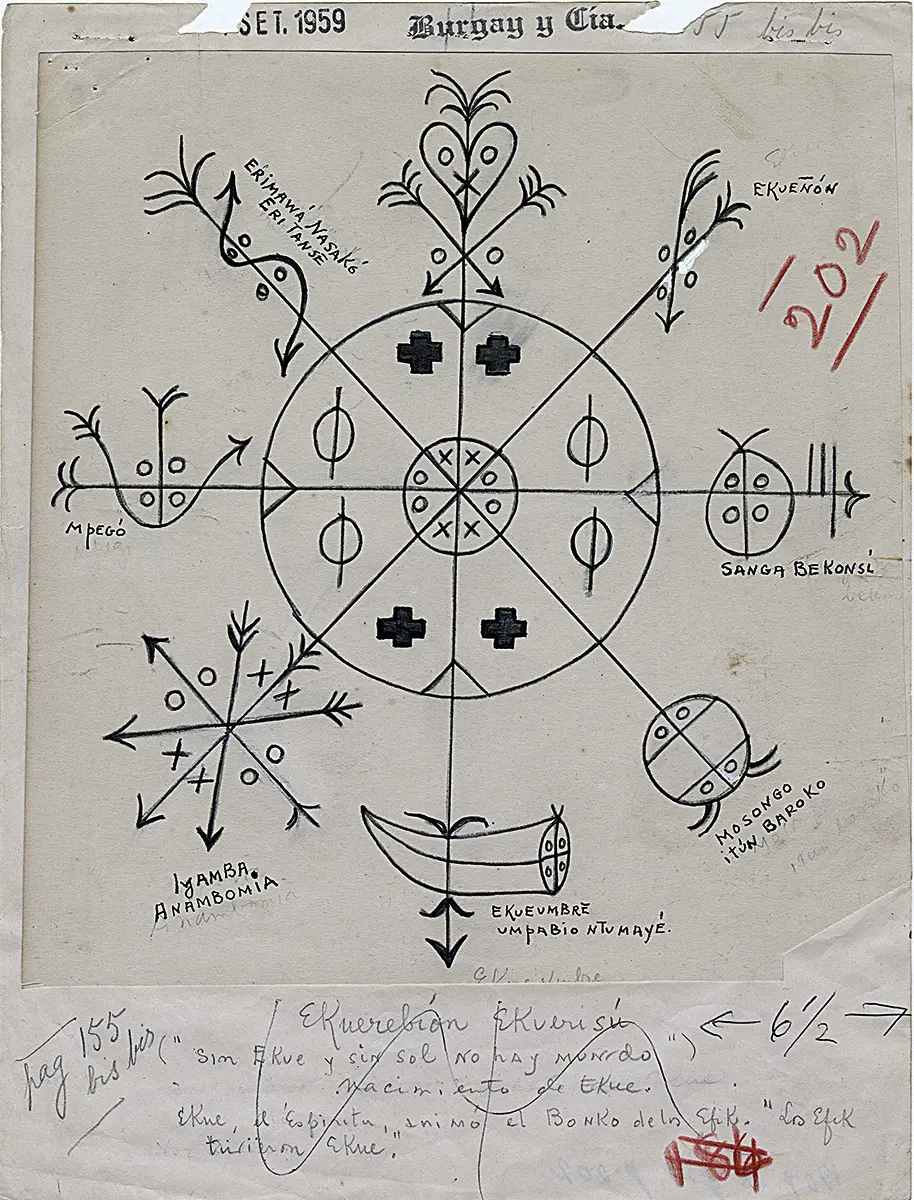
The exhibition is organized in three groups distributed in the same number of galleries, and the intention is to balance the selection of original works by artists from many latitudes and generations, with archival materials focused on Cabrera and Glissant, which serve to expand and multiply the associations between the signs as an extensive network of relationships projected in many different directions. One could think here of a “total curatorship” in the sense that Fernando del Paso was after a total novel, exploiting every possibility offered by the narrative art. Devoid of a center and of entry or exit points, this organization follows the open structure of the rhizome, which is indebted to the theory of the archipelago.
Nevertheless, there are key points of reference in each gallery. In the first one, there is a first-edition copy of Cabrera’s El monte (The Mountain), a treatise on Afro-Cuban religious practices, and a documentary about The Right to Opacity, an essential concept in Glissant’s thought. El monte reveals an up to then little-known universe of folk religiosity, in response to the folkloristic approaches that had shaped Cuban intellectual production in the early decades of the Twentieth Century. It was this book that situated Cabrera as a key figure in the ethnological study of national culture in Cuba, at a time when the conflict between its Spanish and African veins was rather acute. For its part, Glissant’s opacity, a concept developed in Paris in the second half of the century, acquires a highly politicized character, almost like an alternative to the Enlightenment-driven gaze of the Negritude movement and to the psychoanalytic studies propounded by Frantz Fanon. With his defense of the black subject’s right to opacity—a subject that is only visible to the repression and criminalization apparatuses—Glissant gains even greater currency in today’s culture, with the obsession with transparency that characterizes the hypermodern society.
It is not by chance that this introductory gallery presents visitors with works that are hybrid in character, as the artist’s book Homage To Édouard Glissant, by Lebanese-American poet Etel Adnan, an accordion of simple vertical forms in earthen tones and black, hermetic gestures. Or the series Sketches for Atópolis, by American artist Jack Whitten, a polyptych of twelve acrylic-on-paper paintings in an abstract-expressionist language. On his part, Melvin Edwards contrasts the physical weight and the lightness of design with his use of soldering in sculptural compositions of relative complexity and compact mass in End of the Century. Opacity here takes the shape of a protective shell, as loaded with meaning as it is hermetic.
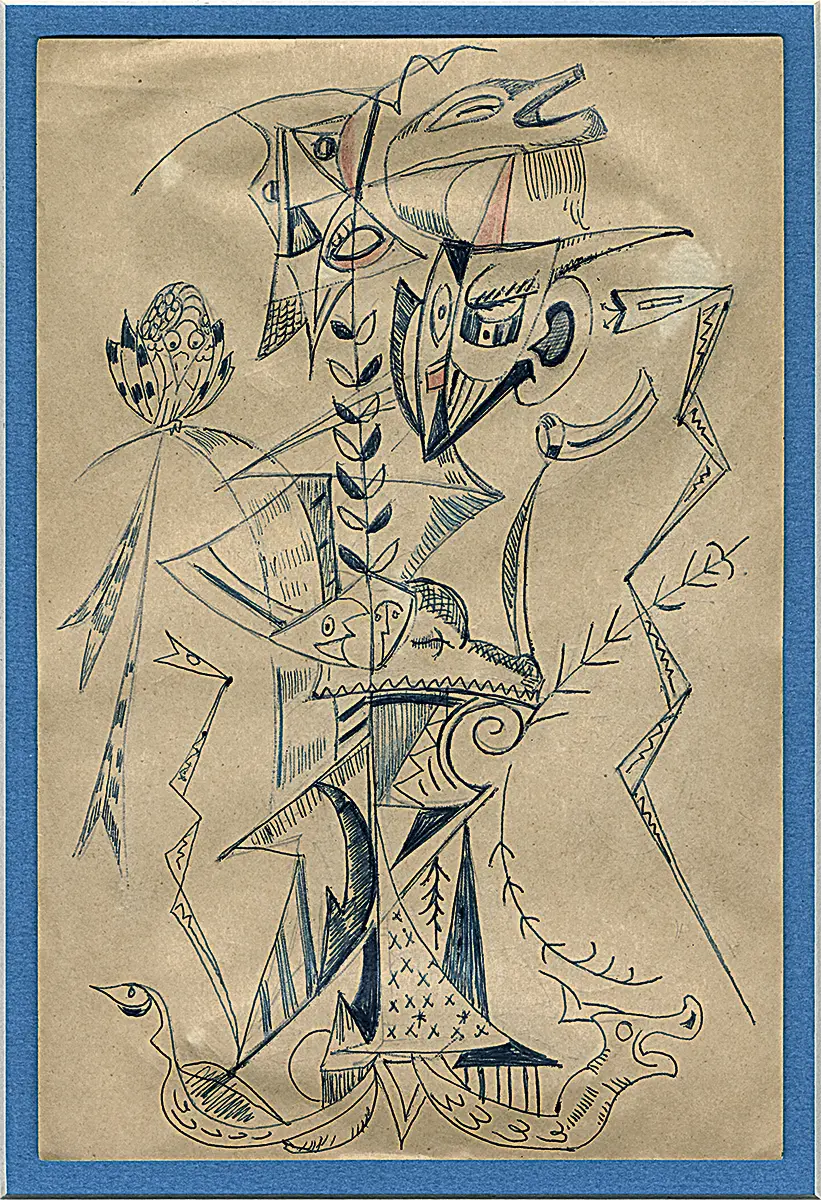
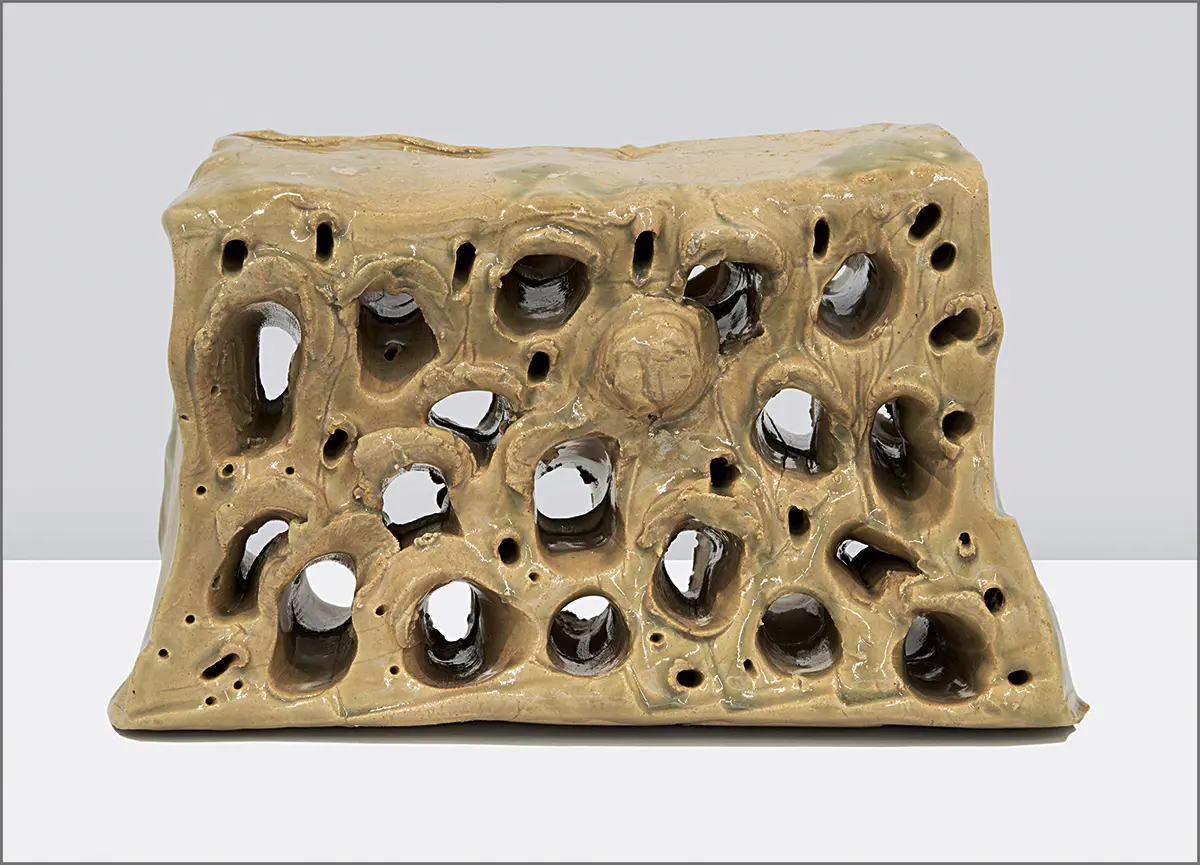
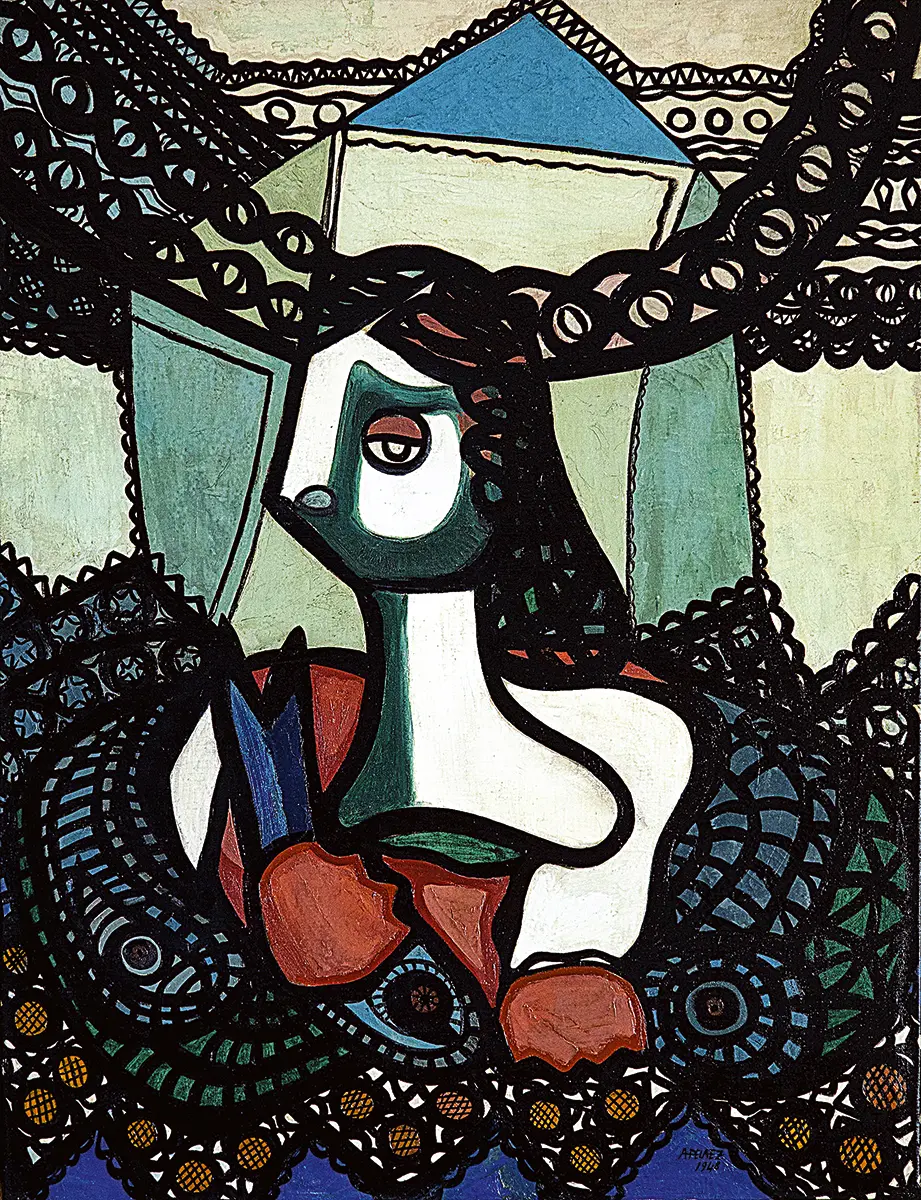
The second gallery is dominated by a set of display cases in which original works of art alternate with publications both in print and in digital format. The distribution of these forces on the viewer a trajectory that to a large degree resembles the zigzagging motion of currents between Caribbean islands. This recourse is evidently based on the same sense of decentralization suggested by the idea of the archipelago. Motion makes it possible to highlight unexpected visual associations. For example, Syrian artist Simone Fattal’s white ceramic works (Wall I and Wall II) with their two perforated walls, in front of a painting by Cuba’s Amelia Peláez featuring a mouthless female figure at its center, surrounded by lacework, brocades, and other designs of frankly Baroque stylization. Similarly, the images in Lydia Cabrera’s own drawings—at some point exhibited by the artist and written about by her under the pretension that the author was a male artist, her heteronym Armando Córdova—dialog with Roberto Matta’s surrealist figures.
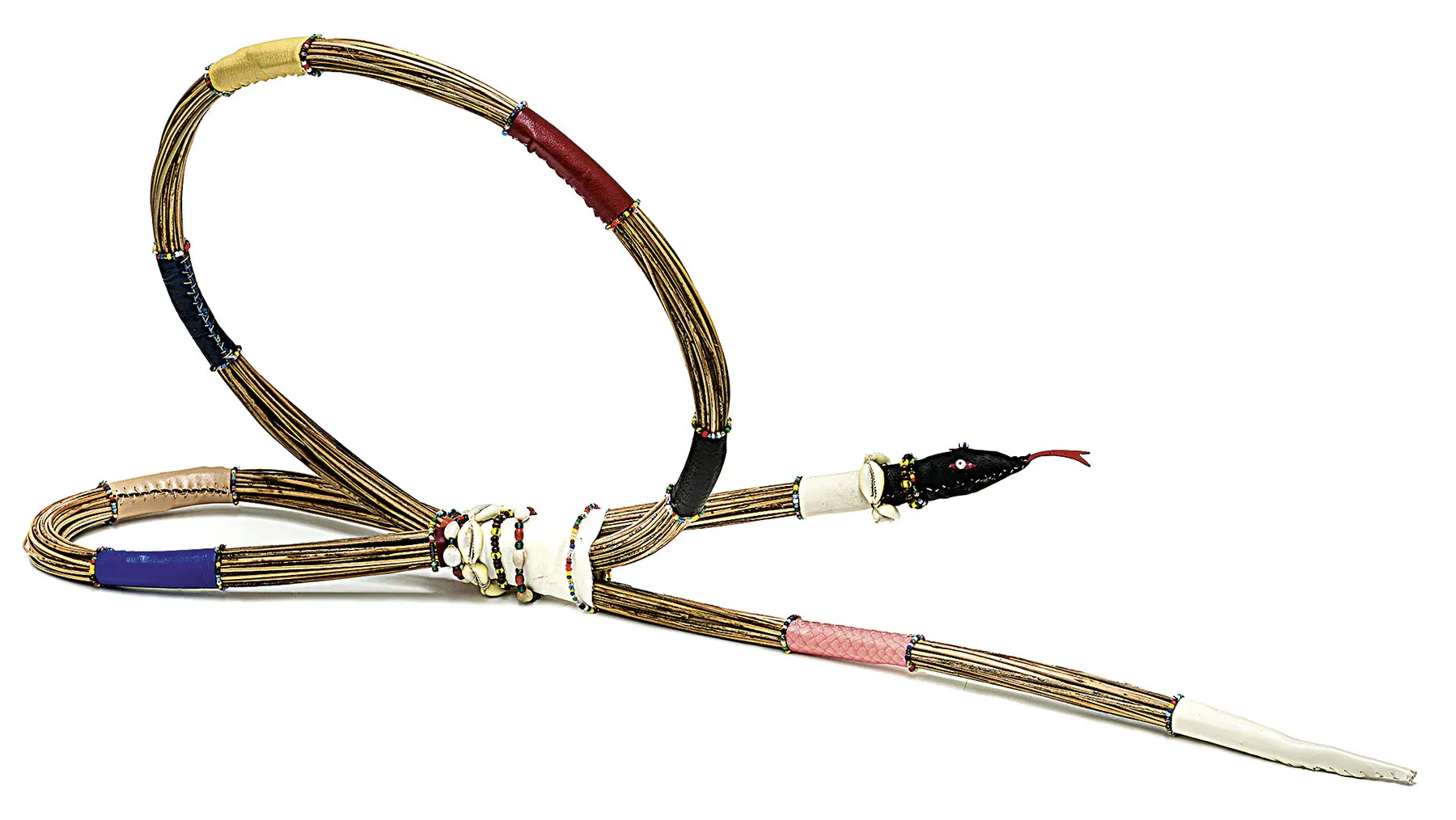
A selection of original drawings by Cabrera features exquisite representations of animals. The animals appear sometimes alone and sometimes in columns, whimsically mounted on the head of a human figure, or on the back of another animal. These are sketches of illustrations for allegorical stories from the Afro-Cuban universe that Cabrera studied and occasionally wrote down, be it as a record of her informants’ testimony or s her own narratives. On loan from Miami’s Lowe Art Museum, these drawings accompany the extraordinary sculpture Ejo Awuru, Dawn’s Serpent, by Brazilian artist Mestre Didi. Using palm leaves, leather, snail shells, and beads, the sculpture resembles a serpent tied in a knot to form two circles that intersect perpendicularly. The detail of the leather head gives the work an interesting vivacity, which in Cabrera’s drawings translates into a nervous line. Echoes of these vivacious shapes can be found in the animal drawings presented by Peruvian artist Elena Tejada-Herrera. Some of the digital-format publications include pleasurable surprises, like Cabrera’s Arere Marekén, A Black Tale, with illustrations by Russian avant-garde artist Alexandra Exter, both Cabrera’s and Amelia Peláez’s teacher in Paris.
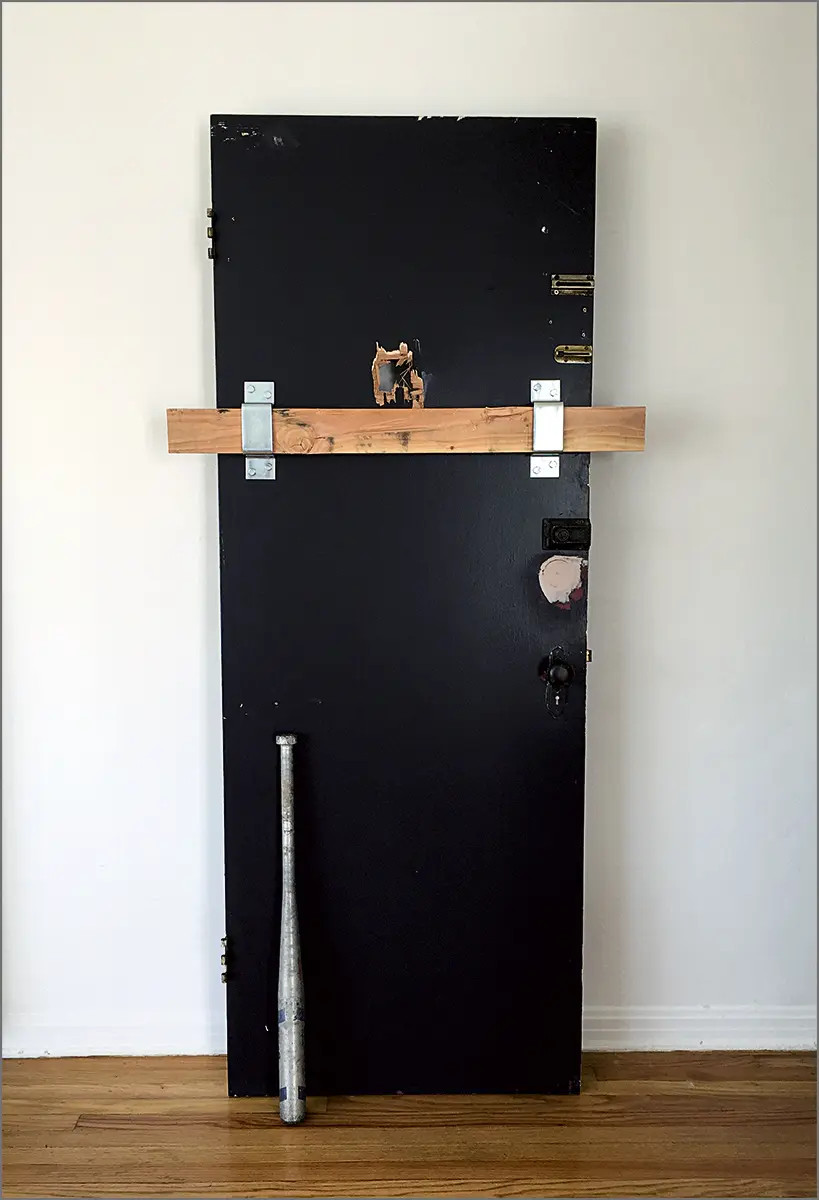
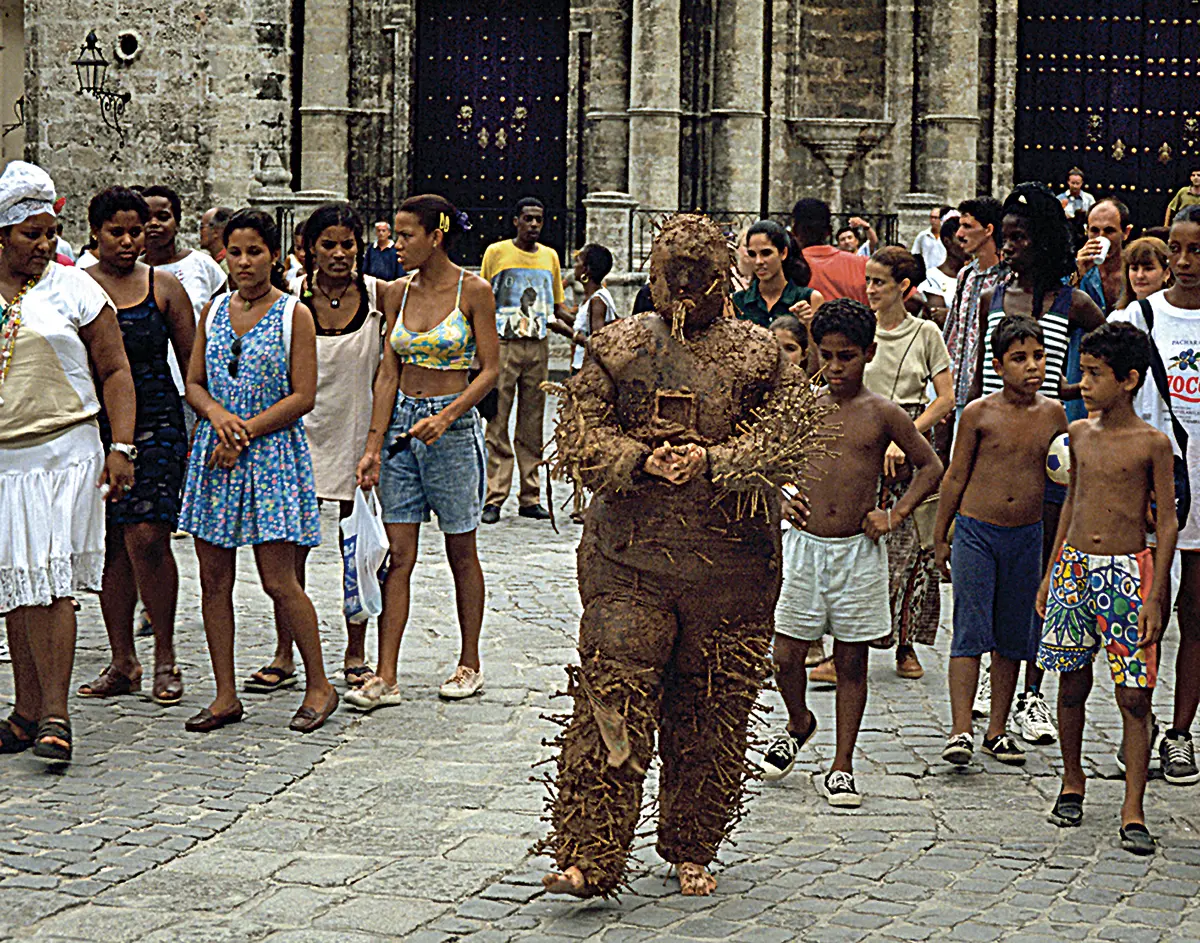
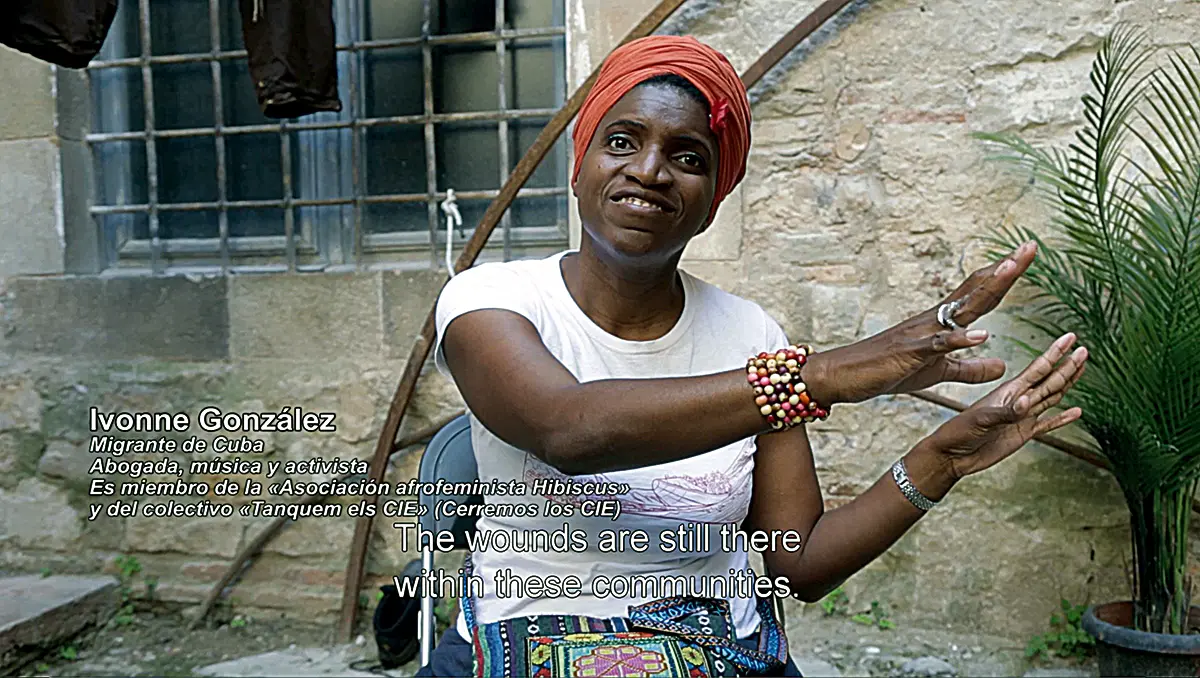
In the final gallery, our attention is diverted from the semi-private realm of Cabrera’s and Glissant’s publications to works with markedly political and social intent. In his sculpture Entryways Diamond Stingily uses the ready-made of a door with evidence of violence and a security bar with a leaning aluminum bat. Placing this work against the wall the gallery is transformed into a domestic, phobic space, awaiting menaces. On her part, Tania Bruguera presents her installation Destierro (Displacement), an imposing wardrobe recreated from the clothes she used in her performance Nkisi, which consisted in her walking around Old Havana dresses in an outfit weighted with dirt and nails, in ways described by Cabrera in El Monte. The performance took place in the Havana Biennial, where later Bruguera’s work would be censured. Meanwhile, de Kader Attia’s video Héroes heridos (Wounded Heroes) is a documentary focused on political mobilization, with images of activists intent on defending the rights of undocumented immigrants with an occupation of the Barcelona School of Art, where Attia was a student. Although less evidently connected to Cabrera and Glissant, these artists are without a doubt part of a new crop of critical, destabilizing thought that has both of them as models.
ELVIS FUENTES