
The Wrath of Devotion is the title of the most recent solo show by young Mexican photographer Liza Ambrossio at the Galería Cámara Oscura in Madrid. It is an exhibition that focuses the gaze on those rituals in which the being is (paradoxically) transcended by its animal humanity. We attend the mise-en-scène of a gloomy imaginary with dark and sinister zones that continuously speak of that cubist and complicated state of our own anthology. Like magnificent allegories and rhetorical detours (somewhere between lyrical and abject), the photographs by Liza Ambrossio respond to that sort of identity that has been already fragmented, speculated, pronounced, and written by others.
The pieces included in the exhibition become a sort of intromissions in spaces encoded by religious and cultural practices such as Santeria, witchcraft, magic, shamanism, animism, esotericism, cabala, and spiritism. It is from these realms—plural and specific at the same time—that Ambrossio constructs overtly disturbing and unsettling visual prefigurations in an attempt to question and criticize the inherited orders, egalitarian models, tyrannies of the given and cultural prescriptions transformed into recipes to be used (and abused). Inscribed in a Latin American genealogy in which the relationship between the human and the supernatural has always been discussed, her surfaces achieve a degree of precision and meticulousness nothing short of enviable. A careful inspection is enough to discover as if in an exorcism, the ghostly existence of characters extracted from the literary and cinematographic worlds, or even from the recent history of photography, created by authors like H.P. Lovecraft, Alejandro Jodorowsky, F.W. Murnau, Roman Polanski, David Cronenberg, Luis Buñuel, and William Burroughs.
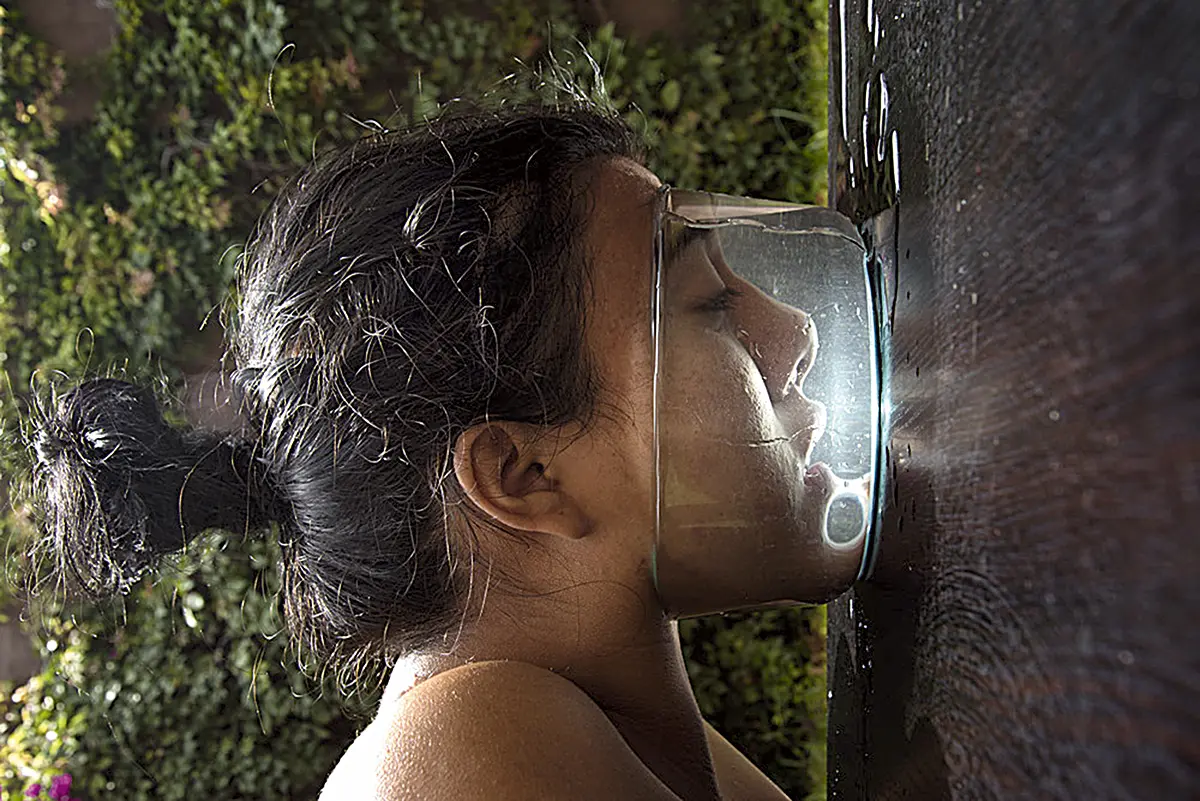
According to the press release: “This project narrates the story of a woman who faces the destruction of an old world that does not allow her to grow and create, and of a new world in which it is possible to build a different order of her own with fragments from the old one. In this instance, destruction is required because the old order—inherited from the mother—has represented a negative experience […].” The truth is that, upon closer inspection, this repertoire of images assault us with an endless barrage of questions about the thematic nature, conceptual anchors, and narrative orders addressed in the formulations by this artist. But her visuality continues to be complex, in permanent transit between the surrealist impulses and baroque gestures that are so predominant in certain areas of Latin American photography. In their own way, these snapshots outline a map of strangeness and uncertainty. The literary and fictional component mobilizes the support and increases the need to search for continuous associations and possible referents.
From any point of view, the affective, emotional, and psychological density of these images is unquestionable. There is in them an ensuing conflict that is not relegated to the surface. In this manner, according to the gallerist: “We are clearly before a somber, dark, and anguishing work of impulses unleashed through the construction of images whose montage ignites repressed emotions. Here, there is no criticism against the patriarchal order or against the oedipal or castrating mother described by Freud. Instead, Ambrossio points to something that the Viennese never addressed, the “syndrome of the bad mother.” Karl Abraham and Melanie Klein, two disciples of Freud, were the ones who described its effect in depression and in the schizoid pathologies of offspring. But, in the end, it results in a sunset where light does appear to triumph over darkness.” This critical assessment reveals the underlying anguish that fuels the point of view that Liza Ambrossio uses to establish—with images—the discursive strategy that leads—if anything—to a sort of purification or even madness.
Today the work by Liza Ambrossio is praised by art critics and curators alike. She won the 2017–2018 Discoveries Grant given by Festival PhotoEspaña and La Fábrica, as well as the 6th edition of the TAI Photography Talent Grant. In 2018, she was also recognized with the FNAC New Talent Award and the Voies Off Award in Arles, which brought her to the attention of critics. If there is one thing in particular that makes her images extremely compelling, is the singular way in which she approaches free associations that result in images that cover an eclectic number of elements and motifs. Ambrossio’s work also stands out for the seemingly random combination of archival photography, highly cryptic paintings, performance, and science fiction.
ANDRÉS ISAAC SANTANA