The feeling you experience when you enter Juan Iribarren’s exhibition at Cecilia de Torres Gallery is one of peaceful contemplation. His works are windows to Zen-like atmospheres that are disconnected from the chaos left behind in the streets of New York. You take a big breath and reach an almost meditative state prior to realizing you can’t just stand still and admire the works. You slowly move through the gallery and analyze not only each piece but also how they are all interconnected.
As the artist recalls, that is exactly what led curator Juan Ledezma to work on this exhibition.1 While visiting Iribarren’s studio, Ledezma was puzzled by the relationships that exist among his latest paintings (2016-2017), the black and white photographs, and the pencil drawings. He was particularly interested in how one work connects with the other, and in thinking about the unusual dialogue he observed happening between painting, drawing, and photography. Three bodies of work inspired the title of the exhibition: Walls, Windows, and Nocturnes. The monochromatic paintings, mostly white and blue, become the “walls;” those divided into four or five fields, look like “windows;” finally the “nocturnes” represent the paintings he produces at night, especially in the winter when darkness prevails.
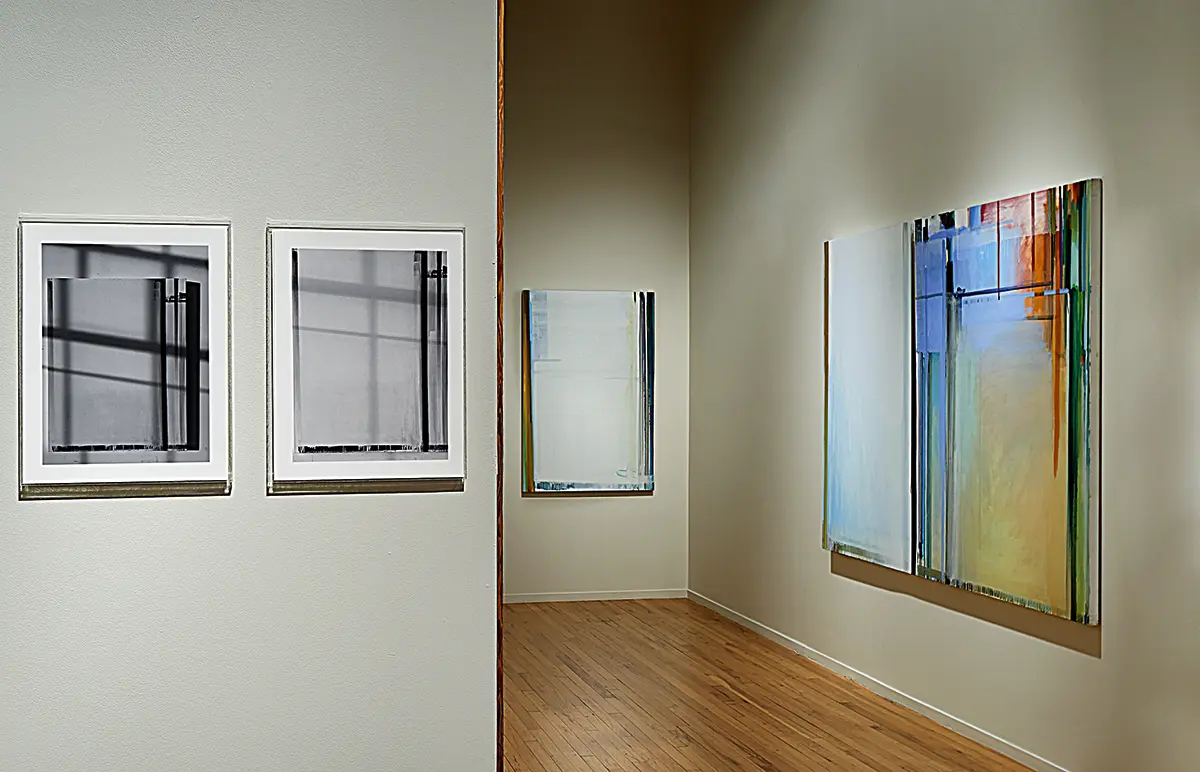
The title also encapsulates the formal elements present in the artist’s creative process: light, color, atmosphere, and time. Iribarren explores the reflection of light using simple lines, grids, and colored shades. White planes drawn with expressionistic graphite strokes, grid-based linen canvases painted with sky-like tones, and multilayered black and white photographs of his studio at different times of the day, resulting from the exploration of what he calls “circumstantial light.”
His painting process captures the changing tones and variations of color and light he finds in his studio. As he explains, “as I go chasing light, the color in my work is an accumulation of daily paintings. When the oil is wet, it gets mixed. When it is dry, it produces a glaze. I paint between ten and twelve layers on each canvas. The result is an opaque accumulation that is barely translucent. That unique atmospheric color I attain in my paintings is formed by the layers of colors that are below.”2
At the formal level, his highly gestural and layered brushstrokes bring forth the geometric basis of his compositions. Lighter color planes become three-dimensional spaces with the application of simple dripping-like darker lines. At the core of these structures are the artist’s gestures, structural, foundational, and monochromatic lines that reveal subtle underlying frameworks concealed beneath the oil-painted surfaces. Through the masterful use of lines and composition, Iribarren manages to create a sort of “visually perceptive” abstraction that transcends the parameters of hard-edge geometric abstraction. It is important to note that he does not paint from sketches. His drawings on paper are actually graphic interpretations of his paintings. His works on canvas always come first. He works simultaneously on three or four paintings of different sizes that vary between twelve and seventy inches. As he explains, “if I am working in a large format and I feel lost, I go to a small one. Using canvases of different dimensions allows me to get away. It is easier than if they were all the same size.”3 He likes to stimulate dialogues among different formats which is why, as can be seen in the exhibition, he creates diptychs by combining canvases with the same colored tones but different sizes.
The paintings are also the basis of an interesting series resulting from photographing his canvases at different times of the day. In 2000, he began to notice the shadows created by the rays of light that traversed the windows of his studio. He became interested in the new abstract compositions resulting from the dialogue between the artwork and the shadows so he decided to photograph what he calls “light circumstances.” What began as a documentation process evolved into a new and exciting way to explore abstraction. The photographs included in this exhibition explore not only the effect of light on the paintings and their transformation into new works due to the lines and areas drawn by the shadows but also the blurring effect that blends the borders of the canvases with the wall’s surface.
The exhibition is accompanied by an illustrated catalog that includes a prologue by the gallery’s director, Cecilia de Torres, and essays by the exhibition’s curator, Juan Ledezma, and by the Professor of Philosophy, Sandra Pinardi.
NOTES
1. Interview with the author, October 16, 2018.
2. Ibid.
3. Ibid.
FRANCINE BIRBRAGHER