
For José Spaniol, onomatopoeia is located precisely between the word and the image. In fact, sound has the purpose of mentally evoking a known visual element that is nevertheless not present; like a translation, it is the description of something transported to another language. In an analogous way, TIUMMMMTICHAMM offers a different kind of translation, one that is not linguistic but sensorial. What meanings are activated in a given type of experience? This is the challenge posed by Spaniol’s installation at Dan Galeria, with elements that retain their autonomy in isolation but only as a whole can activate perceptions that come from memory rather than from our experience of the exhibition space as such.
TIUMMMMTICHAMM derives from a memory of the ocean. More specifically, from the seriality of the waves reaching the shore. So, from the beginning, it deals not with the fact of the ocean, but of the way in which our body relates to the eternal motion of the waters that come and go without relief. We can focus on the sound, which gives the show its title and is repeated in each individual work; or on the luminosity of the water, capable of shining under the sun or in the darkest night; or on the vestiges of froth that insists on remaining for a bit longer on the sand, after the wave retreats.
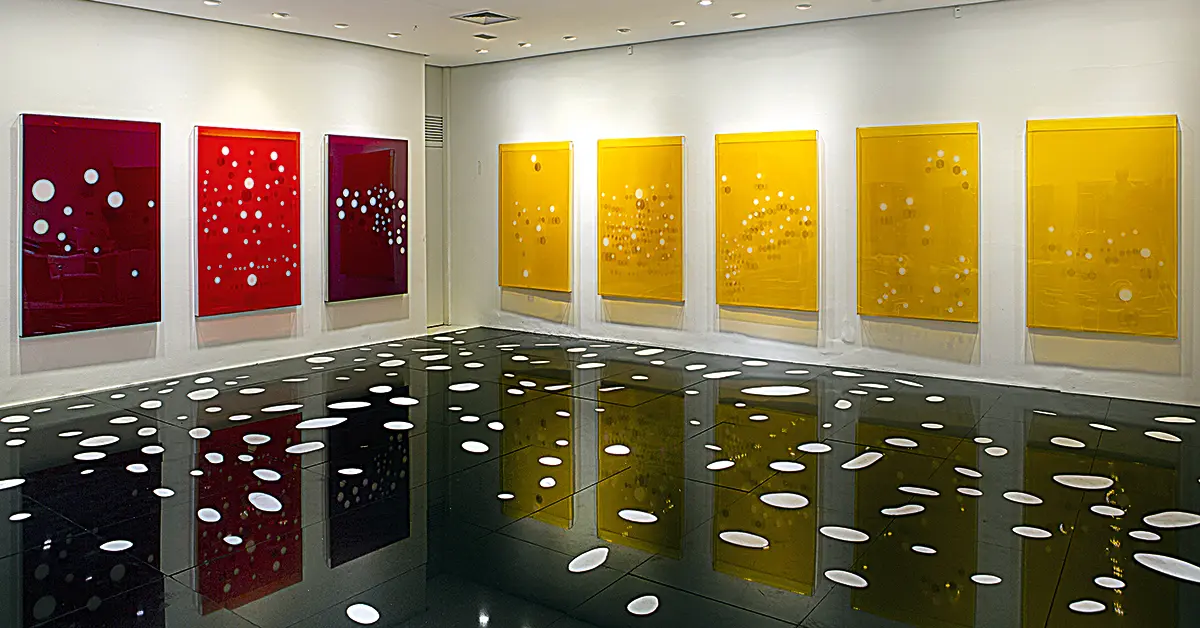
The floor, covered in black granite and black marble trimmed into irregular bubbles, invites visitors to walk on it as they would on sand still wet from the most recent wave crashing. The sheen of the material causes the sensation of its extending up the walls, where a series of sculptural rectangles in translucent acrylic and resin, mimicking the bubbles on the floor, have been arranged. As they project outwardly from the wall, the shadows that form reinforce the work’s illusion of softness, an impression that on the floor comes from the oblong shape of the surf “bubbles”. In this way, space the impression of continuity between the floor and the walls; the smooth, polished black surface of the floor reflects the works on the walls, just as the landscape appears under the water line on a calm day.
The arrangement of the works along the walls in regular intervals evokes the swaying rhythm of the ocean. Even so, each of the works on exhibit is unique, with a rather peculiar composition. Some of these works are almost playfully populated with circles, while others resemble constellations. The colors vary, but are always pure and solid and respond, more or less, to the sequence of a division of the light spectrum. This calls forth a memory of the different moments of the day, and even of the seasons of the year, on the gallery floor’s “waters”: the midday oranges and yellows are there, as are the variations of blue and violet that are caused by the phases of the moon, and even the intense reds of an equatorial summer. For calm winter or autumn mornings, sky-blue tones are captured.
The exercise of challenging the audience’s perception by means of improbable environments and materials is not new in Spaniol’s work, and neither is the inclusion of the architectural particulars of the site where the work is exhibited. In 2016, Spaniol presented at the Octagon of the Pinacoteca do Estado an installation related to the current show: TIAMM SCHUOOMM CASH!, which also spoke of the sea in an improbable space in the middle of the city, inside a building. There, two ships leaning on bamboo poles, ten meters above the ground, inverted our perception of the absent ocean, locating it over the viewer’s gaze and perhaps providing a perspective of the ocean floor. The difference between the two works resides (setting aside the use of entirely different materials, of course) in the intensity that characterizes each. TIAMM SCHUOOMM CASH! was filled with fury, from its title to the denied weight of the ships and the seemingly chaotic arrangement of the bamboo shafts. The natural materials also dialogued with the forces of nature: being from the earth and solid, they tend to fold, break, to rot. Noting like that can happen in TIUMMMMTICHAMM. Phonetically, it is a unique word, containing as many “M”s as a sigh, and its single “A” lacks all the intensity of the previous installation. The intervals between the compositional elements are regular, and there is a degree of sterility in the industrial appearance of the works, impeccable in their finish.
Although originally inspired by the same subject, the two oceans are considerably different. While at the Pinacoteca we intuited a tempest in the high seas, at Dan Galeria the sky promises a soft breeze at the edge of the beach, and perhaps even the possibility of seeing the sunset on the tranquil waters of an imaginary bay.
SYLVIA WERNECK