It is not a new development for the work of José Rufino to lean heavily on memory, be it personal or historical. There are occasions when both avenues converge, as the artist’s own life, his family’s past, and the story of his land merge and, at times, become paradigmatic of events in the country. From socio-historical data—such as the sugarcane cycle, the power and influence of sugar-producing landowners, and peasant movements—to familial feelings and the development of artistic expression, it is true that at least one of them is always sprouting in “Rufinian” art. The rhizomes that emerge expand in a multitude of directions and establish dialoguing relationships with broader themes.
Rufino’s work method is painstaking and detail-oriented. Each decision is deeply thought-out and contemplates several spheres of meaning. He generally starts from a memory that can be either his own or borrowed from someone else, either individual or collective, and can even refer to an entire people. Rufino has already dealt with the traces that his own grandfather, an almost mythical figure, left in the now distant land, with the nostalgia of an entire generation that lost many loved ones during the years of lead and has learned to manage them in the interstices of a fictional memory, as in the installation Ulises (Ulysses, Casa Francia Brasil, Río de Janeiro, 2012), combining the hero of the Odyssey with James Joyce’s narrative and refurbishing the character’s journey with elements gleaned in the course of long perambulations in Rio de Janeiro.
In this connection, literature marked Rufino’s earliest experiences in art, through visual poetry and mail art. And in fact, this unique individual is hosted in São Paulo by the local house of literature: the Mário de Andrade library is the location for Limbo, an exhibition based on what the artist describes as “un-curating”. After more than thirty years of activity, one imagines Rufino has a vast collection of projects, prototypes, and objects, many of them awaiting an opportunity to be transformed and leave the “limbo” to which they have been relegated. Such was the process of gathering items for the exhibition, originally presents at the José Lins do Rego cultural space, in João Pessoa.
Challenged to scrutinize again things that had been cast aside in his studio, the artist engaged in an intensive effort of selection and found all manner of unfinished works and found objects he could no longer remember having collected, much less for what purpose. Many of these items had to be restored, and many acquired new meanings; in the end, the selection comprises some 250 items ranging from architectural models and documents, to what Rufino calls pre-works or proto-works, and to works that have been completed expressly for this exhibition. Responding here to the need to curate his own production, Rufino understands the gathering of these items as “a unique body, a chimerical archive, or a rope of time braided with the threads of many different eras and concerns.” Even after having put together and organized such an extensive representative selection, this is still just a sample of a much larger whole. The items in this sampler are those that contribute to the narrative of a process of artistic creation undergirded by the preferred subjects of Rufino’s poetics, such as nostalgia, memory, the body, the relationship between the public, and the private, the oppressed/oppressor duality. The selection works as a historiographical narrative of the construction of Rufino’s oeuvre as a whole. Add to this the catalog, and what we have is almost a “manual to understand José Rufino’s work.”
The exhibition is organized in three sections. On the side of the library atrium, we find Rufino’s early artistic experiences. There is a childhood drawing, examples of his visual poetry experiments—in truth, expansions of his poems and stories—and mail art. Also in these sections are gestural paintings in the manner of Gutai, a group whose discovery was a profound revelation for the artist.
The central gallery held a U-shaped structure that accompanied the wall format, and with it, the majority of the exhibition’s works arranged on pedestals or on walls, in a configuration that has them integrated as a large book that can be read in any direction. Many of the works in the selection have two different dates since they were completed especially for Limbo. This is the case of the book-sculpture purgatio 1 (2005-2018), which consists of an old medicine compendium on which a mass of plaster has been spilled.
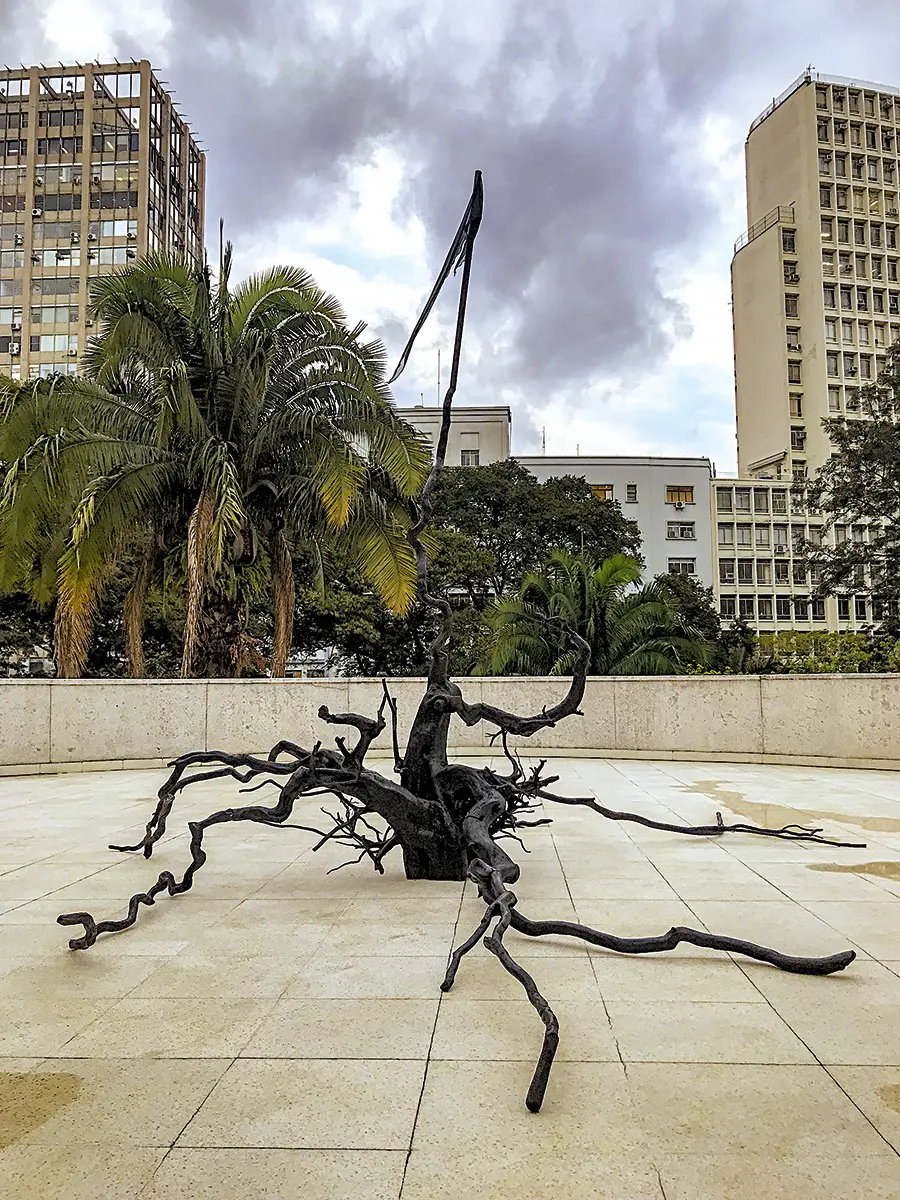
Limbo’s grand finale is found in the fourth level, with a novel occupation of the library’s outside patio, where Exhumed corpus (2015-2018) was installed. It is a composition of blackened tree trunks, and its “dirty” appearance overwhelms the aseptic look of the impeccable floor. A body whose presence comes out of the limbo and reaches into the world, yet stillborn as it wields a black pennant against the clarity of the day.
SYLVIA WERNECK