An unshakable belief in the creative drive fuels José Damasceno’s work, as was in evidence in his first solo exhibition, presented at São Paulo’s Millan gallery. Titled with the untranslatable portmanteau Escadabstrata, the exhibition brought together a selection of eleven previously unseen works, among sculptures, prints, paintings, and photographs, and occupied both the Millan gallery and its annex, Anexo Millan. This large-scale show comes to crown the maturation of a Rio-born artist with considerable international projection.
A sculptor at heart, Damasceno produces objects of variable dimensions that intervene large-scale sites and dialog with architectural projects. The ark of his work resides in the use of a large diversity of materials, techniques, and languages in order to explore the boundaries of sculpture. His poetics appeals to the mind, taking motion and distancing as a point of departure for the conception of mobile and fluid perspectives of spatial representation. The artist enhances and transforms those spaces by means of the insertion in them of improbable objects and events, such as, in the specific case of this exhibition, a miniature ladder, and a static pedestrian.
Damasceno’s work has evolved in close connection with Brazil’s neo-concrete tradition, investigating issues of surface and depth, solidity, and weight, and producing in viewers a physical sensation as they come into contact with the work. To that end, the artist creates fictional situations, transforming nature itself into art and altering the original functions of materials and spaces. Damasceno is interested in deconstructing traditional dichotomies such as the separation between word and image, painting and sculpture, sculpture and installation, inside and outside, image and thing, figure and ground, visible and invisible.
The work from which the exhibition takes its title, for example, can be seen as a symbol of such contradiction: a helix-shaped staircase reaching from the floor to the ceiling of the Anexo Millan vestibule, in a smaller size than is conventional. The shape of the spiral communicates a motion of ascent from a starting point, stages in a continuous process of unfolding and transformation, only at an intermediate, smaller than human scale. The title of the exhibition, Escadabstrata, already evoked the paradox between the real and the absurd.
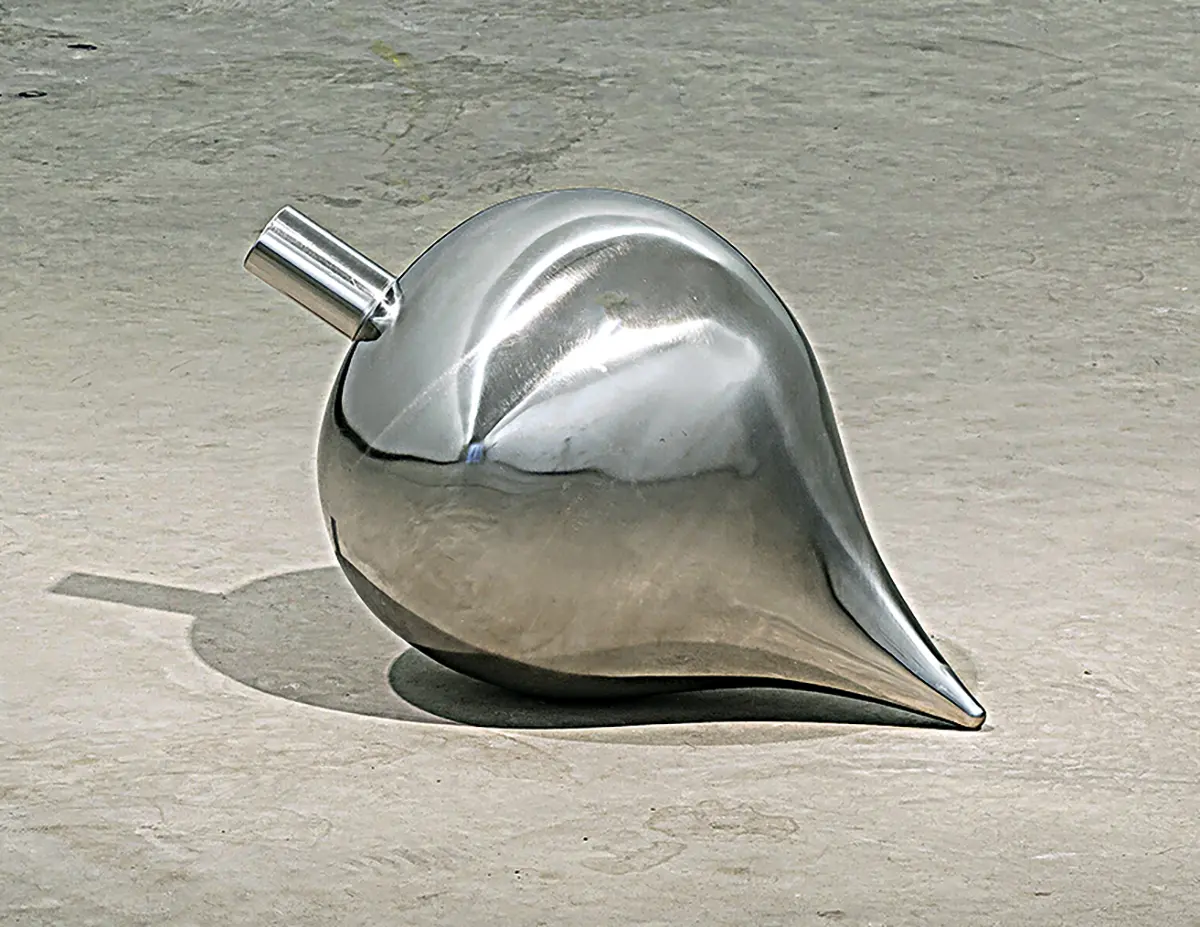
Another work, on display on the upper floor of the gallery, subverted the meaning of a white wall: a neon-light clip (“I am almost convinced that I’m never awake”), placed at the angle between one of the walls and the ceiling, transforms that surface into a large blank sheet. Soundboard rendered one of the Anexo’s walls into a large sound console, with fifty calcite “keys” floating in the flat rectangular surface. In the same space, a large stainless-steel spinner titled Ferramenta Jogo (Tool Game) “rested” on a side, as though after an intense cycle of spinning around the gallery. The exhibition also featured two printmaking series, titled Habitat Paragráfico (Paragraphic Habitat) and Estudos Paragráficos III (Paragraphic Studies III); a series of 240 paintings in crayon, Monitor crayon (Crayon Monitor); one photograph, Jardim Infravermelho (Infrared Garden); and the sculpture Sombras figuras (Shadows Figures), comprised of ninety pieces of black granite, among other works.
The paradox implied in the idea of a static motion has been one of the central issues in Damasceno’s production, with the artist constantly in search of a rhythmic, kinetic, or progressive sensation in surfaces, events, or congealed materials. In his work, visible and concrete things function as the drivers of an imaginary that remains in constant motion. In the catalog for the exhibition, Damasceno explains that his amazement springs from the implacable magnitude of the possibilities offered by a study of the braiding of extraordinary associations, be it common or unusual.
I was from early on accompanied by a sense of exploration. I am driven by an inexhaustible curiosity, where there is always a quest and an appetite for elucubrations, clues, questions, doubts, and evidence of mysterious science,” Damasceno explains as he describes what pushes him forward and what intrigues him moment by moment. He adds that he enjoys observing things as he walks around, comparing the spaces he explores with the pathways in his mind. If to think is also to produce space, Damasceno realizes that speculation is the essential means for producing his art. This connects with the most famous dictum of secularization in our Western culture: “art is a thing of the mind,” as Leonardo da Vinci put it. An even more valid idea in the contemporary moment, moreover when those things of the mind become extraordinary in the work of José Damasceno.
ALESSANDRA SIMÕES