The exhibition On Figures, Numbers, and Statistics by Colombian artist Jorge Luis Vaca (Bogota, 1985) centers on the history of Colombia, collective memory, and, above all, on amnesia, a permanent condition attributed to the historical personality of this nation. The problem with not wanting to remember is in fact one of the symptoms of those who have suffered situations of extreme violence, as is the case with two million direct victims of the war in Colombia.
Vaca has adopted a poetic supported by mechanical methods and digital tools synthesized through the use of analytical processes—historic, documentary, geographic, and legal—whose results, as a whole, offer indexed and poetic evidence. His works always reference texts, whether through the pencil used to write or erase something written, whether through the superimposition of images on paper or the use of a printer that prints and crosses out—which is another form of erasing—what had already been printed.
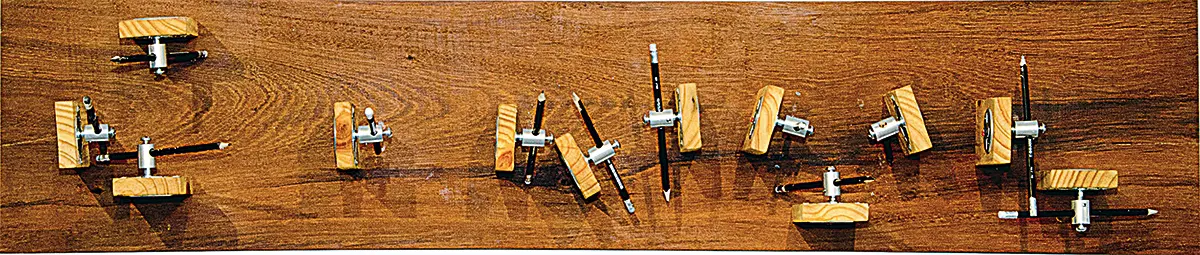
The absurdity of creating mechanical designs which do not serve the purpose that they pretend to fulfill is a constant in the work by Vaca. This is reflected in pieces like Intenté escribir en paz (I Tried to Write in Peace), which consists of four modules: Colombia, Accord, Signature, and Peace. All have different motors that make rotating pencils crash with one another. The difference between an earlier version titled Constituciones (Constitutions)—where the pencils erased what they had written—and this new version is that now the pencils crash with one another and, metaphorically speaking, attempt to write something that they cannot write—a reminder of unwritten laws or of written laws that are ignored.
Vaca also presented the series Transpositions, consisting of four pieces: Transposiciones 1 (Transpositions 1), serigraphy created with five inks, in which each of the names that have been given to Colombia in different periods—from Grand Colombia to the current Republic of Colombia—were printed on top of one another. To create this work, the artist looked for original texts in public archives pertaining to the different Constitutions established in Colombia in different moments of its history. He used font types that corresponded to each of those moments. A specific color was assigned to each name. In this manner, successive superimposed phrases in yellow, blue, red, and black were stamped, in a manner of speaking, with the current name of the republic in grey—a color that in Vaca’s view reflects the current state of things. The serigraphy included the fleur-de-lis motif, a symbol of republican promises.
Transposiciones 2 (Transpositions 2) consists of 32 acrylic plaques identical in size, presented in a wooden box. Every plaque has a map of each one of the 32 departments in Colombia. The division of the territory reflected an idea of a nation that is not articulated as a whole, replicating the political divisions and challenges of a country characterized by the absence of the State. Of identical format, Transposiciones 3 (Transpositions 3) features the words that were most repeated during the peace agreements in Havana between the Colombian government and the Revolutionary Armed Forces of Colombia (FARC). In this instance, the most disappointing finding for Vaca is that the words most repeated were those that continue to defend unresolved situations like peace, implementation, and victims.
Transposiciones 4 (Transpositions 4) also features a collection of 32 plaques. In this instance, every plaque includes numbers that added a total of 152, the total number of social leaders murdered between January and July of this year. It is worth mentioning that these leaders have been the main victims of violence after the FARC handed in its weapons. Diálogos de paz (Peace Talks) is an extension of the first version presented in the 2016 exhibition titled Rapid Response Strategy created before, during, and after the signing of the peace agreements. It is a series of trinities of political personalities who voiced their opinion in favor or against the peace talks. Through a printer connected online, tweets from detractors and negotiators were printed on paper that rotated on itself in a loop. Printing on pages already printed crossed out any content. It represented the sum of works that resulted from Vaca’s intense activity and participation in exhibitions during the last five years; perhaps the most important with respect to the future history of Colombia, as his works about peace suggest.
SANTIAGO RUEDA