Jessica Mein presents her most recent production, the result of a deepening of the investigation she has been carrying out for several years on the physical and spatial aspect of images, in an exhibition titled Tramas (Plots) at Leme gallery in São Paulo. These works bear witness to the radicalization of Mein’s subversive approach to the boundaries and hierarchies between the images and their supports, their surfaces, and structures. The artist builds her works in layers, superpositions, and interferences of materials that are returned to their primordial state and reinvented anew, in a methodical exercise.
Mein works with obsolete visual materials that went through industrial processes in the past and are now replaced by technology. Examples of such objects are outdoor billboard sheets discarded during production processes, or even manually printed burlap sacks found in markets around Dubai.
Mein’s conceptual logic rests upon her investigation of the systems for the production and diffusion of images in the urban space, and the physical, emotional, and mental relationships caused by those products through their processes.
This brings into play culture, time, and space, rationalized in an absolute manner by the comparison between the speed and ease with which images are produced and put into circulation by means of the newest technologies, and the now obsolete, more artisanal methods from a time when procedures and operations were much slower, more demanding, and more complex. The logic of distribution is also contrasted. While the distribution made possible by traditional processes was comparatively restricted, contemporary modes find no limit to their audience reach, when one thinks about the scale of production and transmission of the materials. While taking advantage of technology, Jessica Mein bases her work on artisanal methods, meticulous manufacturing, and on the decomposition of time, space, and matter.
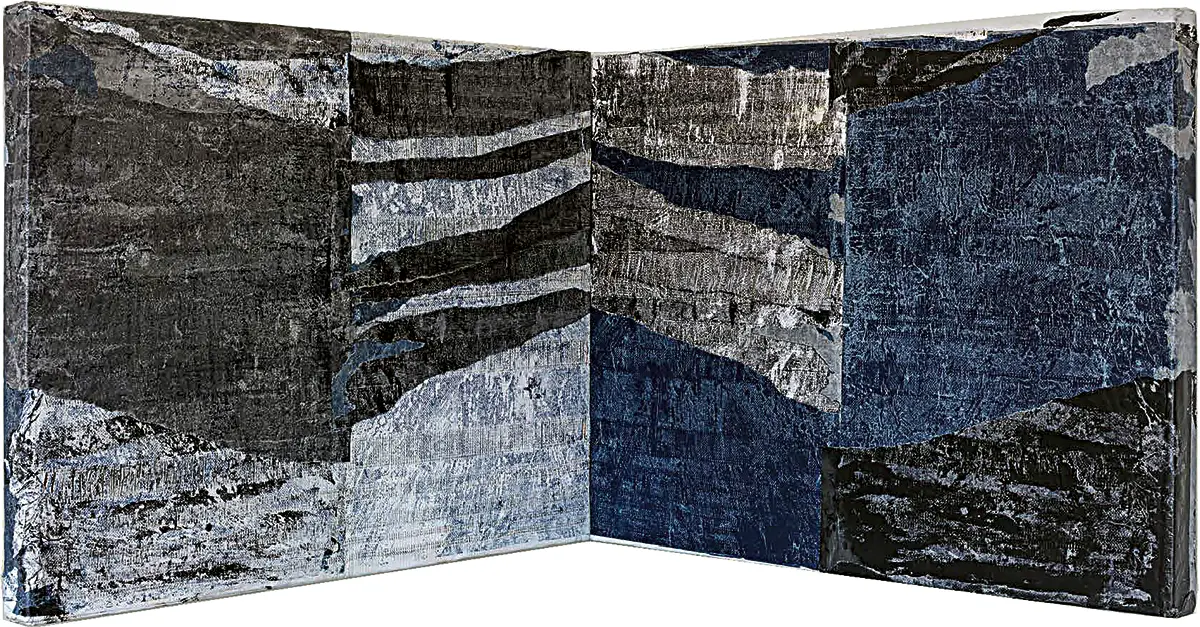
The artist’s processes combine fragments of billboards initially discarded because of errors during the printing process, or images resulting from manual processes on burlap sacks of the kind commonly used to pack and store rice. The burlap, besides being a reference and a source of images, is also used as a material, surface, and support for the works.
Using superpositions and couplings, Mein adds layers. She operates the results on burlap based on a reorganization effort, by digitally printing images manipulated and created using scanners. In another operation, Mein frays, tears, cuts, folds, joints, paints sews, unmounts, and mounts her works again with manual processes, in which she gradually incorporates any errors or imperfections.
The work is finished through all of these relationships and operations by which the textile material gains fiber density, colors, and images. The deconstruction of the fabric, privileging the wefts, brings forth and even exposes the work’s supports, the wooden stretchers under the burlap. In this process, the secondary supporting elements acquire new centrality in conjunction with the work.
The interplay of a process that alternates between construction and deconstruction brings into view the micro-scale of the fibers and the macro-scale of the structures, which relate to the dimension of the billboards in a proportional way.
Jessica Mein’s artistic exercise is connected to the myth of the eternal return. The artist, who was born and raised in São Paulo, lived for a while in Dubai, and now resides in Buenos Aires, repeats in her work the element of transience that influences the concepts behind her operations and reveals her emotions and memories.
The meaning of the myth of the Eternal Return in Mein’s work is anchored to the way in which the artist returns a piece of burlap fabric, produced to be the packaging of cereals, to its condition of fiber, and how she transforms the fiber into an artistic object where the essence returns to its original state and is reorganized.
With its exploration of the concept of time, Jessica Mein’s art prompts a consideration of Nietzsche’s thought (“eternal return”): the temporal nature of human life, i.e. its impermanence and inconsistency, which expresses a will to desire, even that which is already past. The experience that makes it possible to live every moment as if it could be repeated forever. A relationship between the instant and the eternal.
The exhibition was with thirteen of the works occupying the walls of the gallery, in dialog with a video installation mounted at the center of the space. In a 180°, two canvases set together project an animation created and produced by the artist, about the meeting of two trains at a station. In the background, we see a decomposing landscape, with two palm trees and the remains of a postcard view of Rio de Janeiro. Mein captured this image at a train station in Buenos Aires. In the animation, as soon as the train moves, we see the outdoor landscape in the background and perceive its impermanence, given new meaning in the video. The same image is projected in each of the canvases, which, at a 180°angle, enhance the sensation of two trains in motion, meeting.
HÉLCIO MAGALHÃES