Sometimes the outsider’s gaze is the one that best sheds light, like a cicerone, on the most peculiar and strange aspects of any place explored. That Jaime Ávila (Saboyá, Bocayá, 1966) observes and walks like an outsider when he wanders around Bogota, is perhaps the reason why he chooses themes for his work that show the dynamics of a city inhabited by strangers. The work by Ávila often addresses situations that touch on local idiosyncrasies but that also contain global ideas, allowing readings of his works that span beyond local borders: from consumer society, the dark side of the socio-economic consequences of the capitalist system—that devours us and subjects us to a certain way of life—to the subtle manifestations of inequality, among many of the themes that he has chosen to deal with throughout his already long artistic career.
Ávila is one of those artists who teaches us to see our surroundings as if his works could generate a diverging typology of the urban atlas with a profound human relief that shows us the things that are actually hidden underneath statistics. He augments reality from the human perspective, from the street or the geography.
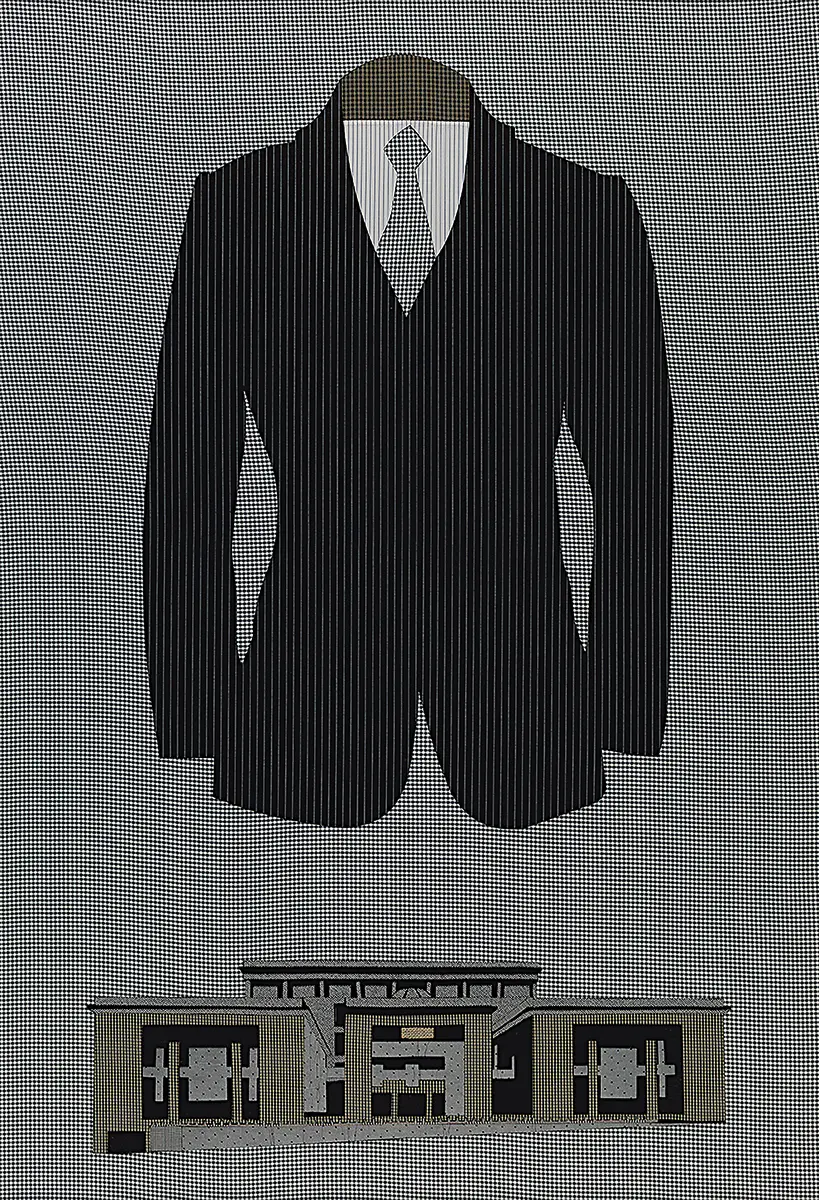
The Palace Suit, his latest exhibition at the Galería Nueveochenta, focuses mainly on the emblematic buildings at Bolívar Square—but also on many other milestones and neighborhoods in Bogota—under the connecting thread of the power of the people in the downtown area who enter these buildings and how they are dressed. Additionally, the exhibition includes, successfully so, the generous gesture of sharing the trail of the artist’s first childhood visit to Bogota during the 1970s. Ávila is the son of a tailor, and his visits as a child to the Colombian capital had to do with his father’s business. The experience of accompanying his father to this and other business trips, allowed Ávila to establish a connection between his father’s trade—brought into the center of the country’s political power—and the vision he has been weaving between two worlds.
This show is an exploration and recovery of memories associated with wisdom acquired by chance through the transmission of family trade and traditional knowledge. But it is also a more thorough reading of several elements like the relationship between formal attire and power, the gradual disappearance of fine fabrics used in the production of tailor-made suits. It is also about people wearing certain types of garments specifically for certain places.
In this exhibition, Ávila uses textiles as raw material to create images of people as well as of buildings. With humor that is ludic but also sober and sharp—like an English suit—he establishes relationships between types of fabrics and individuals (men): politicians, economists, and passersby in the neighborhoods of Chapinero, El Nogal, or La Perseverancia. There are large works where certain styles and fabrics are assigned to specific buildings like the Capitolio Nacional, Palacio de Justicia, Palacio Liévano, and the Catedral Primada—among others. These works are playful associations that, more than criticize, pinpoint and evidence relations of power. There are also panoramic pieces, also of large dimensions, which show the silhouette of a typical scene: a man feeding pigeons on a square. In addition to emblematic subjects and large works, several smaller pieces stand out for depicting different types of fabric samples and characters. In parallels to the central theme offered in the main works, these smaller pieces are nearly equivalent to an unbound notebook. It is often the case that artists’ notes offer windows into more private, personal aspects of the works of art before these become exhibitions or great discursive apparatus. It is through these collections of fabrics, cut-out silhouettes adhered to the sides, like an army of alter egos or shadows, where Ávila explores a large territory of the city and where he very likely was able to have a closer look at the trail of his childhood. And it is precisely there where the exhibition distinctly becomes a tribute to a trade that flourished in the past when society was not duller or more formal. Without being nostalgic, Ávila shows us a modern-day city through the sense of touch; through fabrics from a past known to him, that has gradually been transformed by the democratization of fashion and the increasingly more informal evolution of society.
CARIDAD BOTELLA