Desenrollados (Unspooled), an exhibition curated by Marisela Chivico, brings together the work of Isabel Cisneros and Vicente Antonorsi in La Caja, Centro Cultural Chacao’s spaces. In their long careers, Cisneros and Antonorsi have developed markedly unique artistic languages that, despite their differing narratives, coincide in an experimental interest in materials and techniques. They share bonds of friendship and have already exhibited together, in 2007, in Acumulaciones, diálogos visuales (Accumulations, Visual Dialogs), an exhibition at Sala Trasnocho Arte Contacto, in Caracas. Desenrollados brings them together again after nearly eleven years. The title alludes to formal resolutions, but it also invites viewers to consider art’s capacity for sublimation as a positive response in a crisis.
The dialog of the works in the exhibition space generates a rich exchange of visions and guides us in the direction of a playful treatment of the formats, textures, densities, and colors provided by threads, weavings, and recycled materials. The artists’ free-spirited approach to the resolution of their project is evidence in the unhindered way in which they appropriated the exhibition space. We notice how some of the works break the boundaries of their own dimensions, and, conversely, how they adapt to the angles of the walls, to the ceilings, to space’s ribs. Curator Chivico emphasizes the notion of “unspooling the thread” in order to execute its artistic transformation.
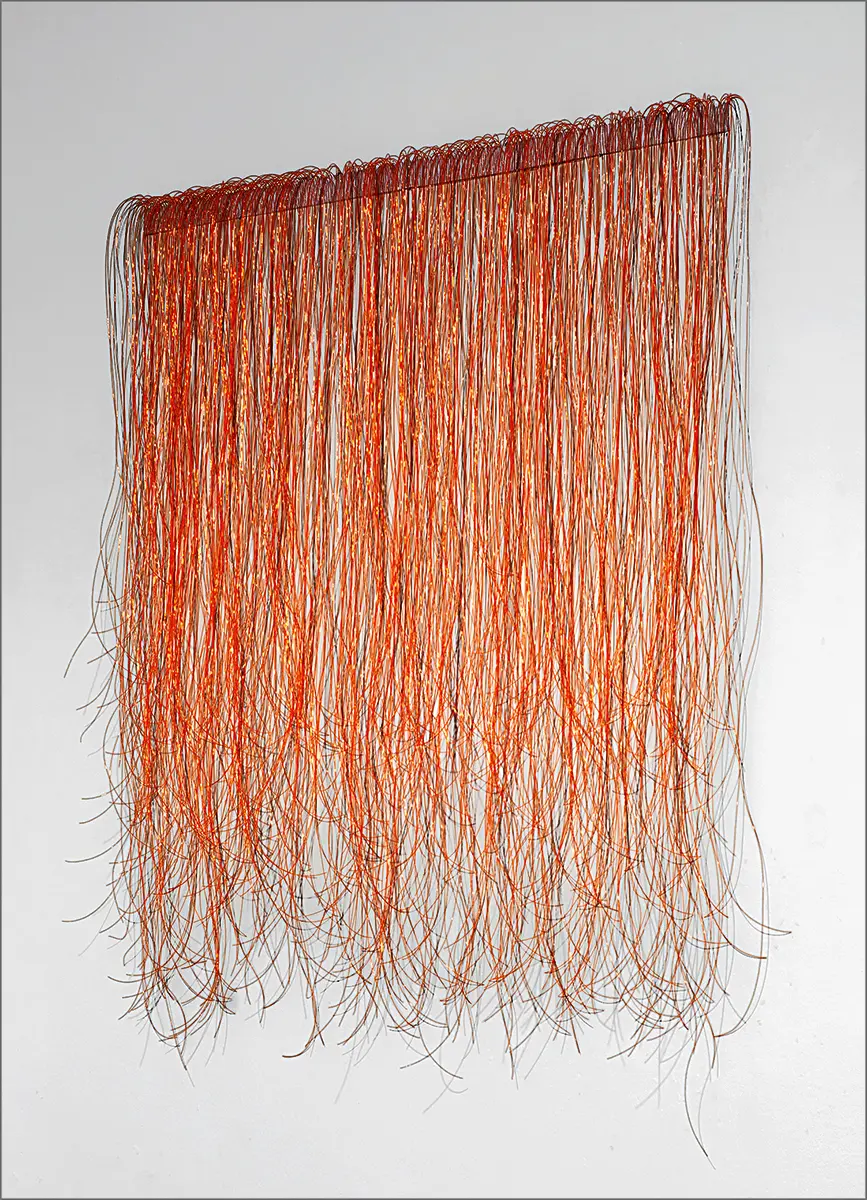
Isabel Cisneros posits ideas associated with accumulation, repetition, recycling, and memory. She has combined her training as a ceramist with qualities gleaned from the weaving arts, as well as with techniques and materials that expand the expressive possibilities of her work. Cisneros notes that in preparation for this exhibition she gathered materials found in her studio—threads, ribbons, pieces of fabric—and then proceeded to rip, braid, tie in knots, and fray, stressing their “memories” and generating a vital, organic work of art. Cisneros dismembers objects and extracts those parts that help her boost her discourse, as she did in U-matic, from 2018. For this installation, she gathered several video cassettes and arranged them in a horizontal sequence against the wall. Along with the chromatic and rhythmic balances of the devices and the tapes she has unspooled, Cisneros brings to the fore the vulnerabilities of our technologies and our archives; an outdated device loses currency, and the information it contains is lost with it. In other works, such as London Style, from 2002, or Nube (Cloud), and Quinto element (Fifth Element), from 2018, Cisneros salvages the structure of polyester and nylon ribbons, making them flexible and emphasizing their roll-up or looseness properties. In M&J, also from 2018, Cisneros used sewing bobbins of similar size but varied colors, arranged as weaving in six columns. The intention that animates her proposal is to foster a playful encounter and an interaction between viewer and artwork.
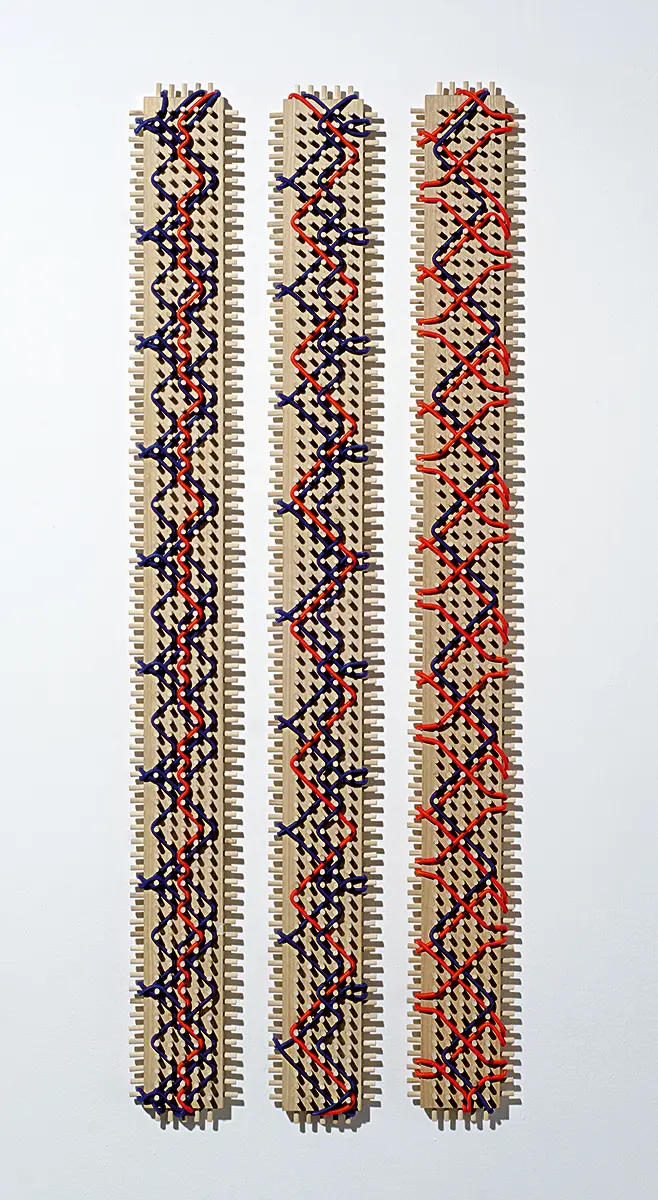
For his part, Vicente Antonorsi, a visual artist, architect, and graphic designer with training in textiles brought to Desenrollados a selection of works that use wood, rope, and galvanized steel. His 2018 thread and wood series is titled Bolillos cuadrados (Square Lacemakers), Bolillos magníficos (Magnificent Lacemakers), and Bolillos cortos (Short Lacemakers), after the style of knot—typical of Bruges, Belgium—that he uses in them. On a small board intervened with a grid of small wooden tubes, Antonorsi uses a rope to create a drawing of geometric shapes adjusted to a pattern in an infinite number of possible combinations. Trama (Weft) is another series in which Antonorsi projects linear grids onto space, using elastic ropes with their attachment points on the ceiling, walls, and floor. One set of works in this series has precise measurements; the rest are on-site installations in variable dimensions that Antonorsi uses to intervene in the architectural structures both of the exhibition space and the building’s exterior. The artist breaks boundaries, takes risks, connects deeply with his surroundings, and returns a forceful response of coexistence between art and architecture.
The visions of these two artists are in constant dialog. Cisneros’ colorful, malleable, and organic works interact with Antonorsi’s linear, chromatically neutral, structural, and only occasionally organic proposal. Commonalities and differences engage to give shape to a powerful encounter. The result is a clear example of the social and aesthetic value of art as a language that subtly penetrates ideological layers of delicate approach.
ANNY BELLO