Materiality, color, luminosity, surface, texture, and space are some of the elements present in the visual reasoning of Iole de Freitas (Belo Horizonte, Minas Gerais, 1945) and at her latest solo show titled Steel Paper at the Galería Silvia Cintra, in São Paulo. The paradoxical nature of the phrase “steel paper” corroborates the beautiful result of this aesthetic endeavor materialized in new small and medium white sculptures. They are displayed in the gallery space in the same manner in which they were arranged in the artist’s studio during the entire development process, barely supported by simple pressed wood planks.
These new series stemmed from the exhibition The weight of Each One presented at the Museu de Arte Moderna do Rio de Janeiro (MAM) in 2015 when Iole de Freitas left behind the polyurethane plates that she had been using for many years in order to focus exclusively on explorations with stainless steel. The challenge of the exhibition at the gallery was to create sculptures on a scale that was much smaller than the one shown at the museum, as well as proposing a new relationship with them. Now the work no longer interacted with space or the architecture, but rather with its own body.
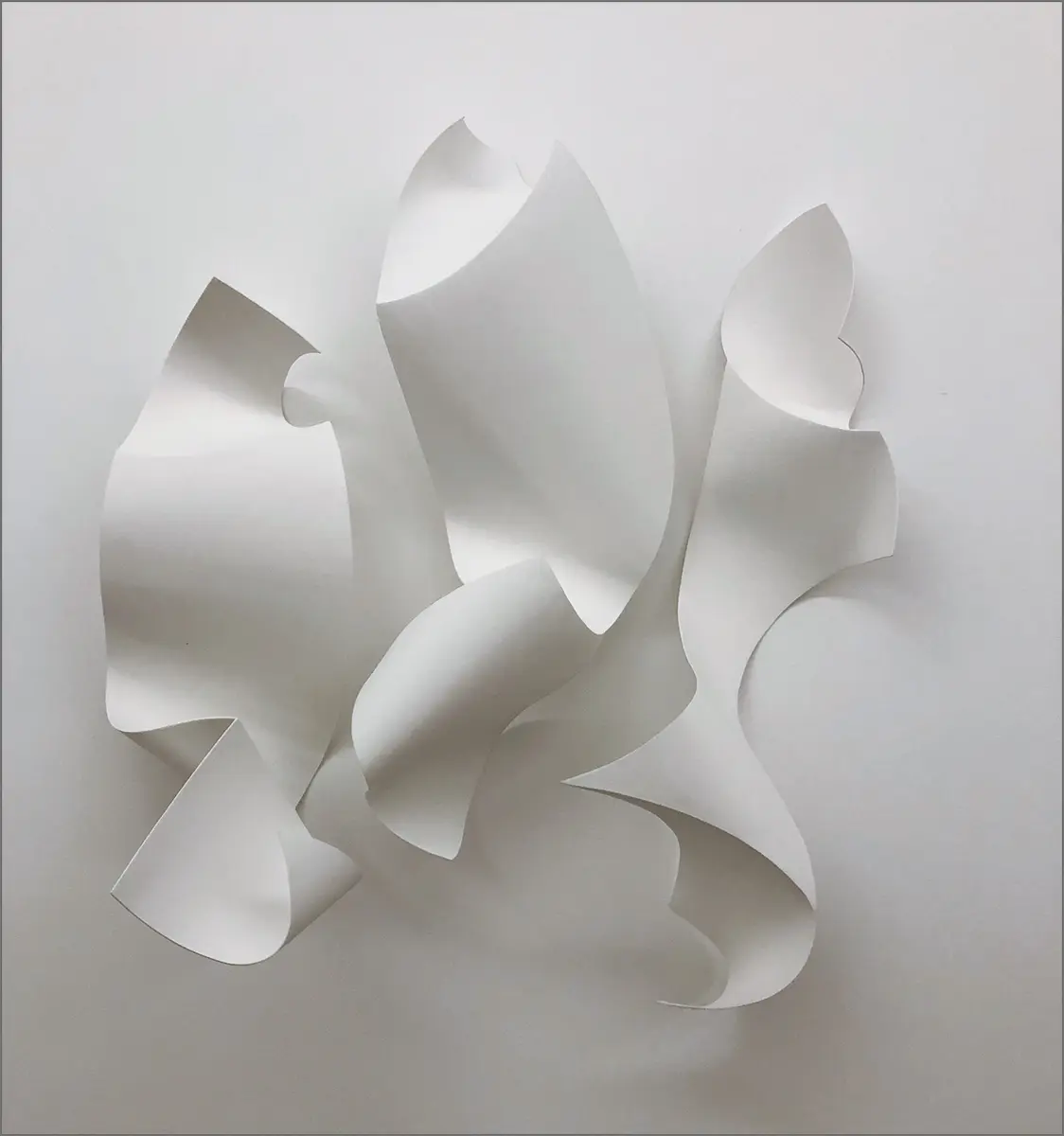
The beginning stage of this research was rendered on regular paper; posterboards that Iole de Freitas cut and folded to explore the possibilities of concave and convex forms. The next step was to transfer the results to aluminum—a material that already was thicker and heavier—and then reproduce them in steel, the material used for the final work. Extremely complex, this entire process also required the element of color, which the artist deemed necessary to ad luminosity and transparency to the sculptures. After applying many layers of white paint and sandpaper, Iole the Freitas was able to reproduce light and shadows and the rugosity of the paper.
Torsions, small support points, and cuts generated fluid forms that, while self-referential in nature, also established a dialog with architectural thought—since the work by Iole de Freitas is defined by its constructive elements. At the same time, some characteristics, particularly the predominant use of white, freed the sculptures from constructivist weight and reached for a poetic of the ineffable expressed through curved, fluid, dynamic, and somber forms that like ghostly serpents collapse in on themselves.
Iole de Freitas's first exposure to the arts was through dance. But her artistic initiation actually occurred during the 1970s through photography. The design class she attended at the Escola Superior de Desenho Industrial (ESDI) in Rio de Janerio, during the mid-1960s, already offered an indication of her interest in architectural themes and the construction of spaces (she even worked as a designer for Olivetti, in Milan). During the 1980s, De Freitas focused on the production of reliefs using wire, thread, tubes, cloths, and metallic fabrics; elements that helped her develop a more matteric and visual approach to her volumetric and spatial works. The relationship between architecture and sculpture became increasingly more frequent, which during the 1990s was consolidated in metallic fabrics put together directly in the exhibition space without forming structures. Iole de Freitas later relied on materials like stainless steel and polycarbonate tubes that gave her sculptures a new appearance, with forms increasingly more sinuous and intense and dynamically connected to the place in which they were installed.
If cinema and photography were the mediums that allowed Iole de Freitas to outline the central characteristics of her work—transparency, movement, lightness, and speed---the use of diverse materials, along with her experience as a designer, definitely marked her contemporary concretist poetic, offering an artistic language that today has attained an even greater level of maturity. The rigorous technique, the use of vanguardist technologies, and the exploration of new materials have contributed to the creation of complex work whose geometric forms and constructivist influences benefit from a poetic that is fluid and enigmatic at the same time. This is evident in the multiple sculptures created with diverse techniques and materials, including flexible transparent polycarbonate sheets, clear or painted with vibrant colors, which mold and subvert the space, floating over the floor or invading the walls.
The transubstantiation of paper into steel appears to consecrate the apex of an aesthetic whose language distills the energy of autonomous forms, like an alternate universe, where art is the only thing that survived. Iole de Freitas invites viewers to immerse in a realm that preceded human gestures, a nearly non-place where the senses can be barely interpreted by gazes that are only able to grasp the content through the forms displayed. The sculptures in Steel Paper seem like spectrums from a parallel universe exclusively dedicated to art.
ALESSANDRA SIMÕES