The fact that a photograph is a moment frozen in time implies, among other things, a creator who is inevitably also frozen with it, bound forever to the series of decisions that resulted in that image. For some artists, revisiting their works entails, on each occasion, revisiting also earlier versions of themselves, attempting to recognize their presence in the work of someone from the past, across a wide distance in years and experiences.
Orbiting around Fotoseptiembre (a photography event that MAC Panamá coordinates every year), Centro Cultural de España presented Panamá en la mirada de Graciela Iturbide (Panama in Graciela Iturbide’s Eyes), an exhibition co-curated by Mónica Kupfer and Walo Araújo that revisits the artist’s travels in the Central American country early on in her career. Before her images in Frida Kahlo’s home or her show at the Pompidou; before Juchitán or the development of her poetic obsession with death; before even her bird series, and definitely before she was acknowledged one of the titans of Twentieth-Century Latin American photography, Graciela Iturbide (Mexico City, 1942) was in Panama.
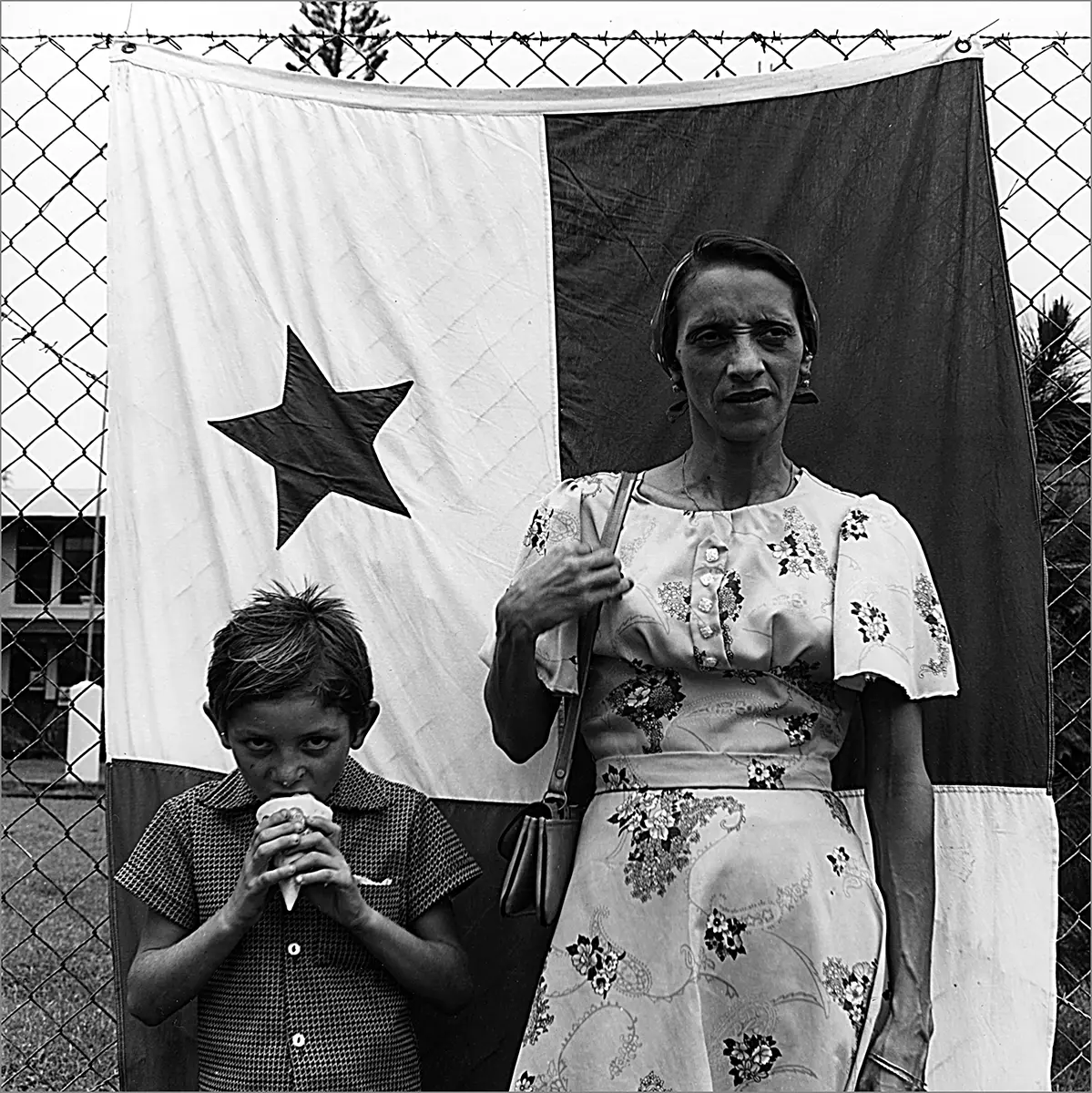
It was the beginning of the 1970s, and Iturbide’s connections in the Communist Party made several trips possible to Omar Torrijos’ Panama. The resulting documents are what Iturbide herself described as the early steps in her career. Nevertheless, in her prejudice-free gaze, one can clearly detect the latent presence of the artist she already was, before the world, or perhaps even herself had noticed. Panamá en la mirada… functions like a two-way mirror where viewers can glimpse fragments of those years and, by means of her reflection, read between the lines the presence of the young photographer, understanding her future motifs and her concerns. Of all the certainties offered by this exhibition, the most relevant is, to my mind, the access it grants to a Graciela Iturbide still unencumbered by the weight of her own myth, fully in the process of discovering the language she would be able to articulate with her camera.
Panamá en la mirada… makes it possible for us to encounter Iturbide’s earliest engagement of subject matter that would later repeat in her work, like the strength of those semi-divine women she began to discover in images like Esperando al General Torrijos: Mujer guaimí (Waiting for General Torrijos: Guaimí Woman, 1974), and whom we will encounter years later in her Mujer ángel (Angel Woman, 1979) or in the emblematic Nuestra señora de las iguanas (Our Lady of the Iguanas, 1979). There is also the persistence of everyday life, the search for national essences in common characters or in indigenous peoples, a leitmotiv of Iturbide’s later series (like the inhabitants of the sands or Juchitán) that can already be felt in works like Mujer “cuna” (“Craddle” Woman, 1974) or Barrio El Marañón (El Marañón Neighborhood, 1975).
Another key element in the exhibition is the figure of Omar Torrijos and his imprint of society during those years. Most of the time we see a uniform-clad General, cigar perpetually in mouth, which on occasion brings to mind the work of such photographers as Raúl Corrales and Alberto Korda and how they dealt, in the case of Cuba, with the peculiar dialectic between a leader and his people. Torrijos’ presence is felt like one more element like any other, fluid between billboards and posters with his image, or even in the very propaganda writing that decorates every corner, almost ubiquitous. It must be noted that one feels the curators demystifying intent, staking out a distinct territory from Torrijos: The man and the myth (Americas Society Council of the Americas, New York, 2008), an exhibition that also explored Graciela Iturbide’s relationship with the Panamanian general, but with very different purpose and approach.
On the other hand, the most exquisite element in Panamá en la mirada… is the way in which Iturbide engages the universe of childhood, taking maximum advantage of every sign not only in its discursive dimension but also in the aesthetic one. Iturbide’s ability to track the ironies that subtly take shape around childhood play, or in the interactions between children, produces astoundingly powerful images. Works like Juegos prohibidos (Forbidden Games, 1974), Niños jugando (Children at Play, 1974), and En cada pecho una trinchera (In Every Chest, a Rampart, 1974) illustrate the true magnitude and weight that the young artist’s gaze already possessed.
Panamá en la mirada… traces an arch that tangentially speaks of the country, of its indigenous peoples, its peasants, its government leaders, its women, its youth, and its neighborhoods. It courses through an entire era in forty images expertly arranged in the exhibition space, images that at times function as a series of portals into the past, and at times as living remnants of time. They are tributes to memory, capable of vibrating and speaking to us from the eyes of their creator. To contemplate the Graciela Iturbide of those years is to see someone who, while still innocent of the reach her name will come to have, is already clear on the guidelines of her art. She already feels an insatiable hunger for storytelling, for sharing with other her version of the world.
RIGOBERTO OTAÑO