“I am making a portrait of my city,” said Georgina Quintana one morning as she went out carrying folded canvases, pencils, and markers. She made direct sketches of architectural details and of the labyrinth of cables in Mexico City. For those of us who know this metropolis, the mention of its name brings to memory the voice of Chava Flores singing México distrito federal. Georgina Quintana, who loves Mexico City’s central area and knows it very well, said at the inauguration that she returned home every day more fascinated by her discovery of so many worlds that existed within that urban core. A large, boundless city, filled with surprises, which the artist thought could be expressed by means of expanded drawings and disproportionate canvases.
Georgina Quintana was not taking notes for a portfolio, but for an installation at Museo de Ciudad de México. How to present, inside a museum, the vastness and the diversity of an entire city, in a contemporary language of the visual arts, not by filling it with small-format documents but by communicating its overwhelming impact, the curiosity it satisfies and at the same time rekindles as one walks around? In the this City of Mexico, the centuries overlap with great elegance. From its lacustrine foundations its pre-Columbian constructions, its plazas, and avenues, all the way to the Latin American Tower, the building that for many years remained “the city’s tallest,” an entirely new era of transmodernity takes place, where cranes play in the diverse spaces at setting up buildings, and the buildings multiply, gigantic, non-traditional in their appearance, expanding to the perimeter of the capital. In the 1980s, Georgina Quintana lived there where architectural jewels of many periods and vicinities coexist with one another, academic and governmental buildings, archeological discoveries, and a few modern constructions. In Retacería urbana (Urban Fragments), Quintana drew wheels that leave their support behind and continue on the wall, entering a different canvas and switching day to night, asphalt to the sky, bicycle to supermarket delivery car. One relevant aspect of this exhibition is that there are enveloping zones allusive to what pedestrians will discover. Also, situations are referred to as if in motion, like a record of a passer-by’s thoughts. A monumental corner on a three-meter tall canvas is like a mythological torch augmented by Mexican culture. In the past art exhibition were organized salon-like, with many paintings in rows, with hyper-elaborate gilded frames as baroque as Mexico itself. Such frames are to a large extent empty now, although Baroque culture persists in various expressions and in folk art, for example with altarpieces that clearly display the symbiosis of Catholic and indigenous elements. An urban folk altarpiece, full of color and figures, is what Georgina Quintana produced as an anchor between dream and reality. Her powerful, direct-on-the-wall drawings of the Mexico City metro are accompanied by texts and allegories, and right below is a frieze of tired feet, young, old, children’s, waiting for the train to come to pick them up after an intense day in the indomitable city. The installation included mounds and buzzing sounds in the heap that the artist created at the center of the space, which could be accessed with bare feet, unexpectedly stepping on a buzzer that produced the menacing sound of a car’s engine or horn, or the deafening noise of a subway train. This nucleus installed by the artist—along with technical drawings of the transportation system—held the surprise of noise breaking into an art exhibition precisely in the way it does in our everyday experience of the city.
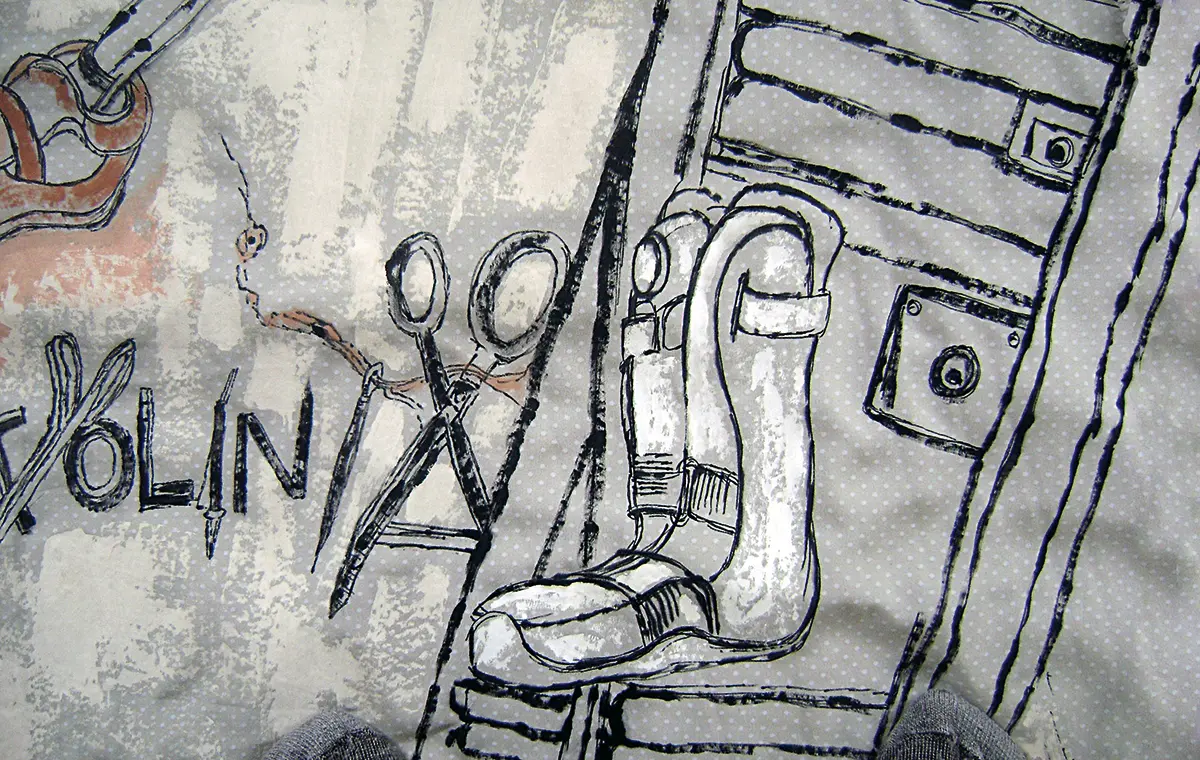
Seeing Retacería urbana as a conceptual exercise intended to express the experience of a city, Quintana joined together to present and past repeatedly, but without overwhelming her audience. Nothing feels repetitive in this installation, made of several nuclei that expand the meaning of its title. The show’s well-resolved museography was also in accordance with the concept and the title: angles of the city. There were a number of ephemeral elements: wall drawings that referred to the congested traffic of cars, bicycles, and motorcycles. Only a monumental two-meter tall book seemed to match the city’s vastness. With its six pages, 1.45-meter wide each, the book used drawings and brief color touches to summarize the themes of some well-known streets and shops in the city center: Lights of Victoria (Street); Chapultepec, with drawings of the park, birds, and other animals; Casa Serra, a historic art-supplies store; Motolinía, with medical supplies. This monumental book is characteristic of Georgina Quintana, who produces highly original artist’s books. The echoes of her exhibition Libros mutantes y caprichosos (Mutant and Whimsical Books), at Museo Carrillo Gil, in 2017, still resonate. To return to the monumental canvas book with a wooden structure, it was not devoid of humorous gestures, and viewers were able to hand-turn the large pages as if strolling from one street to the next.
GRACIELA KARTOFEL