The series Cosmographies by Colombian artist Gabriel Silva (Bogota, 1955) consists of a series of large landscapes that expand within the frame to render a total point of view; a celestial panoptic in which Silva and the viewers can see everything, witnessing stellar explosions (bursts of color) even when it comes to the small events of characters still without stories. The open plane of his landscapes pulls the gaze into the frame and evidences a sort of narrative observation by a creator who disposes and decides the destiny of his universes and the figures on the plane. In the works by Silva is possible to sense the drive of a writer of fantasy stories, an impulse that connects each particularity (faces, characters) with the imaginary topographies and galaxies contained within the frames (even his themes leave to the real world through sculptures and gardens that, while not part of this exhibition, are still part of the same process).
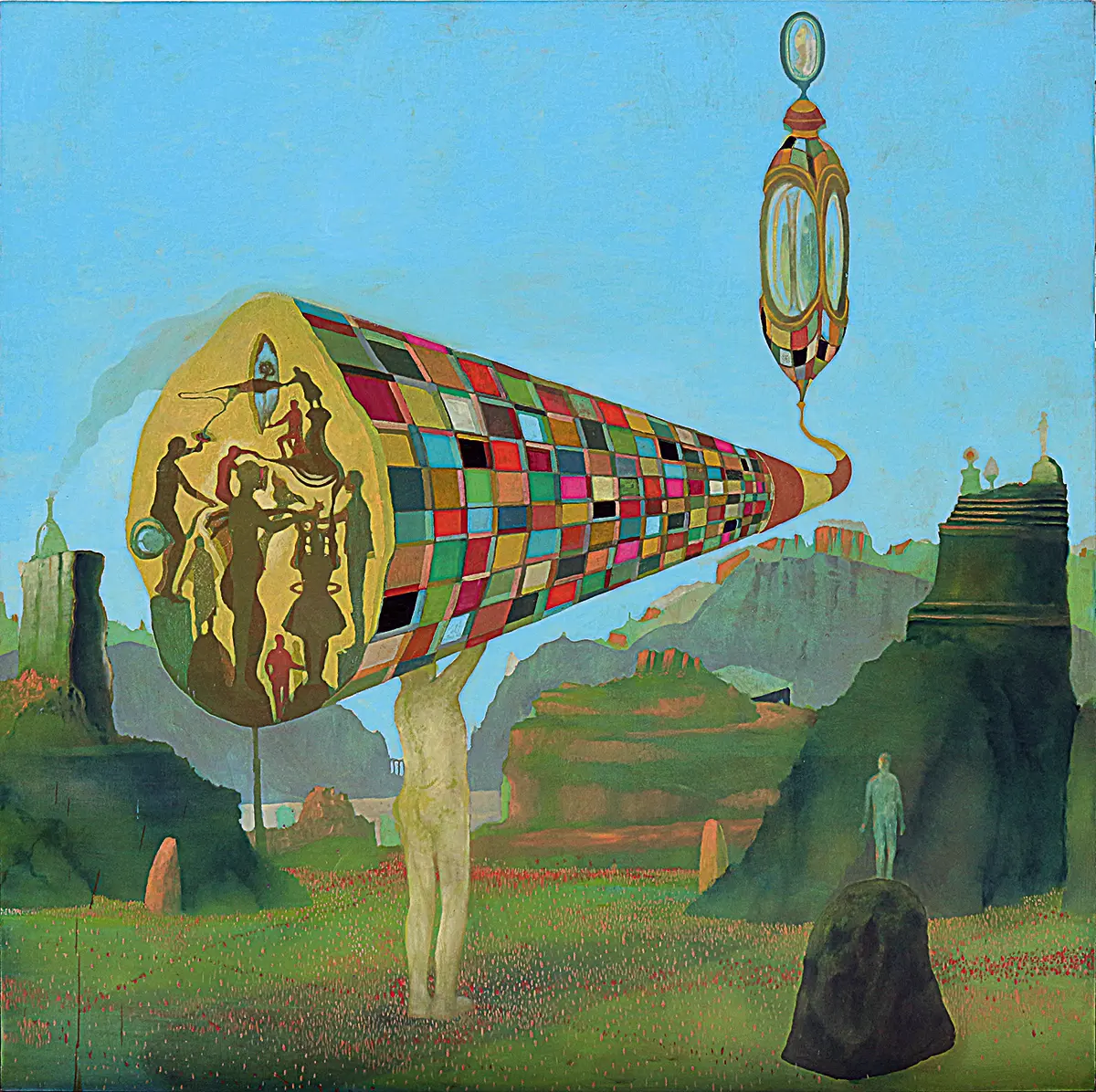
Landscapes can be thought of as scenes, stages arranged for many outcomes. Silva said in an interview that one of the main challenges to embrace painting, “a struggle as an artist,” was to dismiss the human figure and instead focus mainly on what unfolded behind it. With this statement, Silva offers a very important clue for reflecting on his art. The backgrounds here act as central motifs, themes, and not as mere decorations. This means that his scenes condition the figures and that the oneiric context of the entire image influences every stroke—which can become a creature, light source, topographic flows, stars, plants, or structures.
Miguel González, the curator of the exhibition, points to the use of controlled accidents, the explosion of color, the detailed figuration, and the vigorous chromatism, suggesting that pictorial phenomena generate a sense of permanent transformation of universes that would seem to be alive and move when no one is looking. This sounds right if one takes into account the narrative nature of the series. Any narrative, whether a short story or a novel, outlines the boundaries of its own universe, conditions its characters, manipulates time, and subjects it to internal logic. Everything unfolds within this universe and every painting establishes a moment, the shadows freeze before arbitrary lights, nature reveals its absurdity as a privileged point of view somehow encompasses the internal logics once again.
These paintings cannot be explained. We can speculate about the interpretative triggers of the works, but even then it is more vital to approach them from the perspective of the imaginary impressions they provoke. The series could be framed as historically traditional scenes—peasant scenes, proverb paintings, religious imageries of hell and paradise, mythological and even indigenist iconographies. Their multifaceted nature may be explained by this artist’s need to suggest (or demand) a story. Hints of several archetypes interact in Silva’s paintings: centaurs, giants, hunters, and gatherers, etc. However, it is impossible to figure out exactly what they are because they are subjected to an underlying pictorial cosmography in which stains, some tonal degradations, color spills, and veilings frame the images.
There are several approaches to the paintings. Some show entire conflict-ridden landscapes, others depict close-ups of figures that seem to be immersed in forests, and others yet are seemingly centered on single events (although several other things are likely to be occurring in the background). On the other hand, there are those works that look like cosmic incidents and that, while their scales are not defined, are likely to be magnificent phenomena. Lastly, there are the small portraits. These complete the exhibition and reaffirm the need to tell a story, or rather, the absence of a narrative. Cosmographies perhaps propose a paradox: inciting imaginary and narrative thought while lacking a story; which boosts the possibilities of the paintings.
The artistic posture by Silva is so radical—before that double condition of narrative and non-story—that none of his paintings have been given a title. By not being titled, the pieces avoid any connotative intensions in favor of that which in the end is the most important thing: painting. In this manner, then, the landscapes do not completely open to the gaze, as suggested at the beginning of this review. Instead, they do the opposite, allowing us only to look at them but not to know what they are. The stillness of the image also means a narrative that does not unfold. After all, can anybody understand a story after only looking at a single page of such a story?
BREYNER HUERTAS