One thing you can always rely on Gabriel Orozco: what’s there is simultaneously obvious and hidden. He is a legendary abstract game theoretician, and the game is less art than thought and process. We know his general precedents acted out on the chessboards of the Surrealists. Here, perhaps in relation to his move to Asia several years ago, the model is the world’s oldest tactical game board, Go, earlier introduced through his 2005 foray into the language of circular geometric forms in his painting The Eye of Go.
Go is played with stones of binary distinction (white and black) on a gridded board with placement at the intersections of lines, which conceptually convert squares into dynamic orthogonally adjacent points or nodules. It has millions of more variations than chess.
Such conceptual underpinnings are often necessary to address Orozco’s work because the twin ideas of systems and process have been his backbone for decades. Here, you need such a lens to conceive of the static stone placements as dynamic intersections, with a host of implications; static moments within a complex system, like a snapshot of the action.
The danger, especially with his work, is overloading what the work will bear, and when an artist returns to such physical forms as carved stone, an unusual inversion for Orozco, the work must be able to carry the weight of such claims. Otherwise, they are merely small pieces of carved stone whose forms look like those of early 20th century modernist abstract forms and become an exercise at the weak point of all conceptual art, the intentional fallacy. Both readings are possible here, hopefully, bound intensional relation for the informed viewer, as are the few wall-mounted paintings strategically placed in relation to the three-dimensional carvings. And it is that line of potential collapse that seems to motivate Orozco; the implication of some hidden center when in truth there is no center, merely another point of departure, a concept and process that is as old as thoughtful humankind.
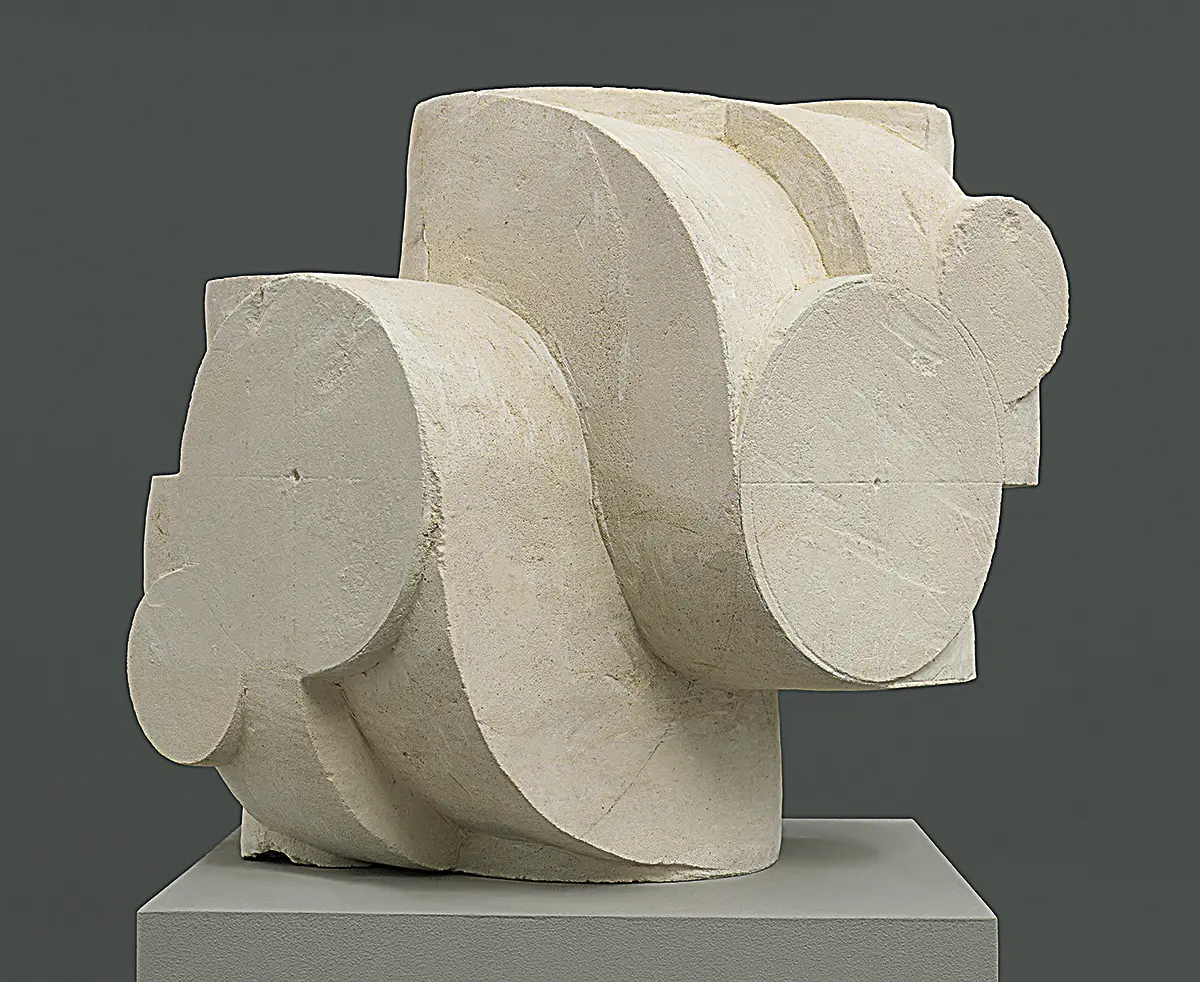
Each of the three different groupings of stone carvings shares the same strategy of production, derived from circular forms introduced into his thinking and production in two-dimensional paintings around 2005 and which he has applied to other three-dimensional objects, such as the whimsy of a semi-circular pool table. The three-dimensional works are thought through in terms of the one-dimensional drawn circles used to produce a range from flat circular sculpted sides to more complex interpenetrating volumes. Orozco contains his experiments in standardized sizes, using the systems approach he so loves. In each of the three different room installations, the stones – minerals are a recurring concern in Orozco’s work, from their small physical dust grains to their cosmological implications – are accompanied by one or more paintings from the same year as the carvings (2018). All paintings and carvings use the same intersections of abstract curvilinear forms. Aside from demonstrating the obvious relationship between two-and three-dimensional media, any implied dialogue is not clear.
The main gallery holds nine limestone pieces hand-carved by Orozco while in Bali, where he went reportedly to learn the necessary skill set of hand carving. The limestone is local and each block retains a standard dimension of 11 ¾ inches (30 cm). Their distribution across the room on low pedestals is exactly measured and balanced to emphasize the regularity of his systems approach, as echoed in the overall geometric development of the abstract forms and in the few remaining pencil marks from the compass used to make them. All are different and all are named in French.
The names of all the sculptures, in all three rooms, use the French preposition “dé”, which is usually placed in front of a noun to establish some sort of relationship to a preceding verb, adjective, or noun. But there are no precedents and that leaves us with a translation “of,” from” and “about” in relation to the following noun; in other words a naming that implies derivation. A work named Dé escargot invokes the snail, as Dé hélice invokes the propeller it names. But what else is at stake here in otherwise formalist experiments with a supposedly open yet now directed and conditional system? Indeed, what does derived from mean here, for instance, in terms of participation between the form, the forming, and the object named? At the far end of the room hangs the blue on red painting titled Orbit’s Trace with the parenthetical subtitle Primal, one used also to name pieces in the other two sculptural series as if the painting has bequeathed its meaning to the stones. If so, in what sense other than formalism?
Similar arrangements and relationships exist in the other two rooms but with differences in material and distribution. The middle section contains seven smaller squares of black marble (5 7/8 inches/15cm) distributed on a flat, waist-high tabletop with a more irregular placement. These works and those in the next room are materials taken from Orozco’s home country (Mexico) where he made them with the assistance of mechanical tools. Here too there are paintings, more complex in design, with gold leaf applied to tempera. Their series title of icon cell, one designated as white, the other as Russian also have an unclear relationship.
In the third section, the four paintings outnumber the three carvings, which are standardized to the same size as those in front but are of Mexican volcanic stone and distributed randomly. The two large colorful paintings are quite beautiful and carry the names Ultraman with Parrots and a Tiger and Ultraman Hiding in the Jungle. Their colors, dynamics, and titles bring what the rest of the exhibition lacked: whimsy. And while I may believe his young son knows of Ultraman – an early Japanese television science fiction series in which normal mortal morphs into an alien and slightly robotic superhero as needed – the adults are left to puzzle over what any child takes for granted: what is the meaning and process for clear actions? As Orozco phrased it: “I don’t know what I am looking for.”
RICHARD LESLIE