From the very first day of her arrival in Mexico seven years ago, Colombian artist Cristina Ochoa has witnessed all kinds of accidents. Her encounter with, in her own words, “the irreparable, the tragic, the perilous, and the violent” has allowed Ochoa to compile objects broken in front of her eyes, from automobile windshields to the chains of fleeing dogs, and including glasses that broke in her presence in art exhibitions. This series of minor accidents gain a fatal dimension when the artist saw a friend of hers be struck by a car in a hit and run. As she put it, “that night I compiled the list of the accidents, and could not preserve it.”
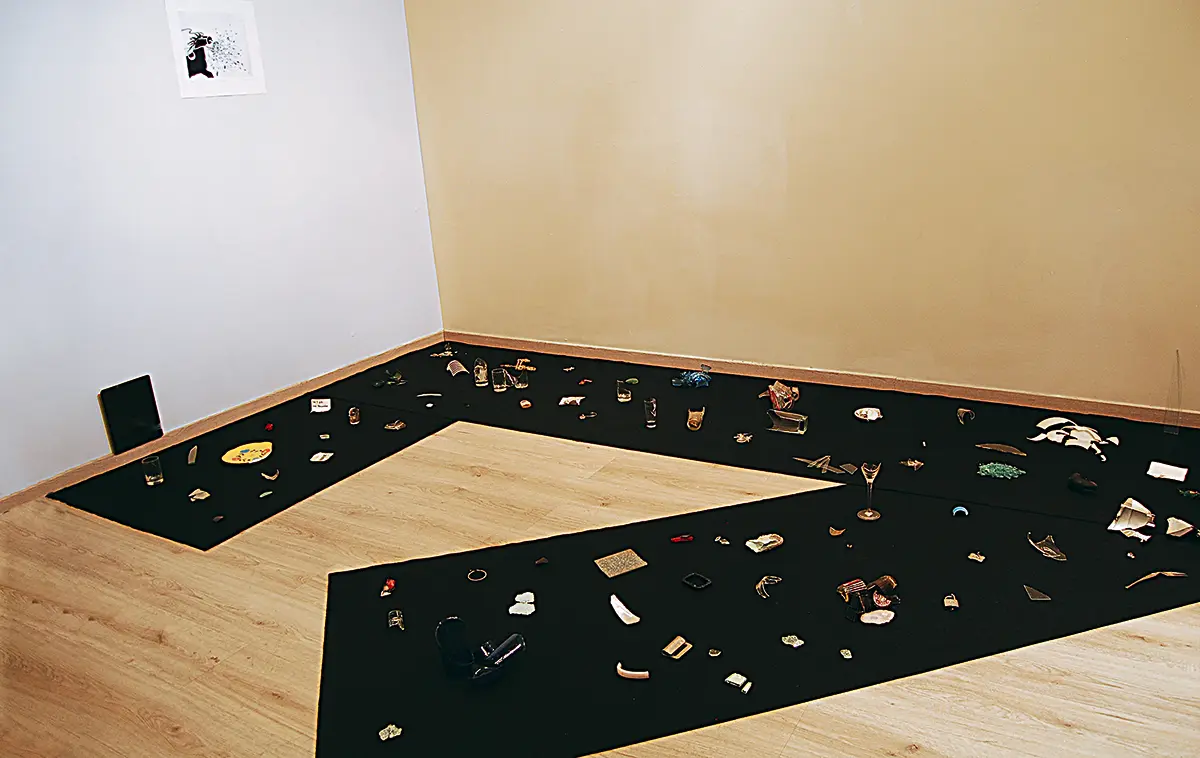
The tragic death of her friend drove Ochoa to prepare the exhibition Accidentados (Accident Victims). On a length of black felt placed on the ground inside the exhibition space, Ochoa arranged her series of 125 mementos, gathered by way of clues or warnings about life’s constant shifts. Interested in chance and the unknown, and following a suggestion by Juan Antonio Molina, the exhibition’s curator, Ochoa contacted a quarry worker, who in turn suggested a Yoruba ritual: to sacrifice a rooster in the presence of a horse. Ochoa adapted the ritual to the logic of her own symbolism and created a lithograph in the La Máquina graphic arts studio, in Oaxaca, where a horse rips out the head of a rooster whose body is buried on the ground. This work, titled La receta del Babalao (The Babalao’s Prescription), was featured in the exhibition. Ochoa also included an x-ray of her ankle after another minor accident and a sign with the word Cuidado (Warning!) in which each letter is outlined by sewing pins.
Ochoa has been working with archives and collections since the beginning of the decade. In 2010, in her exhibition Caos en el paraíso (Chaos in Paradise), at the Colombo-American Center in Bogotá, she used the archives of the institution’s library to build a tornado that, in its way, dragged the American Dream, or at least its library, in the air. In 2012, in her installation No todo lo que es oro brilla (Not All That Is Gold Glitters), Ochoa presented a collection of glittering objects. This is not the artist’s only field of interest. Her Pharmakon project is an exploration of psychoactive substances, creativity, and individual freedom. Ochoa’s interest in psychic realities, magic, chance, and fate, all of which are touched on in her still unreleased film La novia de Juan Padilla (Juan Padilla’s Bride), reappeared in the exhibition in the video Instrucciones para volar (Instructions for Flying), made in a center for the rehabilitation of birds of prey. Projected on a pillow, the video underscored the ironic situation of a human being teaching a raptor how to fly.
In conversation, Ochoa tells us that the exhibition is motivated by the fears that a woman experiences these days when out in the street, the risks entailed in such an apparently innocuous act as taking a walk in the city. I immediately thought of Miguel Ángel Rojas’s Paquita compra helado (1997), a series of seven vignettes set out like a comic, made from 8,000 photographic reproductions; in Rojas’ words, this comic tells of “all the risks a child runs when out buying ice cream in Colombia.” In it, Paquita is pushed by a passer-by, almost hit by a truck, bitten by a dog, and is in the end made sick by the ice cream she eats. While seemingly innocent, the story is driven by Rojas’ pain in “seeing his friends die agonizing deaths, sick with AIDS,” in the words of Natalia Gutiérrez. Ochoa’s forensic archaeology, meanwhile, is connected to Paul Virilio’s Museum of Accidents, to Rogelio López Cuenca’s work, and especially to Hotel D.F., Guillermo Fadanelli’s tribute in novel form to a city that has absorbed Ochoa as profoundly as it has its characters.
SANTIAGO RUEDA