“Instant” is defined as a very short, almost imperceptible, period of time. That temporary fleetingness is found in the flutter of a flying bird, at the moment when the first ray of light comes out at dawn, or in the second when a wave reaches the shore. Marine landscapes–capturing the first rays of sunshine as they glisten on water or hide behind a dark cloud–are the source of inspiration in Consuelo Castañeda’s exhibition, presented at Dot Fiftyone Gallery.
The installation includes photographs, acrylic paintings on canvas, and a video, all based on a series of sunrises captured by the lens of her camera over the course of one year. At that time, she lived in an apartment in Miami Beach; it had a window facing east through which, every day, she could see the sea at dawn. She decided to place the camera in such a way that she could record each surprising moment on a daily basis.
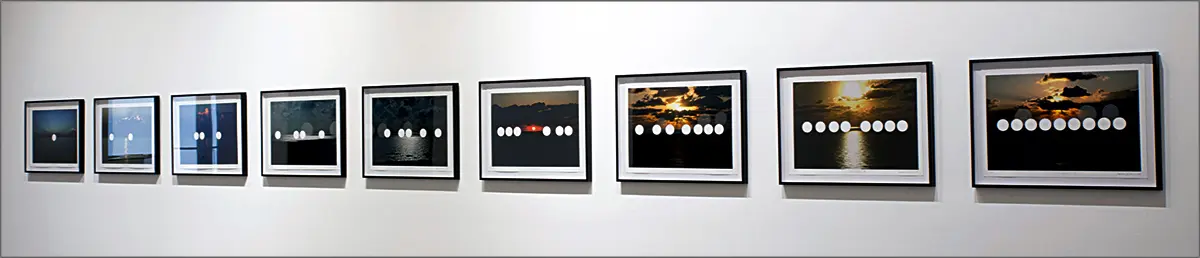
From hundreds of images, the artist selected nine to create a series in which each photograph has one to nine white circles strategically located on the horizon’s line. According to the principle of Pythagorean numerology, the digits from one to nine are considered pure or elementary, and each of them has a metaphysical value of great significance. By showing these nine intervened photos consecutively, Castañeda generates a conceptual approach to this principle, to the extent that the visitor not only contemplates them but also participates in the experience; this is done by visually following the horizontal line in which the white spots or “instants” appear, inspiring a feeling of self-reflection.
The original title of this first series had to do precisely with the nine photos printed in 2008, in which the white circles symbolized the Parable of Pythagoras as well as the very cycle of human existence. The circles also have a formal purpose: to break the two-dimensional representation of the photographic impression. Though her previous work had always played with the negation of the limits of the medium, Castañeda decided to explore the possibilities of the subject in a pictorial way.
It is important to remember that the artist received academic training in Cuba. She studied at the Escuela de Bellas Artes de San Alejandro and at the Instituto Superior de Arte (ISA) and, furthermore, became a professor at the ISA. On a pictorial level, she received training from Russian professors who masterfully worked on reproduction. From them, she learned of methods that allow working on the painting in an exemplary way, and also develop a conceptual structure.
In order to further develop the series, Castañeda traveled to Mexico where artists continue to respect and pursue painting–while community members in other cities, such as Miami, generally regard painting as an outdated technique in the context of contemporaneity. Although she did not paint for many years, she found ease returning to the medium because she had the basis and the knowledge to reproduce the sunrises with extraordinary technique. Her paintings–which span the approximate size of the apartment window through which she initially photographed the landscapes–were to be perforated with one, two, three… up to nine circles; this was to break the two-dimensional representation of the canvas. In fact, she acted on this intention with her first piece, inspired by the work of Lucio Fontana. However, due to the lack of a technical tool that could help her achieve the desired effect with the perforations, she decided to use the same white circles, that she had originally used in the photographs, in the paintings. This met her objective of questioning the limits. Although the perforation would have been more explicit, her choice in utilizing the white circles adequately presents her essential concept, and this can be clearly seen in the five paintings on display in the exhibition; the remaining four are not yet completed. The embodied effect becomes more obvious in the gallery’s space, where the white walls play with the optical illusion that destroys the two-dimensional aspect of the work.
At the end, the artist chose to make a video in which she used the seascape and the white circles, except this time the circles are multiplied. Rather than limiting the number of circles to nine, Castañeda includes countless circles that neatly cover the surface of the image projected on the wall. The concept becomes more explicit to the extent that the white circle–the “instant”–does not stay on the horizon’s line, but instead covers the entire surface. This work is useful because it not only supports and explains the concept of the installation but also highlights its abstract nature. Despite being based on images of great realism, the presence of the circles makes it an abstract work of clear conceptual nature.
Ultimately, the exhibition should be understood as an experience in which the viewer observes and feels the passage of time, surrounded by images that are reminiscent of the value within each moment each breath, each blink… The landscapes represented in the photographs, the paintings, and the video may vary, but time is always present on the horizon’s line. Immersed in the installation, viewers identify with the images of sunrises as well as the real and conceptual “instants” represented. Simultaneously, viewers internalize them, questioning and reflecting upon their own existence.
FRANCINE BIRBRAGHER