Renowned Argentinean artist and theorist, César Paternosto (La Plata, 1931), presented the exhibition Contrasts and Fugues at the Galería María Calcaterra – Moderno & Contemporáneo (MCMC). Consisting of a series of twenty-seven works on paper, geometric constructions, and “low intensity” kinetic art, the calm and reassuring demeanor of the show stemmed from the energy and persistence of an artist who early on chose his path.
Although he has been living abroad since 1967—first in New York and since 2004 in Segovia, Spain—Paternosto frequently comes to Argentina to show his work. As he stated in an interview with curator María José Herrera during this visit to Buenos Aires (https://www.youtube.com/watch?v=3MwSjwZ7QZY), his roots in Argentina and his family relationships here run very deep. While he has changed many things throughout his life, his passion for his beloved soccer team—Estudiantes de La Plata—has never wavered. The color and design of the team’s jersey—red and white stripes—are the same that Paternosto favored in his work. When artist Alejandro Puente (Argentina, 1933–2013) asked him about this, Paternosto replied that it was pure coincidence. In 2002, concurrently with an exhibition at the Galaría La Ruche, where he showed many works in black and red, he also presented at MALBA the book White/Red. Published in the United States, the book included several texts and reproductions of his work.
Chance had it that Paternosto and Puente, schoolmates in the city of La Plata and partners in artistic projects, once again shared the exhibition space of several galleries in Buenos Aires, like in 2004. Along with other artists, they founded the informalist avant-garde Grupo Sí (1960). After its dissolution, the two artists jointly presented the exhibition New Geometry in 1964—called “sensitive geometry” by art critic Aldo Pellegrini—and then took on a decisively geometric path inspired by Americanist abstraction.
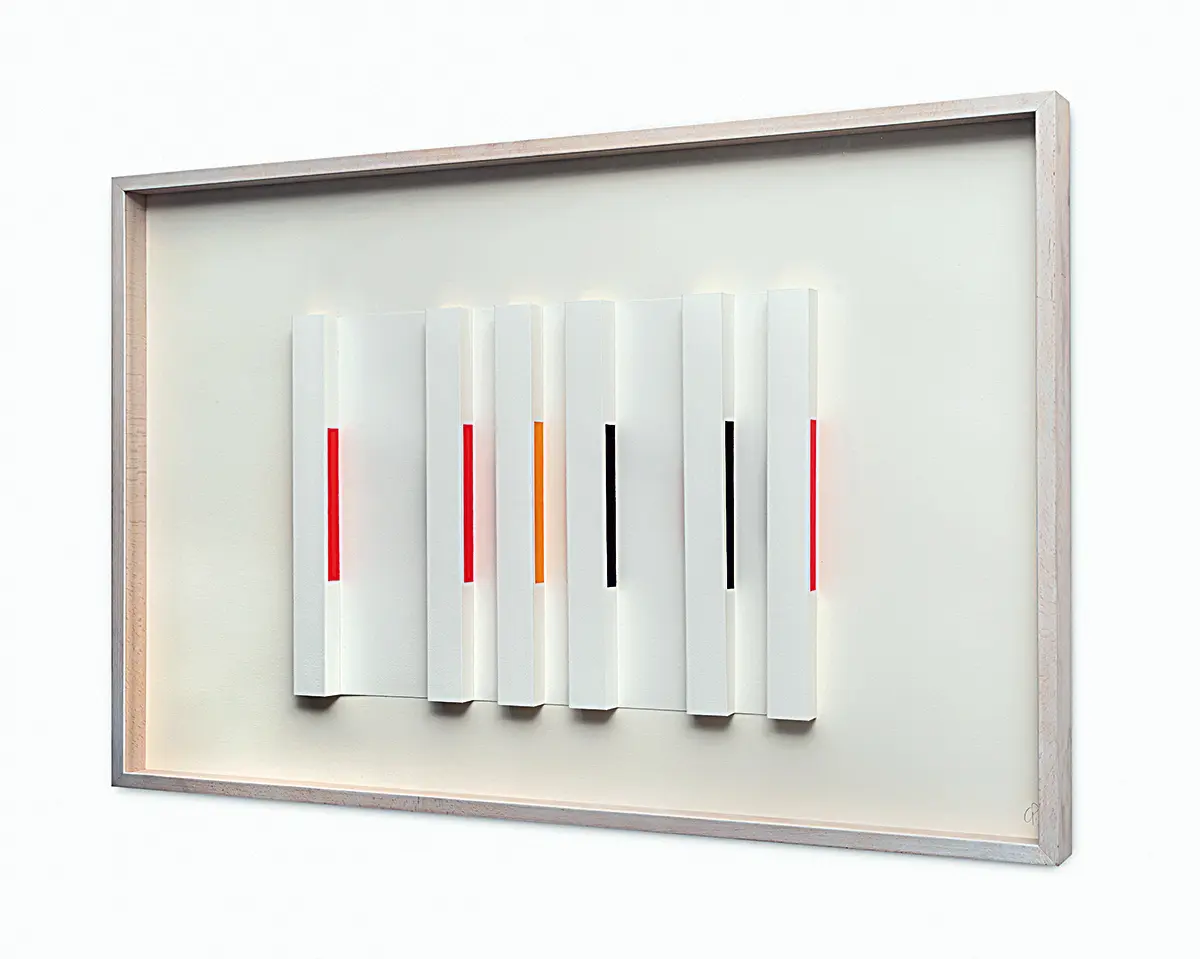
Between the end of the 1960s and early 1970s, Paternosto began painting monochromatic surfaces, rendering geometric forms (color strips) on the edges of the stretcher. He called these paintings The Oblique Vision, which was also the title of his 1970 exhibition at the AM Sachs Gallery in New York City, where he showed the work for the first time. According to well-remembered critic Jorge López-Anaya, “The new works forced visitors to gaze from one edge of the stretcher to the other; it was a way of increasing the complexity of perception, inducing viewers to active and physical participation.” In this manner, Paternosto transformed the edges into fully active elements and made the stretchers three-dimensional: shaped canvas.
While Paternosto was perfectly familiar with the constructivist art from the first half of the 20th century—with the work by Klee, Mondrian, the Madí Movement, Ad Reinhardt, and Donald Judd, among others—after several trips to the north of Argentina and the Andes, beginning in 1977, and following the path of Joaquín Torres-García, he rescued constructivism and the Pre-Colombian referent. The profound impact that the visits to the region of the Incas citadels had on him remains to this day.
Mindful of the aesthetic and anthropological dimensions of his work, he approaches Incan constructions as sculptural walls and ancestral textiles as artistic systems. Today, he continues to incorporate the abstraction model in the interpretation of Incan culture. Paternosto documented these themes in his book titled Piedra abstracta. La escultura inca: una vision contemporánea (Abstract Stone. Incan Sculpture: a Contemporary Vision, 1989) and in his exhibition at Ruth Benzacar in the same year titled César Paternosto. Andean Symbolic Forms 1987–1989. In this book he also explores the coincidences between European and American artists; the sum of pre-Colombian forms that “for artists in America, represent the cultural encounter of a type of geometric abstraction that no longer imitates the European models.”
Now at MCMC, and with his presence in the gallery during the inauguration, Paternosto presented eight historical pieces created during the mid-1960s that show traces of subjectivity: this artist’s pulse and pictorial decisions. The rest of the pieces are more recent and, for the most part, smaller in size. Paternosto’s convictions prevail in them as does his search for “new visual solutions […] combining modernity and his roots, as well as future and identity […] one of the central themes in his work,” as stated in the written information displayed in the exhibition space.
Some of the pieces exhibited—temperas, Zen-inspired flat gessoes, and the folded papers—reflect “his great tenacity” in continuing to develop works inspired by Americanist geometric abstraction, as well as the need for viewers to move around in order to appreciate them in their totality—a simple action that modifies how the work is perceived. This delicate exhibition featuring works that offer atonal musical resonances also conveys Paternosto’s love for painting and invites viewers to silent and reflective contemplation.
At the Museo Nacional de Bellas Artes, his work is on display in the exhibition room dedicated to Neo-Abstraction.
VICTORIA VERLICHAK