In a world filled with images, the exhibition Metaimages by César Oiticica-Filho at the Museo de Arte Moderna do Río de Janeiro (MAM) became an expressively relevant point of reflection on the subject. An evolution of his poetic inquiries centered on the end of photography in the digital era, the exhibition, through fifteen works never before shown, associates the partial destruction of César Oiticica-Filho’s work and equipment in 2009—caused by a fire at the Projeto Hélio Oiticica, which he curated—with the substitution of the analog photographic image for the digital one.
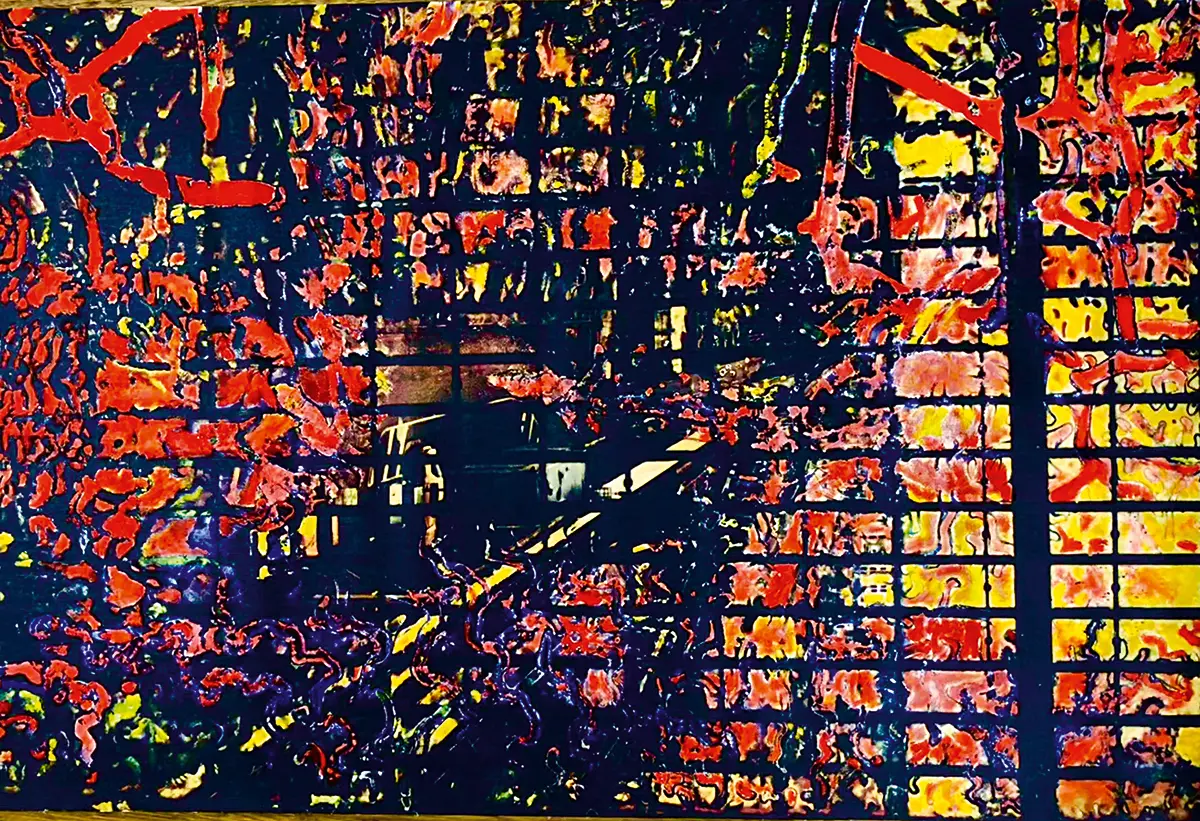
This theme is approached in all the sections of the exhibition: 1) in the center of the exhibition room, the visual is represented by eighty slides licked by fire; 2) in the Metaimages, which are the result of printing some of those slides on canvases in order to bring them closer to painting through pigments; 3) in the projections closed to film, animation, and video, like the Transobjects reproduced in images or 3D print; 4) in the Rolezinho (little excursion), which inscribes viewers in a metaillusionism through eyeglasses connected to smartphones; 5) SolAr, which encourages the return of the observer to his own body; 6) at the MAM’s garden, Es todo verdad (It’s All True), a title that pays tribute to the documentary by Olson Wells of the same name filmed in Brazil in the 1940s.
“I was talking about the end of photography ten years ago. And it actually occurred, objectively and figuratively, with the fire,” said Oiticica-Filho, adding that the “melted” photos became “something else” altogether, and pointed out that the exhibition offers another reflection: the digitalization of photography creates its transformation into a new “image” “manipulated and banal, it loses its credibility.”
Interestingly, in this exhibition, the “banality” of the image reproduction is discussed in connection to its opposite: a profusion of images and figurative elements that seem to evoke a certain figurative and matteric nostalgia. This has been César Oiticica-Filho’s leitmotiv, which he also explored in earlier works in which he experimented with the photographic color range until exhausting the possibilities of the process and material, stopping the action of emulsion with light, using strong beams of light like laser or high-power flashlights directly on the photographic paper.
In this new works, Oiticica-Filho articulates—from the destruction by fire of his own work and equipment—the transformation of photography into digital images and the reincarnation of this medium in painting, film, virtual reality, and objects. “This transmedia vocation by this artist resulted in a generalized combination of several fields where visual production is segmented in autonomous areas (like video, photography, film, publications, and paintings),” said curator Fernando Cocchiarale.
Through a variety of textures, many two-dimensional works reveal colorful stains, melted pigments, fragments of human bodies, buildings, and tropical forests, in a vertiginous tribute to the figure. It is as if the metaphor of the fire strengthened the power of figuration in Western culture even more. Núcleo metaimagénico (Metaimage Nucleus, 2018) is a large installation consisting of a series of lightbulbs framed by dozens of images of the negatives damaged by the fire, “form around the light a nucleus that represents the end of the photographic image and the beginning of a series of possibilities, shown in other works in the exhibition,” affirms César Oiticica-Filho.
Even when approaching virtual reality, Oiticica-Filho places viewers inside the image, truly making the case for the power of figuration, like in the piece titled Rolezinho (2017, 360° film, using a smartphone, virtual reality glasses, and headphones), a sort of “ambulatory delirium” like those by his uncle Hélio Oiticica (1937–1980), a hallucinatory skate ride through the streets of New York City.
By the end of this frenetic aesthetic journey, Oiticica-Filho asks visitors to “stop, close your eyes and lay down, to return to the body, to the here and now, awakening other senses that were dormant as a result of the outpouring of images received.” This is the invitation of the sensorial installation SolAr (2018), in which a bright lamp also serves as a fan to activate a cold/hot sensation as an “antidote against being devoured by the dictatorship of the images that flood our eyes in large quantities every day.”
Born in Río de Janeiro, César Oiticica-Filho was raised and lived in Manaus until the age of 18, when he returned to the city of his birth. He relocated to Río de Janeiro permanently in 1997, when he accepted the curatorship of the Projeto Hélio Oiticica. In 1992, he earned a degree in Social Communication from the Universidade do Estado do Rio de Janeiro (UERJ).
Having been recognized with several awards for his multidisciplinary works, Oiticica-Filho showcases in this exhibition his cinematographic production with the film Hélio Oiticica (2012), which in 2013 was awarded by the Fédération Internationale de la Presse (FIPRESCI), during the Berlin International Film Festival, and by the Caligari Film Prize (for innovation of the cinematographic language), becoming the first Brazilian ever to receive this award.
In this exhibition, César Oiticica-Filho restates his affirmation about the way in which digital technologies invaded our lives, transform our relationship with the world, and the manner in which we communicate. The profound immersion into the images in his work establishes his intuition in no uncertain terms.
ALESSANDRA SIMÕES