With serious and restrained composure, Carlos Motta (Bogota, 1978) titled his second solo show at Mor Charpentier The Devil’s Work. Exhibited from September 8 to October 6 of 2018, the title suggests Motta’s decision to establish a distance from which to denounce and reassess different ways of thinking. By placing viewers at the center of the gaze, the artist particularizes the content and induces a different awareness. He relies on boldness and introspection to combine the whole.
Semantically constructed, the installation is transformed into a decoded message: transgression, suffering, and the presence of death.
The general title refers to the six works written with blood and plaster on canvas. They are ecclesiastic words that describe moral depravations, where decorporation operates to achieve a targeted commitment and generate an individual and collective identitary force.
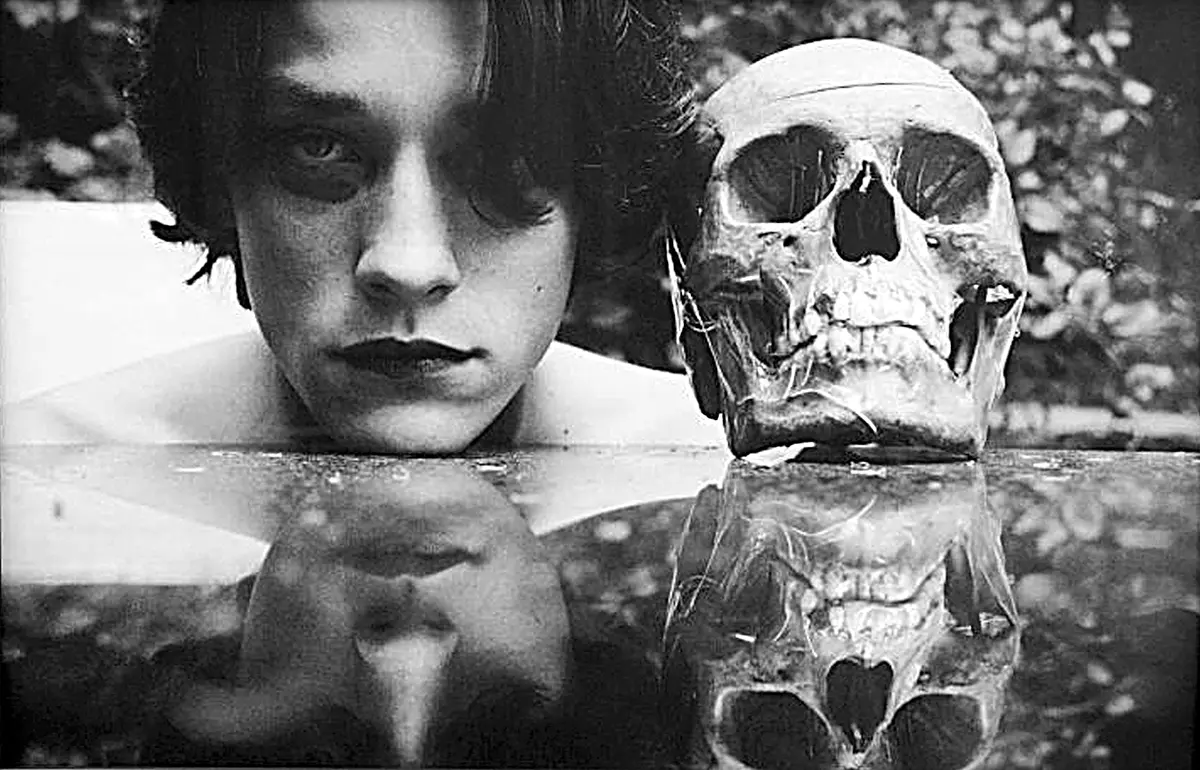
Also in the main space of the gallery, the piece titled Self-Portrait with Death (1996) reinterprets the Vanitas motif through the photographic portrait of a young Carlos Motta. In this image, he assumes the role of promoter and intermediary of values held by minority groups and dissident sexualities.
His sculptures-objects are like wedges nailed into the social system. The laser engravings on wood bases, like Circulo VII (Circle VII), represent the illustration fragments from the Divine Comedy created by several authors from 16th to the 20th centuries. In these pieces, Motta realistically rewrites the journey in which Dante encountered the souls of some historical figures. The exterior forms consist of circles and incisions that resemble the path taken by Dante: the spheres or orbits of planets.
And following the discourse leads to an interpretation of both the visual artist and of the Florentine writer.
The narrative poem represents Dante Alighieri’s most important work and one of the most significant writings of the transition from medieval and theocentric thought to a renaissance and anthropocentric vision. It was developed in the context of a secular intellectual environment whose evolution generated the consolidation of an autonomous political sphere. A progressive opening that culminated with the transformation in the practice of everyday politics. Divided in chants, it showcases the art of words. This association leads to the video installation Réquiem (2016) located in the lower level of the gallery. While Dante’s poem focuses on three main characters, the message in the work by the New York-based Colombian artist draws a parallel through the personification of humanity, temptation, and sin. We perceive in the video installation the equilibrium and stability intrinsic to a triangle. The video performance is a song of faith amid social change. Along with the four sublimated elements, this adds up to the number seven, as in the seven deadly sins.
Carlos Motta replaces the elements of a story of conditionings with new ones. The slow purification of guilt—until becoming free—symbolically coincides with the video titled Inverted World 2016. The stage of a 16th-century chapel makes reference to Caravaggio’s Crocifissione di San Pietro (Crucifixion of Saint Peter, 1600). A reflection of shadows with the modernity of the united background is part of The End of Crucifixion. There, feminism and theology are expressed emphatically (the woman has the leading role throughout Dante’s poem, where she is expected to say what has never been said).
The exhibition also includes pencil drawings depicting scenes and views of the Church of Saint Eustache in Paris; a total of twelve unique pieces that complete the group of works. Motta stands for the artifice of change by establishing new rules in the political game and by attempting to legitimize it in front of central cultural actors. By speaking in first person, he confers the proposal of great humanity, given that every spectator can identify with him: resent his doubting, pain, compassion, his infinite hope.
The entire work is populated by symbols that refer to knowledge and thought: religion, philosophy, mathematics, and optics incarnated in characters and places. Paradise represents knowledge and science.
Despite the distance that separates Motta from Dante—centuries, cultures, and techniques—they share an affinity in common. They themselves are symbols of severity, doubt, change, and of the passage from the religious landscape to the profane. It is a secular philosophy that places language on the same philosophical and poetic level as the privileged place occupied by the action.
It is a new mise-en-scène, never exhibited before, that inverts the relationship between decency, indecency, and their representation.
SUSANA SULIC