Birlibirloque is an old-timey Spanish language word meaning “as if by magic.” Its origins lie in the rapid-fire pronunciation of the onomatopoeic expression birliqui birloque, at one point equivalent to “abracadabra.” According Centro Virtual Cervantes, the words birlar and birloque mean, respectively, “to swindle” and “thief” in the caló language spoken by Spanish gypsies. Perhaps in connection to the idea of the sleight of hand and to the notion of quackery, the expression also refers to hucksterism and to circus acts.
Such a title is not unbecoming for this exhibition: throughout his career, the artist has explored the boundaries between reason and order, especially around the city and contemporary architecture. The comings and goings of an unfinished interrupted or ruined modernity that coexists in a city so unique as Havana have given Garaicoa more than enough materials to reflect and comment upon the impossibility of a scientifically designed city, according to Marx’s and Engel’s ideals.
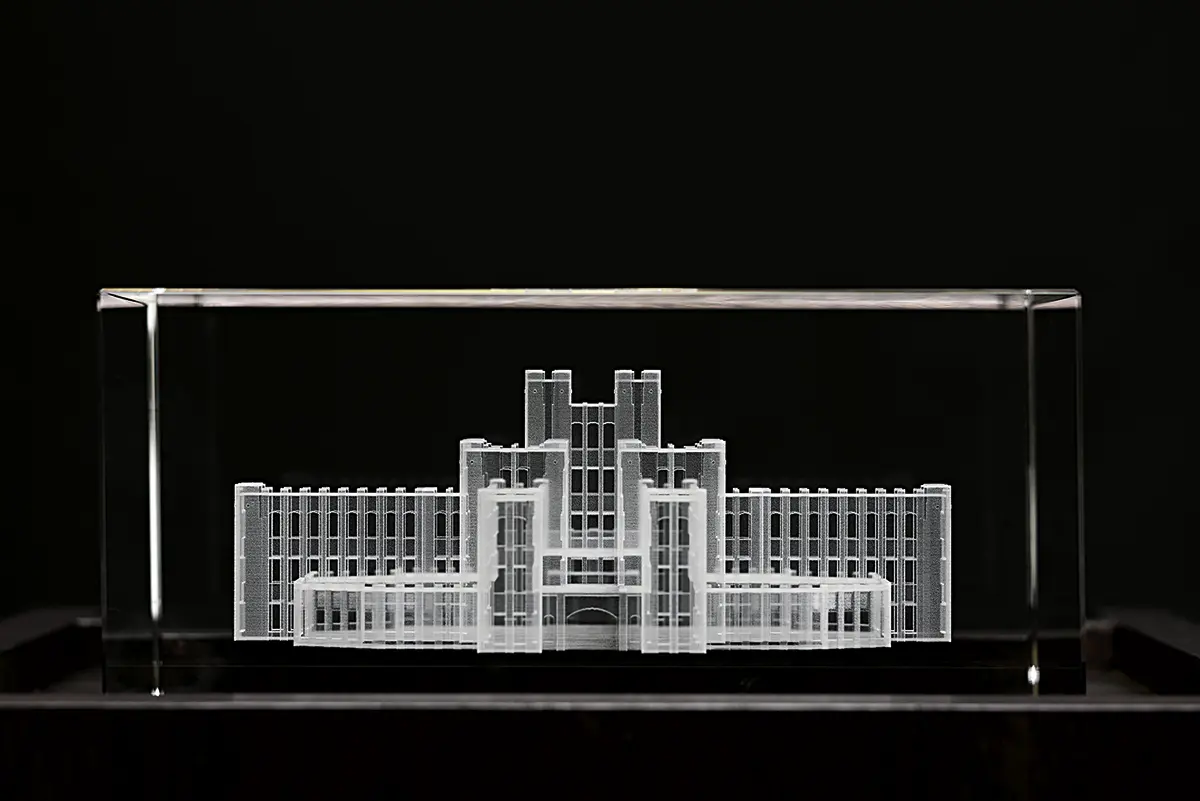
The series of installations titled Birlibirloque (2018) consists of two medium-format photographic diptychs and 3D models engraved in glass and arranged on wooden pedestals. Each instance features, in the first photograph, a Havana building; in the second, the empty space after its collapse; and, across from them, an architectural model of the same building. The buildings are presented, disappear, and reappear “as if by magic” in the model. But, beware: the motion from two-dimensional support to an object is a tease. The building in the model does not exist as res extensa: it is a mere image, an optical effect, an illusion.
One of the installations, Hospital Infantil (Children’s Hospital), grabs my attention because it synthesizes many aspects of Cuba in a beautiful and eloquent way. To the left in the first photographs we see, foregrounded, a large royal palm tree, the classic emblem of Cuba. In the central section of the photograph, in the background, is the building of the title in a state of total dereliction. Around it, a white wall with signs reading “Danger”, “Do Not Enter”, “Demolition Zone.” On the sidewalk, ix people walking. Projected by architects Félix Cabarrocas and Evelio Govantes (also the creators of other emblematic Havana buildings, like the Capitol) and located in the El Vedado neighborhood, it was the first pediatric hospital in the country. Renamed “Pedro Borrás” in honor of the young medical student who died in Playa Girón during the Bay of Pigs invasion, the hospital closed in the 1990s. Finally, after three decades unattended, the structure was demolished in December 2017. Speculations abound about the possible future use of the lot as a parking facility or for the construction of a luxury hotel financed with foreign capital. It is a powerful image; it coexists street life, endemic tropical vegetation, and a state of suspension (the “Demolition Zone” warning evokes the instability and fragility of a structure that still stands but in a hollowed-out form. In the next photograph, the building is gone but the palm tree and the people remain. It is a powerful way of saying that “life goes on.”
Two of Garaicoa’s most recent exhibitions in Spain focus deliberately on challenges to order. In Orden aparente (Apparent Order, 2014), at the Botín Foundation, a model of the port of Santander made in glass and magnets spoke of the city’s fragility and, in a wink towards the host space (belonging to a powerful bank and financial group), it shone a light on the flimsy stability of the global economy. In Orden inconcluso (Unfinished Order), at Centro de Arte Dos de Mayo, Garaicoa’s commentary focused on the city of Madrid in the context of the indignados protest against the financial crisis and the weakening of the welfare state. Garaicoa has explored the impossibility of Utopias from two extremes: on the one hand, the failed socialist project; on the other, the dismantling of social equality in late-capitalist democracies.
Birlibirloque perfectly evokes the sleights of hand and shell games with which advertising, political rhetoric, and financial dynamics make things, principles, and even people appear and disappear. Buildings that vanish “as if by magic,” proclamations that function as conjuring tricks, and the elusive mystery of a city’s genius loci are some of the issues explored by this exhibition where, nevertheless, reason and order are rigorously maintained. The impeccable exhibition design and Garaicoa’s distilled aesthetic keep every detail under control. In the series Pliegues (Folds, 2017), the photographs are presented in extended form, atop tall display cases. The rice paper on which they were printed has been deformed by means of folds that give it volume and distort the image: each fold is perfect; each sinew, planned.
DIANA CUÉLLAR LEDESMA