The photographs of rural and natural landscapes by Camilo Echavarría invite visitors to perform an activity that is increasingly rare in contemporary urban life: to fix the gaze, to give things a closer, deliberate look, to reclaim the ability to contemplate. Partly the result of technological advances, the speed involved in many of our actions in the contemporary world impedes and frustrates the desire to observe things carefully, to assimilate and process what we perceive when contemplating a scene, a work of art, a landscape.
Camilo Echavarría takes advantage of digital image-capturing and post-production technologies to convey a level of visual information so massive that it becomes impossible for him to interact with his photographs and videos in the same impatient, efficient, and accelerated manner required in most daily activities in the contemporary world.
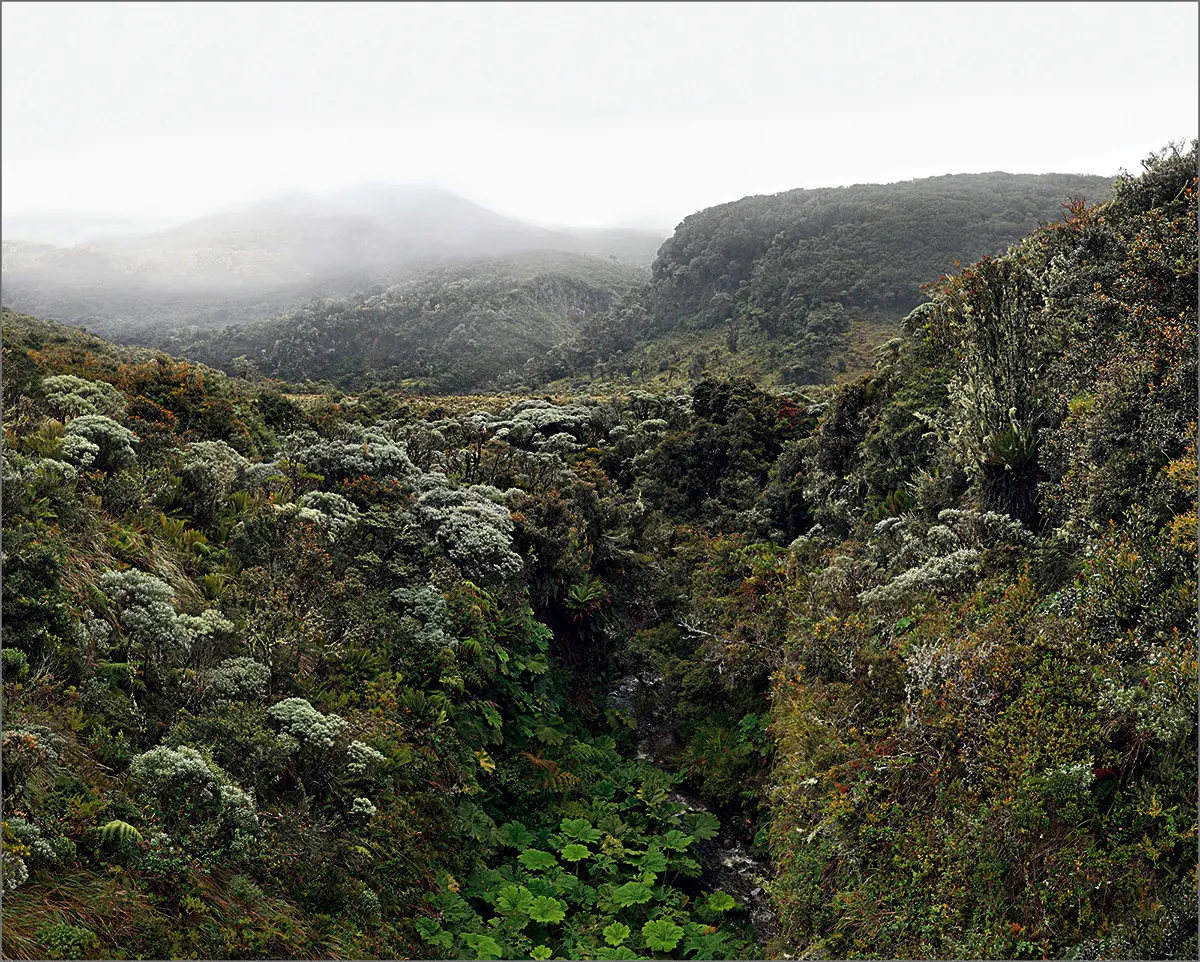
As part of the work that Echavarría has been creating for more than ten years—which so far have involved trips to Colombia, Ecuador, and Peru—the eleven photographs and one video he features in two exhibition rooms at the Galería La Balsa Arte, reveal the distinctive individuality of every component—in some cases, human footprints—present in his images of forests, paramos, valleys, lakes, mountains, and coasts captured in the northernmost region of the Andean Mountains. It is a singularity that coexists in the images through a wide-ranging vision of the surroundings where these “individuals” fulfill a small but constitutive role.
According to the text that accompanies the exhibition, “based both on photography and video, his work frees the photographic image from its instantaneous condition and erases the boundaries between both mediums.” Indeed, Echavarría introduced in his work a sense of time that is inherent in the video in terms of passage and duration. In this sense, the image transcends the instant. The passage of time is also perceived in the emphasis given to changing conditions like the effects of altitude, the light filtering through the clouds, as well as atmospheric and climate-related conditions like fog, which have an effect on the viewers’ perception of the physical characteristics of the landscape components and on the perception of forms, space, colors, volumes, texture, and lines. These images maintain the virtues of photography because of their static nature and ability to attract and focus attention.
The works exhibited at the gallery involve the use of digital post-production techniques whose purpose is, according to Echavarría, to stay away from “the particularities and distortions of a monocular vision from a fixed point,” in addition to neutralizing aspects that are inherent to the photographic image pertaining to focusing. Large formats allow the eye to examine in-depth every millimeter of the portrayed landscape and survey it as one would when experiencing it in the person or through a video.
Consequently, the works are placed in a space-time that involves an eternal present. Converging in Echevarría’s images are the documentary nature of scientific illustrations (like those by the great explorer Alexander von Humboldt, whose work is admired and studied by Echevarría), along with the poetic and evocative qualities of paintings by 19th century US romantic artists like Thomas Cole and Frederic Edwin Church—from the Hudson River School—and luminists like Martin Johnson Head and John Frederick Kensett.
It is a space-time that immerses viewers into an event that reclaims that which ancient philosophers considered inherent to the act of contemplation: understanding. In photographs like Miasma I and Miasma II, Corte en el Bosque (Cut in the Forest), Lluvia aproximándose en el páramo de Sumapaz (Rain Approaching the Sumapaz Paramo), Margen (Margin), and the video Chisacá—visible in the evening from outside the gallery—it is possible to contemplate-understand, among other realities, the rich and complex botanical and geological nature of the landscapes, signs of the human presence and its impact, the fragility and vulnerability of ecological systems, as well as their aesthetic qualities. They are realities whose invisibility facilitates and even encourages, the abuses and threats generated by the needs, conditions, blindness, and indifference of a modern world determine to make them/us disappear.
MARÍA MARGARITA MALAGÓN-KURKA