The old interests were not enough, nor were the sharp reexaminations of known images, the seductive and powerful appeal of classical restraint, or the intoxicating strangeness of the unusual. The notion of a comfortable return to the alluringly solid, refined, and popular earlier work was out of the question. After a long period of inactivity, Arturo Montoto’s return to the exhibition space demanded much more. He had to become free from any “legitimizing” aesthetic crutches and develop the intellective capital gained during retirement and, through that experience, attempt to subvert, uproot, and surprise.
“Dark” stems from the corollary of these appetites. Shown during the month of August at the Galería Taller Gorría, in Havana, the exhibition raises deconstruction as a flag. Large sculptural pieces—a departure from the scales that Montoto had been working with—stand alongside equally larger paintings brought together by the predominant users of the color black to redirect the artist’s aesthetic postulates towards other paths. Perhaps encouraged by Jacques Derrida’s idea of inverting the hierarchies of conventionally binary pairs—such as man-woman, life-death, or happiness-sadness—Montoto offers that same deconstruction to the light-darkness duality but with an emphasis on the latter of the two.
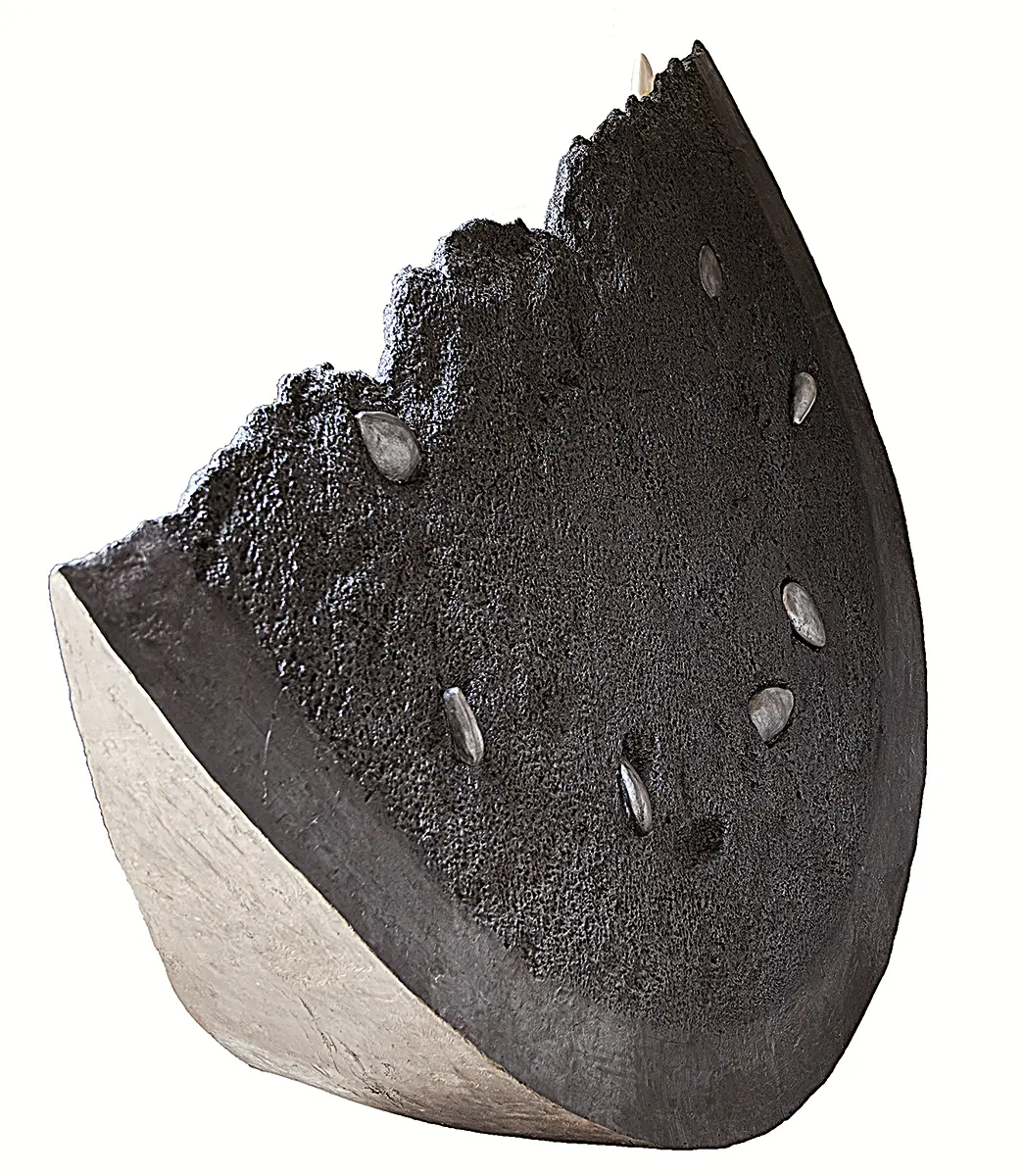
In this manner, darkness appears to take over the gallery. But it is not gloomy or decadent darkness or the reflection of the emotional state of an artist who finds refuge in his work; it is rather a visually destabilizing device intended to support the discourse. According to Montoto, black serves as a neutral element that counteracts the formulation of any aestheticizing readings. In addition, there is also a deconstruction of the very language of the work, where color is replaced by homogeneous darkness. Does this darkness ultimately reemerge as a positive, virtuous, element since what is light without shadows? Could it be that those moments that muddle the mind perhaps also fuel our desire to reencounter and become even more aware of our reality? What would it be of the mythical last spark of light without the dark tunnel that takes us to it? It would perhaps be best to suppress the relations of power between these two extremes and respect the harmony that naturally exists between them. The details of color that appear in the pieces of “Dark” address precisely this need not to lose the compliment; the tanned skin of a melon, the yellow of an egg yolk.
The curatorship and museography entrusted to renowned art critic and curator David Mateo—who knows Montoto better than anyone else—offer a spatial arrangement that takes advantage of the visual appeal of every work. As result, it is possible to establish a differentiation between the sculptures and the paintings through two different cognitive processes and two different expressive needs.
The sculptures level the space with self-sufficiency. Their eccentricity, given their imposing size and rare solemnity, overtly addresses a public that feels provoked but enjoys the weird atmosphere nonetheless. Shyness also gets the best of us when confronted with works like Dividiendo (Dividing), which feels like it is trying to belittle us with its gothic attitude. The enormous melon slice dwarfs any person who upon seeing it becomes overwhelmed by his/her own condition.
These oversized pieces—which clearly borrow from the Soviet monumentalism studied by this artist—may be a metaphor for the creole hyperbole, for our characteristic proclivity to amplify everything, even the most trivial of problems or elements. And in this overestimation of objects, there is a subtle play on the Heideggerian nature of art “as a thing” hovering around the place.
It is difficult to penetrate the intellectuality of Arturo Montoto. A pile of personal influences and explorations intermingle, along with the invariability of being Cuban, of being Latino.
“The visual basis for the new paintings is connected to the insular cultural diversity thesis, specifically in association with the presuppositions by Severo Sarduy about American variegation.1
I believe that in its purest, more relaxed, form, this intermixing that initially inhabits the mind, is also the one populating the paintings. The flood of thoughts is reflected in the works, where one thing superimposes another without any apparent meaning. The fleeting nature of their arrival and departure is evoked here through the nearly abstract stylization of forms and the artificial sparks of light and color that momentarily examine the dark environments. Hence, unlike the sculptures, the paintings are more intimate, evasive, and, while by no means confrontational, they are meant to confuse viewers.
Even if Arturo Montoto’s latest work responds to an impulse that subverts chiaroscuros and realist renderings in favor of variegation and washes, and despite a structure that appeals to the vindication of his precepts, it does not suggest however a break with the past. Montoto assumes it as an evolution that is part of his artistic trajectory, as a necessary turning point. And he embraces it fearlessly. I can venture to say that even if commercial imminences result in a momentary return to an earlier and pleasing production, after “Dark” the work by Montoto will never again be the same and, if it is, it will only be to provoke.
NOTE
1. “Dark: a new provocation by Arturo Montoto,”published in Boletín Artcrónica no. 49, 1-8-2018.
MÓNICA PÉREZ