
Chilean visual artist Ángela Wilson exhibits an installation in the room of the San Francisco Church in Santiago that houses a collection from the end of the 18th and 19th centuries.
In addition to its unique 400-year old structure, the San Francisco Church in the city of Santiago is a very special architectural work simply because it is still standing after enduring five major earthquakes. Save for a few repairs, it continues to exist amid the hostile environment of a modern city like the Chilean capital, with its very peculiar smog and constant heavy traffic.1 A Heritage site, the church houses a museum with a collection of colonial Andean art.
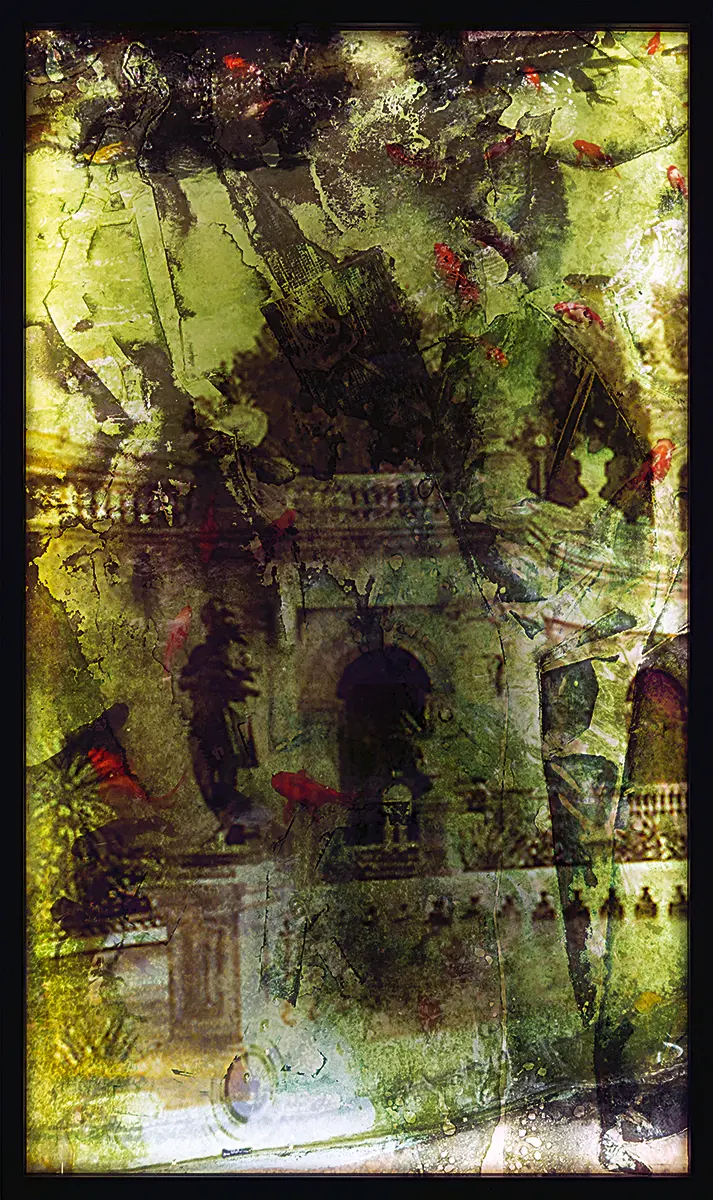
The intervention aims at generating tension inside the dark exhibition space through the display of video, five lightboxes, nine small acrylic boxes, and three large pieces created on crinolines and translucent fabrics. The installation incorporates the cloister’s pond along with historic photographs of downtown Santiago, bodies of water, and other natural landscapes. All of which inspire the exhibition to achieve an encounter between the old and the contemporary worlds, private and public realms, figuration and abstraction, the sacred and the profane, silence and the city.
Wilson intervenes in the Hall of the Beacons not to disrupt it but to energize it through the release of tensions and meanings. She takes over this historically charged room and embraces the presences that inhabit it, extracting the threads of secret symbolic affinities and reactivating the past from the present.
Ángela Wilson›s formal artistic education included a technique developed in the US—she attended the School of Visual Arts in New York—during the 1940s called "drip painting," in which paint is dripped from a perforated container onto the canvas, which is placed on the floor.
In November of 2013, Chilean art critic Justo Pastor-Mellado said the following about Ángela Wilson’s work:
“The labor-intensive painting approach seeks to establish a relationship of continuity with the history of painting rather than to break with it, as it has always been the case with the vanguards. Ángela Wilson has gone through the experience of US abstraction, which has permeated her biography as if it were her own personal Classical antiquity. The dripping of paint and chromatic vibrations obtained through the superimposition of translucencies evoke a serene gesture (drawn from US abstraction) to eliminate drawing through the deductive effect of a disfigured figuration.”
Since her early works, Wilson has been exploring the unconscious as an undercurrent of memory, as an archetype for the figure of the mother and the watery depths of the uterus.
NOTE
1. From Iglesia de San Francisco (San Francisco Church), a book by Chilean architect Natalia Jorquera, published by Sa Cabana. It contains a study centered on architecture, construction, and seismic behavior since 1618.
ERNESTO MUÑOZ