Ana María Millán’s exhibition at Witte de With Museum in Rotterdam is a significant recognition for a Colombian artist who has for years explored the universe of pop images without sustained critical, institutional, or mass-media acknowledgment in her own country. The pop label might be excessive here since Millán’s work has focused on the more circumscribed realm of youth subcultures, as fascinated with rock and punk, video clips, videogames, and role-playing as she is. Only she has not limited herself to the role of the fan, but, as an artist, has maintained a distance and a critical relationship with that which seduces her so powerfully. Millán has done this by intervening in the feedback of video games and role-playing games, organizing gatherings of youths whose interests have turned them into veritable experts in the reception of and interaction with these innovative cultural forms.
Millán’s exchange of experiences, debates, and interpretations with these collective, both in-person and online, has provided her with materials, stimuli, and suggestions, on the basis of which her writers produced scripts that the artist and her team then turned into images. This methodology not only gives value to the contributions of individuals marginalized or distant from the stages of contemporary art but also gives them a role of undoubtedly political significance. It allows them to intervene in the imaginary worlds they are so fond of, questioning and presenting alternatives to the clichés and stereotypes that to a large degree condition their own usual responses to the interactions proposed by their video games and role-playing games.
The most notorious (and questionable) case is the war/shooter video games. Ana María Millán deals with a class of them in her animations Trescaras (Threeface) and Doble faz (Two Faced), both from 2017 and featured in this exhibition. In this case, the artist called for the formation of a group lab intended to test, reinterpret, and give a new meaning to Snowflame, a Colombian supervillain presented by DC Comics in New Guardians. In the original comic, the character’s evil nature is emphasized by his compulsive use of cocaine, which enhanced his powers as he confronted the superheroes charged with defeating him. The thinly veiled intention of the creators of this comic was to contribute to the so-called “War on Drugs”, the long-lasting effects of which in Colombia have been utterly disgraceful. And the artist’s intention is to question it.
In the development of these animations, Millán worked with a number of Larpers (Live Action Role Players), who differentiate themselves from those who assume invented roles that exist only as avatars in online platforms by physically representing their characters in a real-life environment. “Role-playing, which makes it possible for one to change identity—or forces it—is a de-localization and disorientation strategy that produces a multitude of echo chambers for people to inhabit comfortably so that the totalitarianism that surrounds us goes unnoticed,” Millán explains.
The third animation included in this exhibition is titled Wanderlust (2015-2017) and is intended to explore the desire to escape to those imaginary, fantastic territories to which the imagination of those subjected to stressful conditions in real life often moves. It is based on a two-year process of exchanges between six young players from communities and sub-cultures in Mexico City, and it crystallizes the various worlds that came to connect with one another in the course of this creative process. “Founded on personal stories, Wonderlust is an exercise in catalyzing self-reflection, skepticism, and joy. At the same time, it seeks a critical voice in the narrative space of videogames in order to express different modes of transmitting information in connection to the various sub-cultures,” says the press release. It adds that this work was produced with the collaboration of “a large number of local Mexico City creatives, including technical scriptwriters, voice artists, designers, and storyboard animators.”
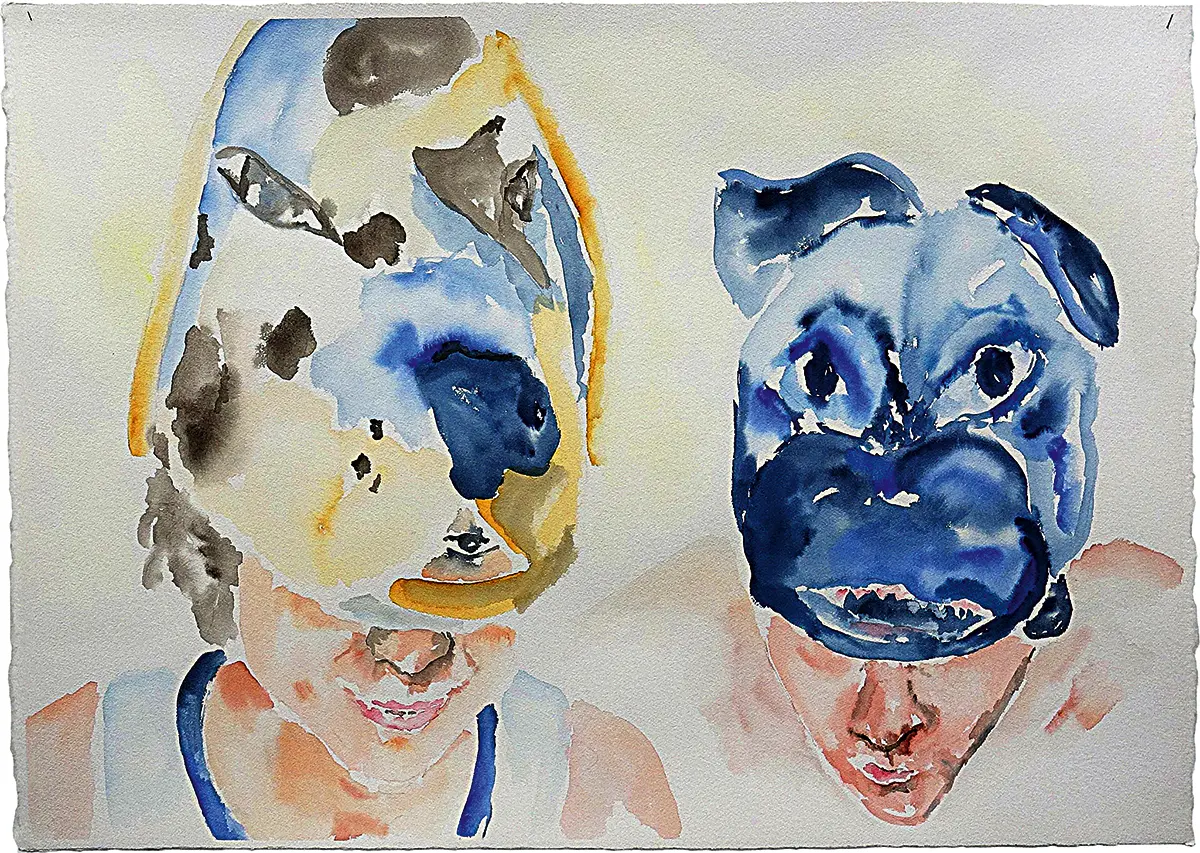
The exhibition also includes Acuarelas (Watercolors), a series painted in 2018 that depicts both Millán’s collaborators and characters created for them in the animations. The artist chose watercolors in this case as the best medium to express gamer culture’s characteristic fluidity and to establish a counterpoint between hand-made and digital productions. It also connects with the sketches and storyboards used in the development of the animations.
CARLOS JIMÉNEZ