Any viewer of the videos documenting the production process of Alberto Cavalieri’s sculptures will perceive the connection between different disciplines and their specific areas of knowledge: computer science (specifically, programming); design; engineering (with its metallurgical knowledge); calculus; architecture; and, of course, the knowledge of abstract-geometric aesthetics. Their articulation speaks of the complexity entailed by Cavalieri’s work.
All of this is on display in an exhibition like Pipe-Lines, featuring more than a dozen stainless-steel works in different dimensions, made between 2014 and 2016. Along with these artworks, the exhibition presents interesting documents about their planning and preparation, designs, drawings, and even small samples, molds, and sketches of parts of the sculptures. And when we are able to visualize the process in its entirety, be it by focusing separately on its various segments, be it by apprehending them in a continuous perspective, we can see the gap between contemporary sculpture practices and their modern counterparts less than four decades ago, as the production processes of a good portion of contemporary sculpture are also those used in the construction of ships, cars, trains, buildings, and all manner of industrial machinery. Sculpture’s dizzying journey—of which Cavalieri’s work gives clear testimony—can be incomprehensible if one is not aware of its background.
For example, the fact that in1889, the Paris International Exposition had as its distinctive icon the Eiffel Tower itself, which welcomed visitors at the entrance to the fairgrounds. It was also the icon of a new era in modern construction methods, which had never before achieved the harmonious large-scale fusion of industrial design, engineering, and applied art. From that point on, a large window of options was at hand for artistic ideas with broader horizons to steadily filter through, illuminating the advent of the Modern project.
But it was only with the arrival of the Russian avant-garde, and specifically with Constructivism, in the second decade of the Nineteenth Century, that the relationship between industrial design, engineering, art, and architecture developed to its full potential. The project for Tatlin’s Tower, which was in the end never built, embodies the formal and conceptual innovations that Constructivism brought to Modern sculpture. For example, the use of plated metal, wood, Plexiglas, and other materials in the creation of mathematically designed geometric structures that established a Spatio-temporal communication between the work of art and the real world, where the geometric-sculptural component is presented under an industrial-looking surface.
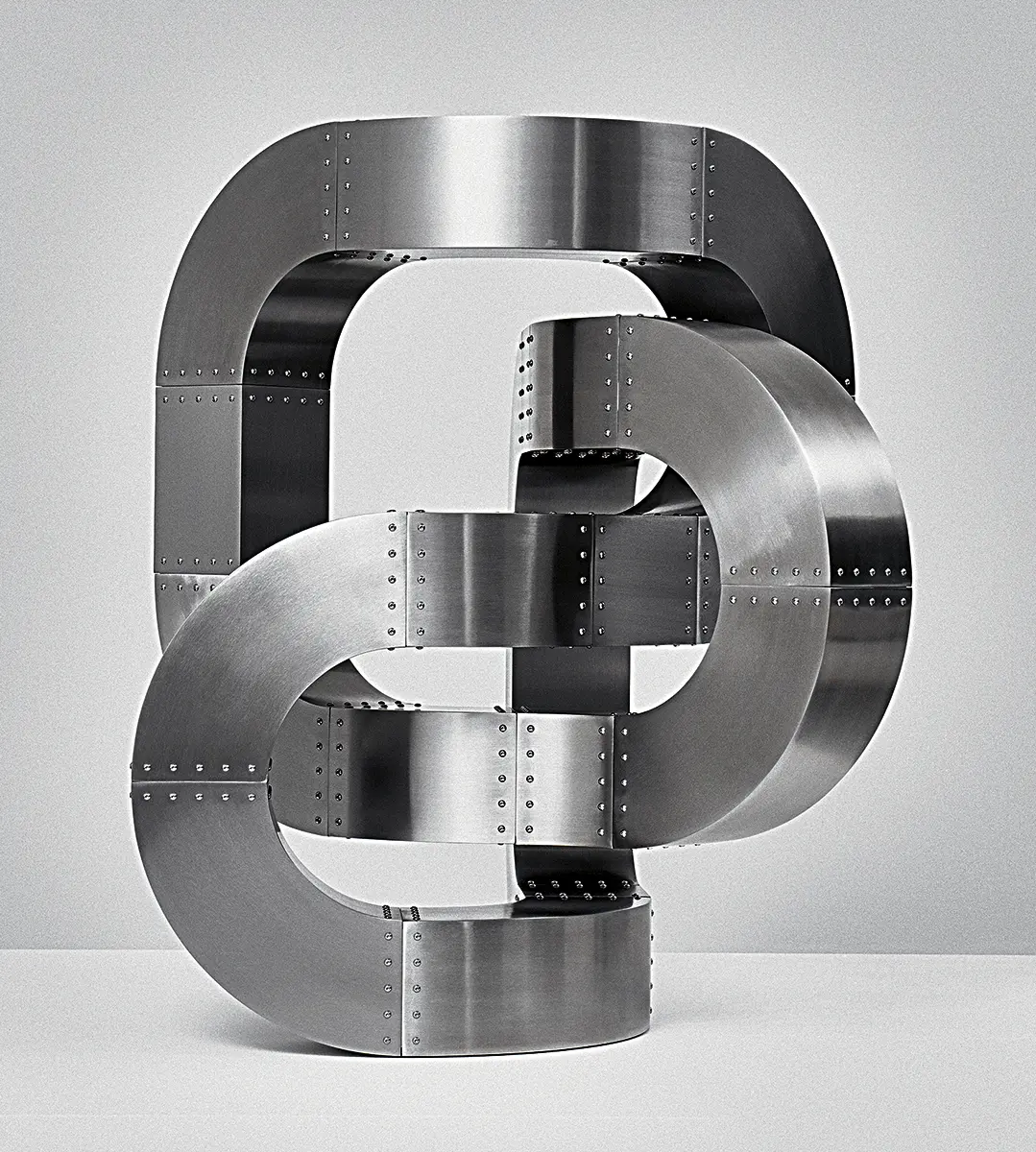
The same industrial-looking surface, to return to the Pipe-Lines exhibition, that can be found in all of Alberto Cavalieri’s sculptures, above all in the way in which the different parts are joined, with the rivets that stitch them together clearly in view. The shining, painstakingly polished surfaces of sculptures with zigzagging structures that continuously emit, as though in physical motion, images alluding to the objects, and also to inorganic things. This is particularly noticeable in Cavalieri’s 2014 series titled Pipe-Line, where the sculpture is objectivized on the basis of an object that first inscribes (cuts out) a background space and then contracts or expands in different directions against it. Here, as in all the works featured in this exhibition, lines (and curves) become a key expressive capital for Cavalieri’s abstract-geometric poetics. Lines that zigzag, whose linearity is impacted so that they cease to be straight and register as curves, establishing a visual grid that creates illusions of weightlessness in the viewer’s perception; but it is a strange sensation of weightlessness, set in contrast to the perception of metal as a weighty material.
Alberto Cavalieri’s Pipe-line exhibition presents us with the work of a multidisciplinary visual artist in strict command of his material, thanks to the number of crafts and fields of knowledge of which he is in control. This makes it possible for him to organize or undo structures and shapes as expressions of an abstract-geometric that pursues experimentation, unmaking the viewer’s retinal-sensibility perceptions in order to demand a conceptual, reflective approach.
DENNYS MATOS