
On April 6, 1986, terrible femicide profoundly shook Costa Rican society. An adult woman and six girls who had participated in a religious ceremony, at the sacred site known as La Cruz de Alajuelita in San José province, were brutally raped and murdered by unidentified men. Death found the victims as they were making their way back home during a day meant for celebration and cult. The crime remains unsolved to this day because of several procedural mistakes during the investigation and judicial instruction during the criminal process. The impunity of these crimes remains a trauma deeply ingrained in the collective memory of a Central American nation whose people observe with shame the ongoing wave of violence that connects the past with the present. Helpless, despite their faith, the lives truncated during the mountain descent on that fatidic day reopen a wound in Costa Rican society with each gender-based act of violence that appears in the headlines of print and broadcast media.
These murders triggered the installation Tres cruces (Three Crosses), a sort of scenography of violence that immerses us in traumatic mourning environments through poetic images that avoid morbidity, scatology, and the pornographic nature of forensic science at all costs. Archival research did not result in decontextualized documents, as is usually the case in museum policies pertaining to memory. Cuban-born artist based in Costa Rica, Aimée Joaristi, has preferred a reflection connected to the languages of her earlier work, where abstraction and landscape guide viewers through the geography of the event.
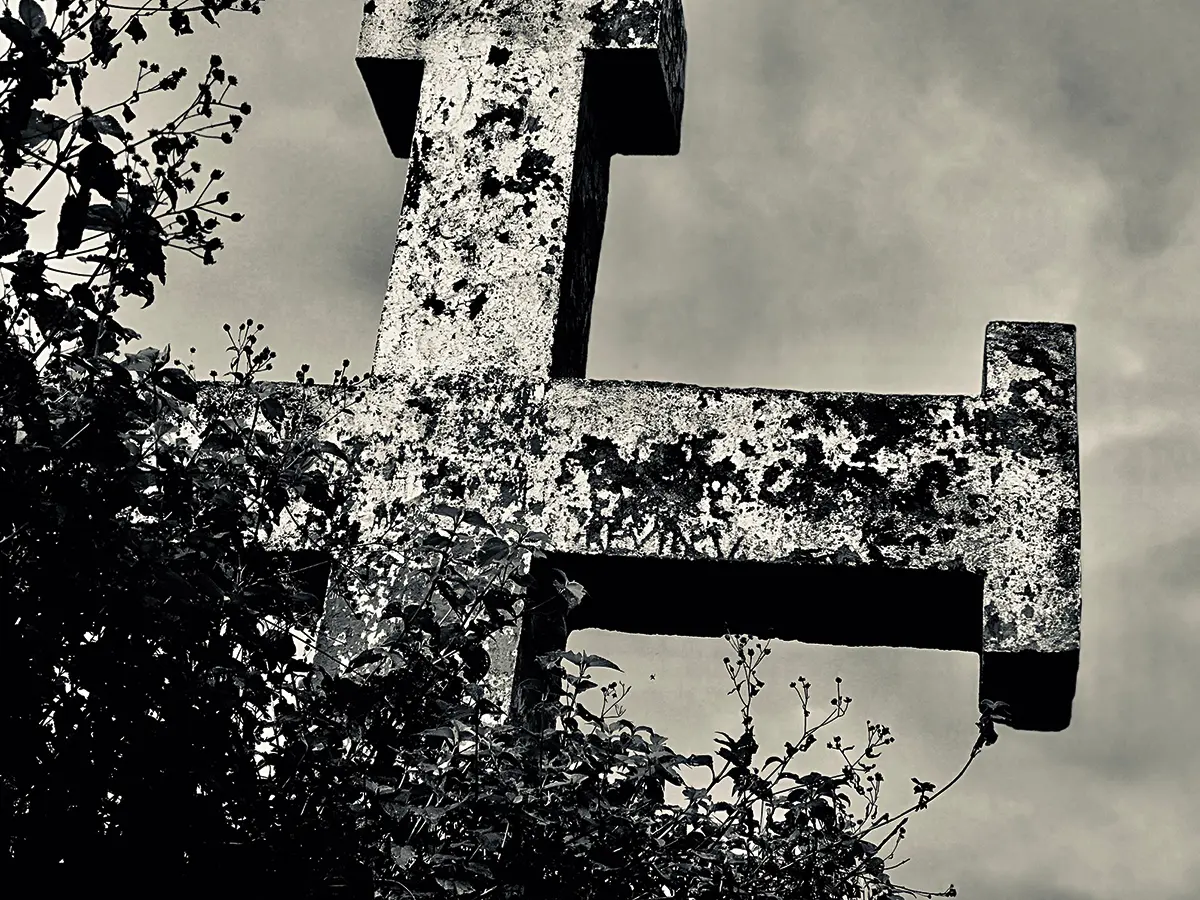
“[…] I am intimately familiar with the location where the murders took place—the San Miguel de Escazú Mountains—because it is where I live and where I begin my daily routine with an early walk. With no specific objective in mind other than to search for images for this piece, I eagerly explored the area equipped with a camera, a cane, and water. I climbed without minding the effort. My only preoccupation was finding the meaning that I should give this work and the best way to “appropriate” a tragic event that belonged to other people’s pain, in order to translate that experience through the language of art…”
Tres cruces are structured in three scenes or passages in which tragedy finds a place for evocation. The public turned into witnesses, is invoked to participate, to enter the fully immersive environment created by Joaristi through the hybridization of several visual mediums and technologies. Photography and painting are the basis for an installation that deconstructs the theatre of the absurd of a reality projected on the canvas and the screen as an intersection of affections, a conflict zone between the presence and absence of bodies. In the first exhibition room, the lateral walls that surround the public are large abstract canvases that resemble fragments of a map. It becomes a presentation abstracted from the territory, the mental reconfiguration of geography where life inhabits a fleeting moment lacerated by geopolitics. Seven mirrors in the background-position us in the victims’ place. The remarkable image breaks the perspective, as the distance of the gaze is interrupted by the macabre substitution.
Conversely, the second station of this emotional walk limits visitors’ participation to the role of spectators; those who from the comfort and safety of a room—turned into an observatory—contemplate “other people’s pain.” The dynamic drama in this presentation unfolds somewhere else, in a distant place. Nonetheless, the photographs displayed on a small auxiliary table, along with the enveloping projection of a video featuring a lush mountain landscape, convey the intentional search for a beautiful baroque image while avoiding the exploitation of the documentary resource and of the very event addressed. Contrary to the documentary images of photojournalism that bring the event to the forefront, the photographs presented by Joaristi if anything looks to establish a mystic connection with the landscape. As a whole, the tenebrist nature of its chiaroscuro, the low-angle framing, and the selection of photographic motifs, remit to a historicist tradition of representing pain, to the iconography of violence, sacrificial in nature, which inundates the colonial and post-colonial Latin American imaginary.
For the last part of this descent into hell, Joaristi takes us to the last space: an interior in which the display of a double bed reaffirms the male chauvinist sign of this type of violence. Another abstract canvas, rendered with different soils and charcoals extracted from the area in which the crime was committed, covers the mattress like a mantle. Because it is a mass grave, any vestige of life is suffocated in this place for hiding denigrated bodies.
SUSET SÁNCHEZ SÁNCHEZ