The exhibition Now is the Time: Narratives of Southern Alchemy by William Cordova allows us to discover and/or to revisit the work and philosophy of this interdisciplinary artist who, through drawing, painting, sculpture, photography, video, performance, installation and especially by combining all of them, deals with the metaphysics of space and time. Through his work, he invites the viewers to become more sensitive towards the objects and to decipher them based on their own personal experiences.
More than sixty pieces chosen for this project – made between 1995 and 2018 – are displayed in a room in the form of a large installation designed by the artist. The combination of the works and the dialogues established between them offer a fairly complete vision of the themes and strategies that define his practice, not only as a visual artist but also as a cultural manager.
As a student at the Art Institute of Chicago, Cordova showed an interest in writing as well as for marginalized stories from contemporary culture that challenge and transcend the established social order. Each work included in the exhibition synthesizes symbols, artifacts and languages related to the artist’s cosmology which creates politically charged connections towards expressions of popular culture, music, architecture and diasporas of different origins, especially Andean, African and Asian.
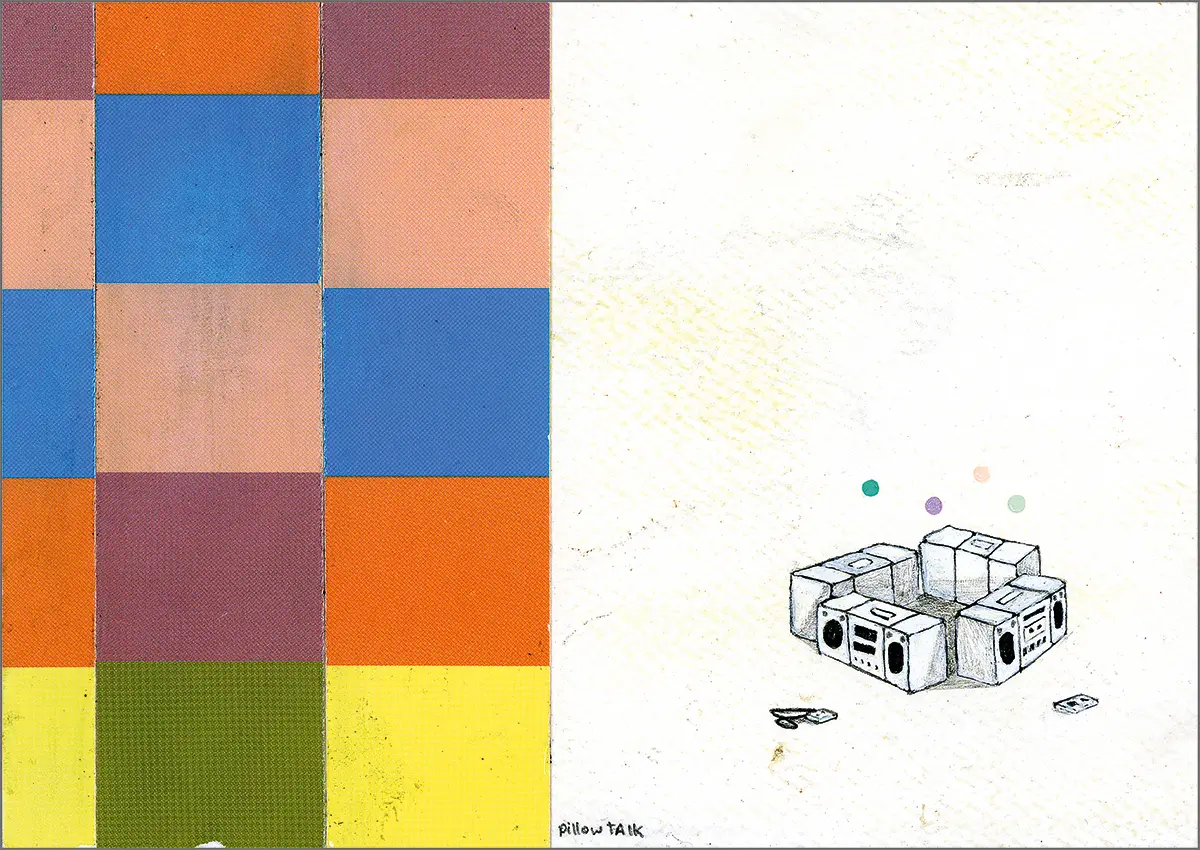
A distinctive trait in his work is the incorporation of ephemeral and precarious materials in the creation of pieces that challenge traditional notions of identity and offer a flexible critical space to meditate on cultural transformations. He constantly uses common recycled and low-cost materials as well words and texts with multiple meanings in the work itself or in the title that defines it. This can be seen in a series of postcards Untitled (1996 and 1997) intervened with ink and correction fluid. Since the early stages of his career, his work has been closely linked to the action of changing and transcending through the process of transformation so that the common object, found or appropriated, plays a fundamental role physically and conceptually in the creation of his aesthetic language.
One of his most recurrent and representative symbols is the speaker. The artist remembers driving with his father through the streets of Miami as a child and seeing broken speakers abandoned on piles of trash. At the time, he thought the speakers were drums or “cajones,” percussion instruments originally used by African slaves in his native Peru. Years later he decided to collect dozens of them and to create a monumental sculpture titled Machu Picchu After Dark (2004) which was part of his master’s thesis at Yale University. The imposing construction, as its name implies, refers to pre-Columbian Inca architecture. Since then, he has recreated new versions of the installation that include scaffolding and overlapping objects that relate not only to monumental architecture but also to collective thinking, to the ways one person perceives another, to the question of how a reality is known or unknown, and how reality is charged with multiple layers, including the spiritual one.
Another piece that at first sight refers to music but actually transcends at a conceptual level due to its multiple meanings is Labyrinths (after Octavio Paz and Gaspar Yanga) (2003-2018). The installation is constructed with two hundred record sleeves without using any type of glue or tape, the same way that Machu Picchu’s buildings were made with huge stones that fit without the need for any type of cement. The album covers have a significant origin. Cordova took them from the library of a North American university knowing he would not return them as an act of protest, after learning that the institution refuses to return to Peru a collection of pre-Columbian objects borrowed in 1914. As indicated in the title of the work, the labyrinth alludes to Octavio Paz’s novel The Labyrinth of Solitude which deals with the essence of the Mexican identity, and to Gaspar Yanga, a run-away slave hero who fought for the survival of slaves of African origin in Mexico. The labyrinth is also a symbol of reflection and transformation, the core of the artist’s philosophy. At the curatorial level, Labyrinths (2003-2018) is located in the center of the exhibition that must be seen, according to the disposition of the works, following a spiral in the shape of a snail.
Other works that stand out include fifteen videos made between 1993 and 2015 – several of them produced in collaboration with Wayne Hodge, Luis Gispert and Monique Walton, among others, and numerous drawings in small and large format, all of which address issues of power, the environment, traditions and popular beliefs, and spirituality.
The exhibition is accompanied by a book with essays by the exhibition’s curator María Elena Ortiz, journalist and music critic Jeff Chang, curator Candice Hopkins, and an interview with artist Leslie Hewitt.
FRANCINE BIRBRAGHER