The intermittent presence of Chilean artists in Colombia appears to resume once again with the exhibition titled “Red Heads. The Artifice of Terror” by Víctor Hugo Bravo (Santiago, Chile, 1966). Probably since the 2016 exhibition of “The Complex” by Claudia del Fierro at the Museo de Arte Contemporáneo in Bogota, there had not been a show by a Chilean artist so closely connected to Colombia on so many levels. The group of objects, photographs, flags, digital prints, and drawings created by Bravo touch on the central issues facing a country unable to end its long civil war, a conflict that has turned weapons into a continuous threat to the lives of Colombians.
The omnipresence of military elements throughout the works presented by Bravo—war tanks, brass knuckles, submarines, camouflaged flags—is precisely what serves as reminder of what we do not want to experience ever again. The project is a reconstruction of “Black City,” an exhibition that Bravo showed also this year at the Museo de la Solidaridad Salvador Allende in Chile, and whose two versions, the black city of Santiago and the red city of Bogota, immediately reminded us of William S. Burroughs’s Cities of the Red Night, the non-linear novel that surveys the stories, real or fictional, of a group of cities located in the Gobi Desert 100,000 years ago, an 18th century anarchical and libertarian pirate community, and a late 20th century crime; all offering scenarios and situations used by the writer as metaphors to describe the climate of paranoia and oppression during the Cold War.
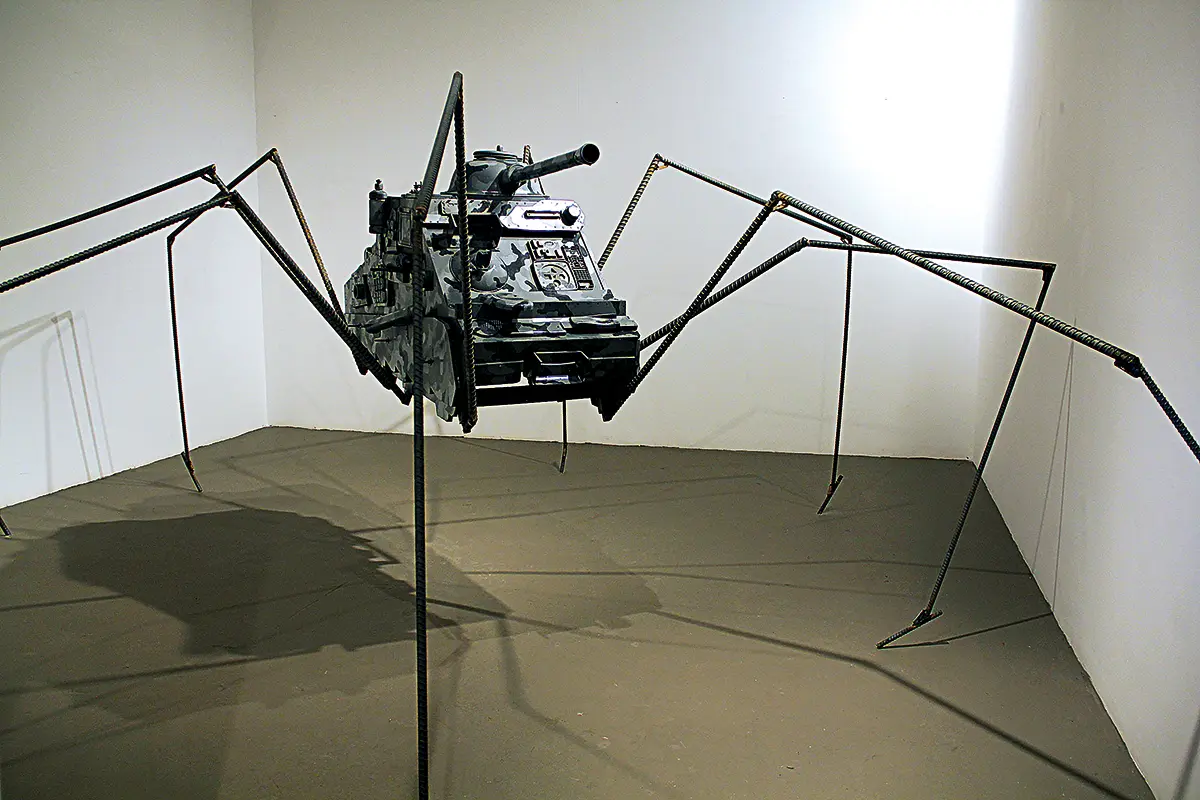
The same environment described in Burroughs’s novel could be perceived in the exhibition by Bravo: the existence of secret organizations that work under codenames; a global control society and its agents, the prevailing weapon race, and an interest in sexuality and death represent, in sum, a poetic analysis of necropolitics. It is perhaps no coincidence that Bravo became interested in acting in Easter European countries like Poland, Germany, and Slovakia, where the shadow of war and the ghost of totalitarianism are still present. Bravo has recently shown several exhibitions there, developing the pieces in situ, like he did in Bogota, and establishing a continuous dialog with the place.
For “Red Heads. The Artifice of Terror,” Bravo decided to bring back to life works shown in the city over a decade ago and also include fragments of works by other artists, in addition to creating, in the short period of one month, large, medium, and small sculptural pieces that covered the vast exhibition rooms of the gallery.
The general installation was a combination of the universe of science fiction, video games, punk and metal iconographies, horror movies, anime, photographs by Joel Witkin and Barbara Kruger, Joseph Beuys, and Viennese Actionism. In sum, it was about the exploration of fluids, secretes, secretions and repressions, death and excesses, scatology, anthropophagy, and the cyborg universe.
The half menacing have festive nature of this exhibition operating somewhere between authoritarian and anarchic realms, messianic and apocalyptic worlds, worked and allowed viewers to reflect on the nature of instability—spiritual, intellectual, social, and political—a state whose essence interests Bravo.
In previous interviews, Bravo has spoken about his early interest in Nietzsche, and the deep sense of tragedy becomes evident in this city of red heads fashioned with plastic objects, garbage, bricks, wood, paint, paper, fabrics, ribbons, and cables. Bravo’s training and trade as a painter could be observed in the layers of paint applied on the mockups of war machines as well as in the drawings on paper in which he synthesizes unknowns and reflections that pertain more to the organic, the body, and inert elements than to the military realm.
I do not think that Bravo intends to be peachy and lecture us about what is right and what is wrong. Indeed, some objects attract us for their sharply menacing nature. But yes, recreating the works included in the exhibition in every city in which he exhibits reveals a need to convey—and communicate with—elemental forces through creative rituals. This ritualistic aspect—which in previous projects was manifested in a more sexual and scatological way, more violently opposed to a conventional moral, in which forensic, medical, and pornographic photographs were combined with sharp metallic elements and organic materials—including harpoons, bones, and plaster molds—has continued throughout the years without losing its power. He did this in Bogota by using matter to invoke spiritual powers; in this case, gods of war, whether it was Ares or his counterpart Ogun—here transformed into Saint George, who Bravo seemed to want to conjure in this intervention. Bravo renovated his magical formulas in order to understand, rationalize, and reject the dark forces of the human spirit. Whether we may choose to regard it as concealed or overt, the fact is that Bravo is completely committed to this struggle.
SANTIAGO RUEDA