“Under Pressure,” the title of the exhibition by Brazilian artist Túlio Pinto (Brasilia, 1974), offers clues into this artist’s approach and practice of sculpture as an extension not only of the body but also of the totality of the phenomenological experience of being in the world. Pinto displays extreme tensions in his sculptural pieces by tying them with cords or simply by employing materials as antithetical as concrete plates, rocks or industrial steel rods, and elements that are synonymous with lightness and fragility—such as glass sheets and sinuous bubbles. The blown glass bubbles—a visual focus because of the levity and translucency that they confer to the pieces exhibited—standout for the way in which all heavy forms sink into them. Far from breaking as result of the pressure, they actually serve as support for the entire sculptural system. This effect represents the honing of a technique already present in earlier works with balloons subjected to the pressure of solid and impenetrable elements.
While the visual and tactile penetrability of the pressure-shaped glass bubbles suggests that they are the most fragile elements, they are actually the ones supporting the weight and elevating the richness of the sculptures by Pinto, who has transformed the lessons taught by the minimalists into an ontological language. Reaching beyond the poetic qualities of each of the elements employed, he sculpts paradoxes that expose existential tension in such a manner that as the sensation of vulnerability increases so does the strength of the works. By imagining spatial situation in which the contrast between the physical properties of different materials and their arrangements lead to boundaries where balance seems impossible—and yet it is maintained—Pinto creates exactly what he imagined: sculptures that successfully contain and irradiate the very beauty of that which defies limits.
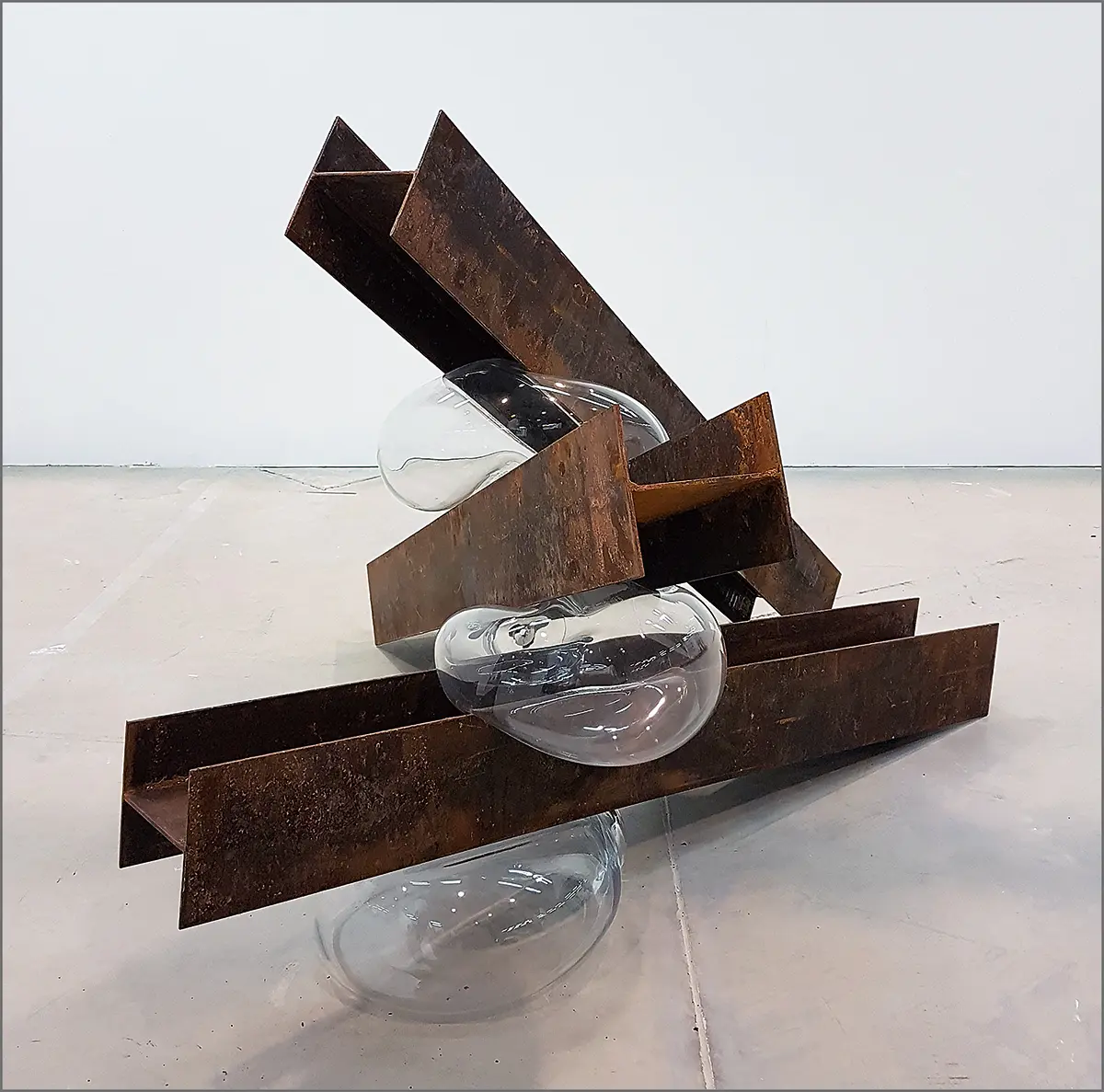
The metaphor par excellence is contained in Cumplicidade #16 (Complicity #16, 2018), the only piece exhibited in “Under Pressure” that does no rest against the wall. Formed by the intercalation of three rusted steel beams and three glass bubbles, the structure stands at the center of the space in such a way—unbelievable to the eye—that its entire weight rests on one of the glass bubbles. The perceived impending threat of collapse that never occurs in the end keeps viewers in a continuous state of amazement. At the same time, the piece is proposed as the essence of a sculptural practice that, in addition to being installative in nature, references the artist’s body of work and his own corporal presence projected on the structure of the entire system of objects that have been placed in impossible situations.
If one had to somehow offer a general definition of Pinto’s oeuvre it would be: installative and performative sculptures that oscillate between these two artistic mediums; where every material, technique, and approach at play expand, project and involve the entirety of Pinto’s being and practice. “I do not disassociate who I am from what I do. Everything is connected. The dialog in my works is directly with my own body,” affirms Túlio Pinto. To imagine his spatial situations he projects his body against the material, places himself in its place and identifies either with the strongest and heaviest components or the most vulnerable ones, depending on each case. In this manner, he activates the changing and intense perceptions contained in his works.
His affinity for the thinking of Maurice Merleau-Ponty pertains to the French philosopher’s way of conceiving space as a “field for all surrounding relationships,” which goes beyond the merely physical and is essential for life. Pinto’s work occurs within the flow of accumulated empirical learning from personal experiences and conveys Merleau-Ponty’s notion of perception: “If we connect the paradox of time to the paradoxes of the body, the world, objects, and otherness, then we then understand that there is nothing else to comprehend beyond that.”
There is a visceral poetry in situations like the one proposed in Prenúncio (Presage, 2017). It offers a risky balancing equation consisting of a stone tied to a cord that, like a Damocles sword, hangs over a crystal ball. The crystal ball in turn is not only tied to the same cord as well but it also appears to be split in two as result of pressure exerted by the section of the cord that transverses it. While the materials are subjected to extreme pressures, such pressures also maximize their greatest potentials, their ability to cast shadows, lights and parables, as well as the possibility of physical and psychic combinations. They are bodies that have been penetrated, collapsed, stretched, and tensed to their limits, but they actually never reach their breaking points.
Other pieces in the exhibition explore situations involving vectors against the wall or transfers of the notion of the pebble—one of the many clasts of rock polished by the environment—into blown glass. Túlio Pinto stopped studying drawing and began learning about sculpture after discovering the work by Richard Long involving the transportation of rocks during walks. This image took Pinto back to his own childhood, when he would collect rocks during his travels and leave them somewhere else, in a sort of secret operation that altered small worlds. In his installation created in Porto Alegre titled Transposition, he first formed an impossible cube with six thousand bricks and then transformed it into a new floor in the gallery. Both works involved a practice of intense corporal movement. The transposition was not only from one form to another using the same materials: it was actually the transposition of his body into sculptures and installations that elevated a poetry of collapse, as he time after time maintained the balance while dancing over a tightrope.
ADRIANA HERRERA TÉLLEZ