NG Art Gallery presented what was perhaps the most important solo exhibition of works by Servando Cabrera (Havana 1923-1981) outside Cuba in a long time. The exhibition featured more than thirty works, the result of an agreement between the two main collections holding Cabrera’s oeuvre: the Los Carbonell Foundation (LC, in Panama City) and the Museo Biblioteca Servando Cabrera Moreno (MBSCM, Havana)1. Sin embargo es la vida… (However, It Is Life…), the title both of the exhibition and of the last series Cabrera worked on before his death, proposed an anthology review of the Cuban artist’s production, covering the most significant moments of his vast and complex career.
Intending to introduce Cabrera’s academic beginnings (he graduated from the San Alejandro Fine Arts Academy in 1942)2, the exhibition established a connection between a number of works from the artist’s formative period and elements of the everyday context of his life. Furniture and various objects were used to recreate an environment similar to his residence, while at the same commenting on Cabrera’s penchant for collecting decorative art. Visitors thus encountered early works like Motivo de Ballet (Ballet Motif, 1943, LC Foundation) or a discreet sanguine from 1940 (MBSCM collection), brought together for this small “homage-space.”
By the mid 1940s, Cabrera had expanded his horizons beyond the country’s borders. After several European sojourns, he began a period of dialog with abstract art and cubism, leaving behind the tremendous weight of his academic training. Then we discover an artist who, while fully given to experimentation with those styles, never sets the human figure entirely aside. Origen (Origin, 1956, LC Foundation) and Familia (Family, 1957, MBSCM collection) exemplify the idea in a stark way. Sin embargo es la vida… reinforces these notions, leaning on an archive of great historical value that included photographs, catalogs, and posters from the period.
Later, with the deep social transformations undergone by Cuban society in 1959, all perspectives were redirected towards a common vortex: the Revolution. The fledgling social project became practically the only subject to be represented, and Cabrera, a man of his times, went all in into this current. From that period we have Sin título (Macheteros), (Untitled [Macheteros], 1964, MBSCM collection), a modest example of what would be the interminable series of his epic period, later given continuity in the Habaneras and Guajiros of the 1970s. Of the latter, on display in the gallery were works like Rayando el Sol (The Sun Rises, 1979, MBSCM collection), María Castaña (1975, LC Foundation), and Así somos (This Is How We Are, 1981, MBSCM collection), from the series that gave the exhibition its overall title.
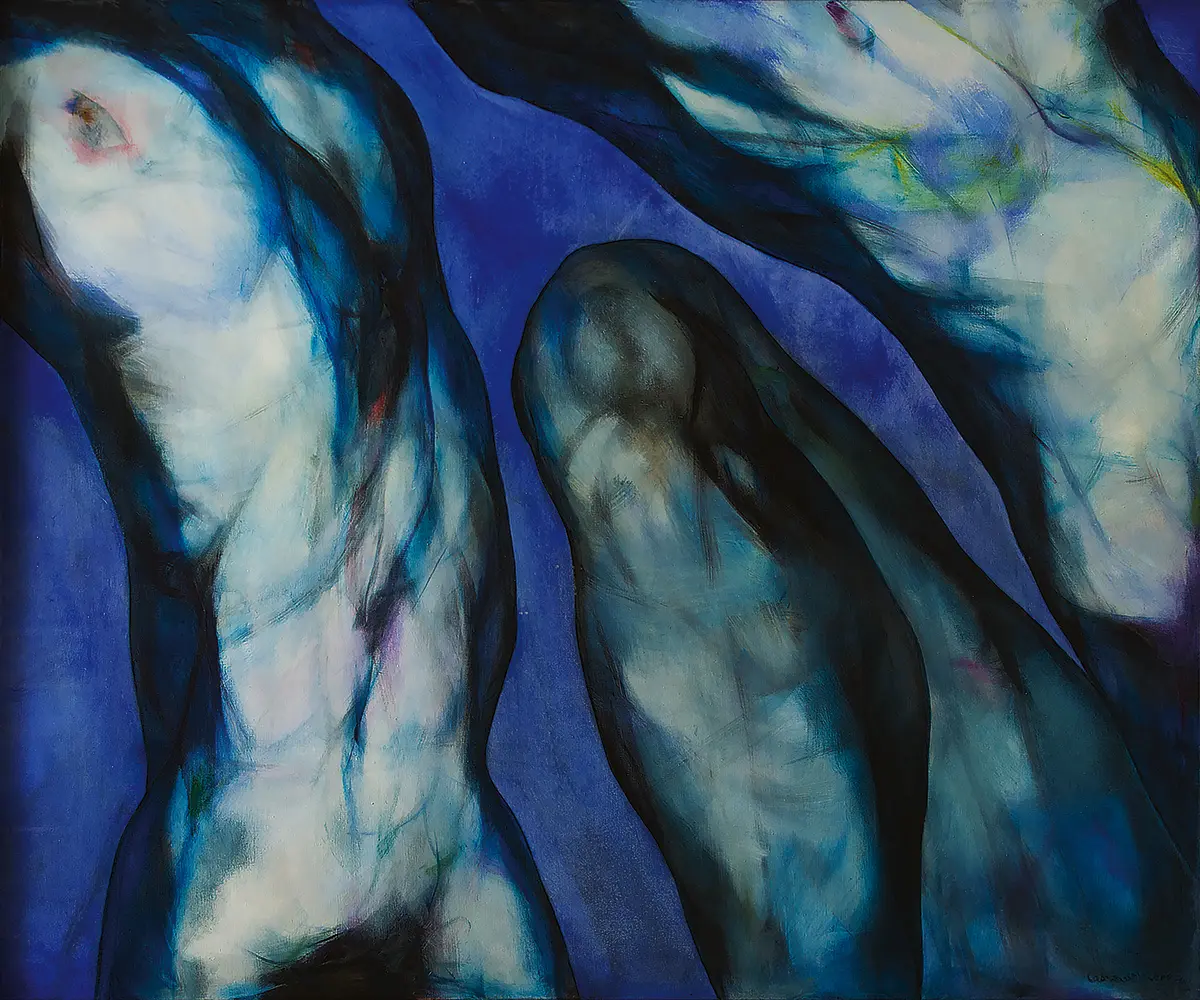
The second half of the 1960s was perhaps the period of greatest existential conflict for Cabrera. As the early years of the Revolution, when his artistic practice accompanied the spirit of construction of a new society, passed, Cabrera’s art took an aesthetic turn that was increasingly dictated by his own condition. In that way arrived an important period in his oeuvre, influenced by Expressionism. It was the moment of the struggle for women’s rights, for the rights of black people, for the rights of the poor; however, in the attempt to make the figure of the Bourgeois subject disappear, the very notion of a subject was diluted under unifying criteria. Representing this period in the exhibition were works like Beso 5 (Kiss 5, 1966, LC Foundation) and Columna humana 7 (Human Column 7, 1966, MBSCM collection), where the figure dissolves in a single matter. By means of violent mixes of color, the bodies begin to lose their individuality, becoming amalgams that would over time see their erotic aspect increase.
Two personal events marked this period for Cabrera: his forced separation from the Cubanacán Visual Arts School (1967) and a heart attack (1967). Both have been understood as consequences of the hardening of policies of repression of sexual diversity. This drove Cabrera to reconsider his work, as he confessed in an interview with Gerardo Mosquera: “My paintings of that period were very violent: genitals appeared with great satisfaction at being connected to the soil, like fruits or flowers are. They didn’t have to hide.”
By then, Cabrera had found a crucial balance between the two lines of work he had been developing in parallel, and which coexist in his oeuvre despite being, in essence, opposites: the tendentious representations of his Habaneras and Guajiros, and his (homo)erotic works, evolving back then in the privacy of his studio. It is not by chance that a sharp dividing line is established in this exhibition, as visitors move to a second, much more private room in the upper floor, where the beauty and the violence of this period are on display. Alongside works like Amistad (Friendship, 1975, MBSCM collection) and Pepe el romano (Pepe the Roman, 1979, MBSCM collection), the exhibition closes with La hora azul (The Blue Hour, 1979, LC Foundation), a masterly canvas that reconciles Cabrera’s pictorial genius with his universe of spiritual joy.
Beyond signaling the first steps in what was to become a grand collaboration between the most important powers around Servando Cabrera’s oeuvre, Sin embargo es la vida… was an act of cosmic justice. An initial contribution that soon resulted in a second show at the Centro Hispanoamericano de Cultura in Havana3 and in the making of a documentary about the artist’s life.
As a title, meanwhile, Sin embargo es la vida… defines to a degree Cabrera’s own position towards life, his philosophical posture in the face of a world that never ceased to be nuanced and from which, despite all adversities, he was always able to extract the essence needed for his art.
NOTES
1. Referred to in this article as MBSCM collection y LC Foundation.
2. Servando Cabrera was seen by some of his teachers as the messiah of academic painting in a Cuba more and more immersed in avant-garde tendencies.
3. In May of the same year, now including works on loan from Cuba’s Museo Nacional de Bellas Artes.
LOLIETT M. DELACHAUX