The latest solo show by Mexican artist Saúl Kaminer (Mexico, 1952) consists of sixty-four works including paintings (large, medium, and small), sculptures (rendered with white and black marble from the Puebla region), and drawings. It is a retrospective that covers the last five years of a continuously evolving work that reveals an inquisitive spirit and where reflection favors formal correspondences between drawing, painting, and sculpture. Located in the old Palace of the Counts of Santiago de Calimaya, 1 one of the crowning achievements of Mexican baroque architecture—the extremely high ceilings of the two rectangular exhibition spaces of this 18th century building demanded a creative and effective museography—to ensure that Kaminer’s large (six meters high) canvases did not take all the attention away from the sculptures with which they had to enter into a conceptual and aesthetical conversation. The intelligent proposal by the museographer allows for a swinging gaze and reinforces the aesthetic complicity that Kaminer—painter and sculptor at the same time—wanted to establish so visitors could discover a coherent work inscribed in the legacy of “total art.”2 Indeed, the proposal by Saúl Kaminer, who is also an architect by training, is characterized by a reliance on several techniques conceived and developed at the same time that painting and sculpture—the most relevant mediums when it comes to his relationship with himself and the world—were established in his work.
During the years in which his mental, intellectual, and cultural universe was profoundly immersed in Mexican and Latin American cultural issues—in the 1980s-1990s, in Paris, Kaminer became part of the group Magie-Image (Magic-Image) alongside other Latin American artists—his work proposed a narrative identity whose imaginary (and iconographic) universe resembles the one created and consecrated in France during the 1960s by the Latin American Boom Writers. Back then, the figures in his paintings narrated personal myths and stories through highly complex compositions in which lines and forms intersected and interacted in plays of lights and shadows, reflections and mirrors, duplicates, carvings, cut outs or fragmentations, never forgetting to underscore the importance of movement—which traversed and breathed life into a particular type of vibration.
For several years now, Kaminer’s work has been evolving away from the figurative narrative in order to become more minimal, preserving only the structural skeleton or lattice of lines and forms of a space formerly dominated by figurative images. This abstract syntax, back then underlying the images, today determines the inquiries on form by this artist and dominates through the use of color (which here is central) the organization of the pictorial space. The exhibition at the Museo de la Ciudad de México, consisting of a selection of works, is the result of such evolution and underscores Kaminer’s ability to oscillate between the intimate realm (medium size sculptures and drawings) to the monumental proposals of the two very large paintings that mark the begin and the end of the walk through the exhibition.
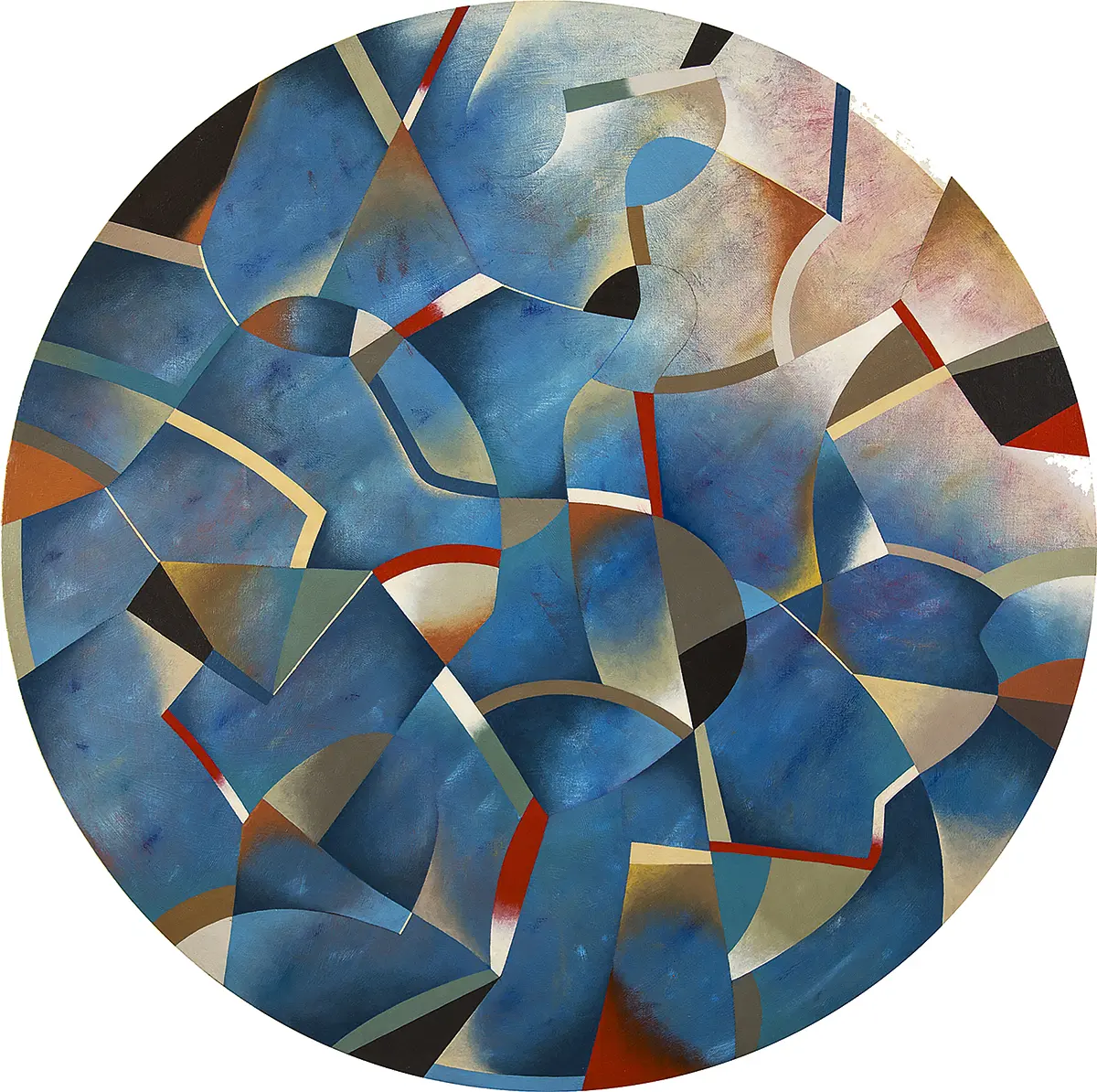
In the first exhibition area visitors are immediately stunned by the monumental nature of the piece titled Ein sof. Their gaze is somehow drawn to it by the visual “axis” formed by a succession of black sculptures created with several materials (high-temperature ceramics, marble, and steel) and installed on bases of different heights. This undulating materialized “line,” is like a 3D projection of the geometric lines and “volumes” in the painting—where warm tones of reds, ochres, and yellows dominate—that occupies the entire back wall. While undulating forms have been present in his canvases and sculptures for a long time, now Kaminer also uses it on an ancient circular format: the tondo. More geometrical in the cold palette of Las voces del cielo (The Voices in the Sky) and more sinuous and shiny in La sombra del fuego (The Shadow of Fire), the pictorial surface is covered by spots of light, a contrast that sometimes accentuates the relief effect in the formal space of the tondo. Further ahead, to the right, a series of four small drawings and two paintings introduce a new dimension of Kaminer’s special concept. Like the important role that color plays in the compositions, these works underscore the central role of drawing in his work. The translucency resembling an undulating ringlet on the space—in the sculpture titled De Este a Oeste (From East to West)—allows viewers to observe the drawings to which it is virtually superimposed and perfectly merges the two techniques. This simultaneous perception allowed by the museography confirms that Kaminer’s pictorial inquiries have always approached the double reflection on the plane (paper and canvas) and the volumetry (sculpture, installation), as if it were a continuous challenge that confronted emptiness with the supposedly real.
The last painting created for this exhibition, titled Asideros en el vacío (Handholds in the Void), turns Kaminer’s vision around across two spaces vertically treated, where dispersed forms appear to be floating over the color, barely united by fragments of lines and some disseminated light touches. More a poetic constellation than a constructive one, the piece invites the gaze to an immersive and dreamlike experience, in the center of a pictorial universe in which the senses, emotions, and reflection, are undistinguishable from one another in a profound work brimming with life.
NOTES
1. The building currently houses the studio of one of the pioneers of Mexican landscape, Joaquín Clausell (1866–1935).
2. In recent years Saúl Kaminer has produced several installations and performances. The concept of Gesamtkunstwerk (total work of art), an all-embracing art form involving the combination of different media and artistic disciplines, was advocated by the Romantics of the 19th century. Later on, during the 1950s, the concept was put into practice by the Black Mountain College artists, in the US.
CHRISTINE FRÉROT