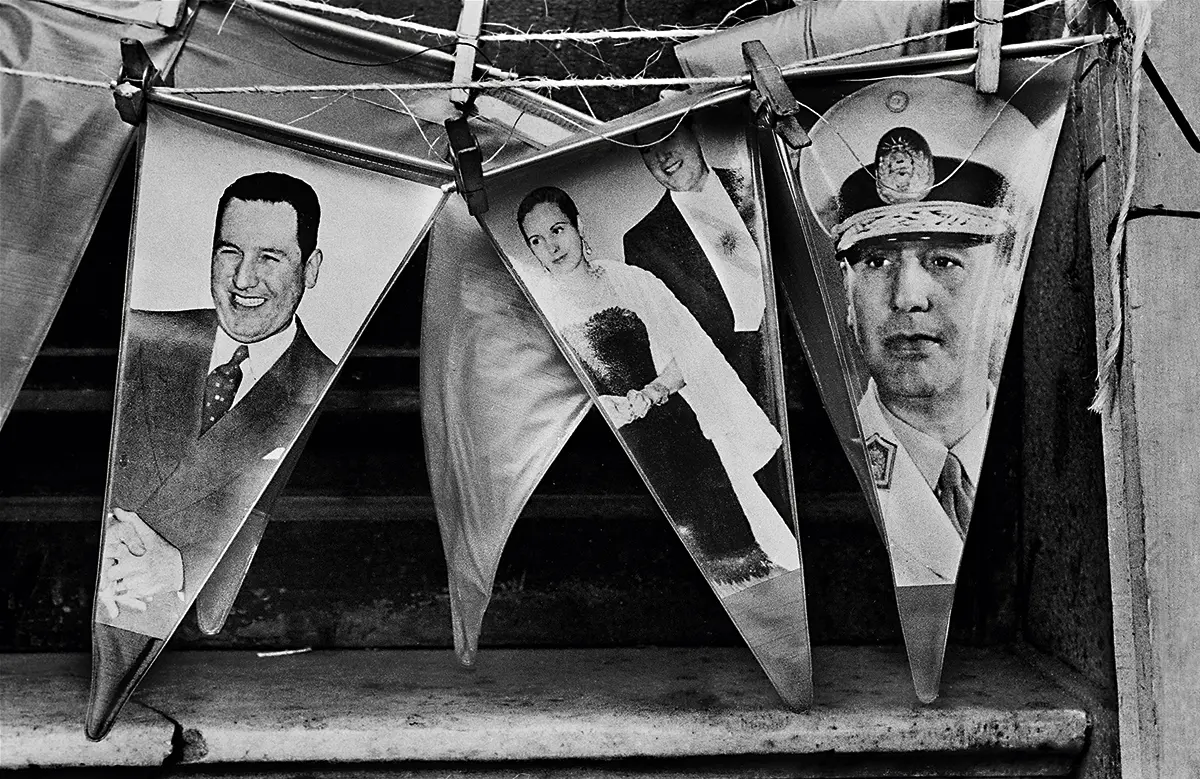
The exhibition Sara Facio. Perón was organized at Malba–Museo de Arte Latinoamericano in the years of the 44th anniversary of the death of Juan Domingo Perón (Argentina, 1895-1974), army general, three times President and founder of peronismo, to this day a popular political movement in his country. It features 115 powerful photographs from 1972 and 1974, particularly memorable among them those taken at Perón’s funerals, like Los muchachos peronistas (The Peronista Youths), where four youngsters looking straight at the camera represent the grief of millions of Argentineans.
The selection of photographs on exhibit reflects historical events in the trajectory of peronismo and the country, as well as the emotions of mostly anonymous protagonists. The show’s curator, photographer Ataúlfo Pérez Aznar, found the photos now featured in Sara Facio. Perón—41 36-exposure rolls, for a total of nearly 1,500 images, many of them have never published before—as he dug through thousands of images in Facio’s studio in preparation for the anthology book Sara Facio (Larrivière, 2012).
Sara Facio (Buenos Aires, 1932) devoted her life to photography from a variety of standpoints: artist, editor, collector and curator. Her images are part of the memory of her times, of Argentina; also, it was thanks to her efforts that photography became more widespread and organized in the country. Facio began in 1957 as an assistant to Annemarie Heinrich, whom she considered her teacher. A keen-eyed portrait photographer, she created emblematic images of many Latin American writers: Bioy Casares, Borges, García Márquez, Neruda, the Ocampo sisters, Onetti, Pizarnik, Vargas Llosa. Facio was able to photograph Juan Rulfo thanks to the critic and writer Marta Traba (also the subject of one of her portraits), who distracted the great Mexican novelist with her conversation and sustained his attention. Facio was the founder of the San Martín Theater Photogallery in 1983 and of the La Azotea photography publishers (with her Guatemalan colleague Cristina Orive); in 1995, Jorge Glusberg charged her with establishing the Museo Nacional de Bellas Artes’ photography collection, to which she donated almost two hundred works by notable artists (as well as her own), and for which she secured contributions from many colleagues.
Art and testimony coalesce in the black-and-white photo stories that Facio produced in the 1970s in collaboration with Alicia D’Amico, when they both worked for the French news agency SIPA, and which capture impressions of those days in a spirit that is far from sensationalistic. The Sara Facio. Perón exhibition is a dramatic synthesis of the two contradictory years it makes reference to, filled with enthusiasms and tragedies. Facio does not sacrifice quality to the urgency of events; in that way, her photographs are able to communicate the joy of Perón’s first return to the country after his exile in Madrid (1972), and describe the fear and desperation of the day of the general’s second return, June 20, 1973, when many left-wing peronistas and montoneros who came to greet him at the Ezeiza airport in Buenos Aires were massacred (the exact number of victims remains unknown).
These eloquent, honest images capture the artist’s subjective gaze and her shock at the events of history. They summarize a shaken society and the feelings of people photographed in the streets. Other works reflect the exultation of Cámpora’s ascent to the presidency and the impotence felt as he was forced to resign (by none other than Perón). The obscure Raúl Lastiri succeeded Cámpora and there was a euphoric moment during Perón’s own presidential campaign, with a bumbling Isabel Perón joining his ticket. Facio’s gaze captures the public’s swaying emotions: longing and mistrust, conviction and disappointment. Once again the streets and the distress caused by Perón when he had his militants and montoneros expelled from Plaza de Mayo. With her portraits and vistas, Facio tells the story of the tense climate in which the right-wing band Triple AAA started its assassination campaign. Finally, the grief of the peronista masses at Perón’s death, summarized by a man who, seated on a street curb, reads a newspaper with the simple headline: HE’S DEAD.
Despite being at the antipodes of peronismo, it was Facio who consistently and respectfully captured the greatest amount of images connected to the movement. “Sara (…) was able to produce a narrative of great photographic coherence, based on strong close-ups and well contextualized photographs. (…) Her view of the events interprets a historical moment we now bring to the public for their consideration (…) This material is key in the history of photography, but above all it is part of our country’s collective memory,” said Pérez Aznar to writer María Moreno, in the publication that accompanies the show.
At 85, Facio has lived long enough to have met the still current Eva Perón, inescapable in peronista iconography, in political rallies between 1972 and 1974, and in Facio’s photographs. These days, after an accident in which both her hands were broken, Sara Facio is not taking photographs. She is busy organizing the Foundation and Award (for short stories) named after María Elena Walsh, the writer and singer-songwriter who was her partner in art and in life.
VICTORIA VERLICHAK