The Arizona State University Art Museum presented the group exhibition Saber Acomodar: Art and Workshops of Jalisco 1915–Now, with a clear idea and a precise objective: to highlight the impact of the tradition or artisanal industries and crafts from the Mexican state of Jalisco, where the city of Guadalajara has become an influential scene beyond its local context. The idea behind Saber Acomodar, notes curator Patrick Charpenel, recently named Executive Director of New York City’s El Museo del Barrio, refers to the technical skill associated to the arts, a concept that the ancient Greeks knew as téchnē. In this way, the exhibition proposes a look at the collaborative work between artists and craftspeople, underscoring an interest in the practice of certain crafts and the unique marriage of avant-garde and tradition, challenging the dominance of conceptual currents in contemporary art. The exhibition had a first run at the Museum of Contemporary Art Denver before traveling to Tempe, in the Phoenix metropolitan area.
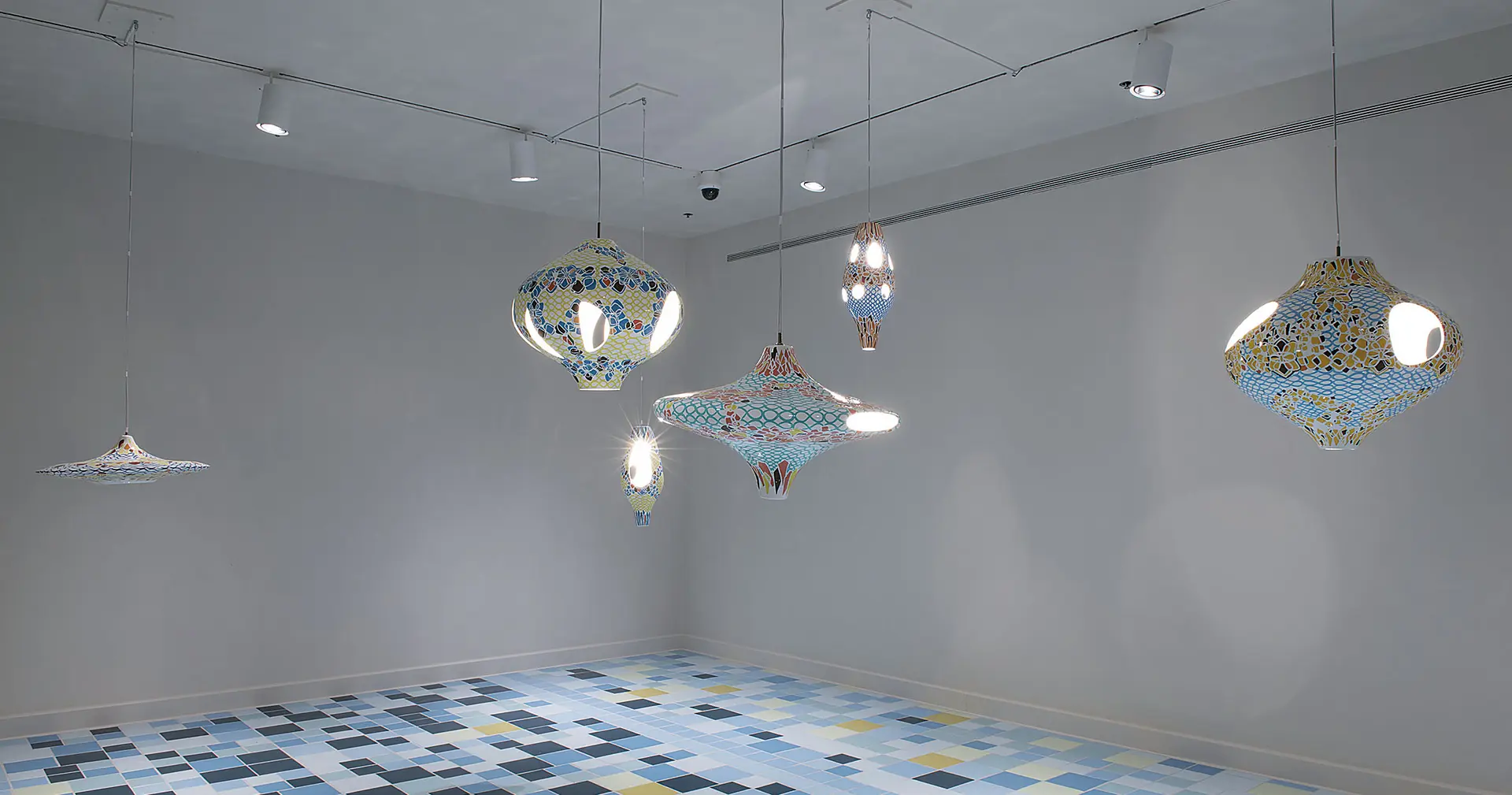
The exhibition museographic arrangement does not follow chronological criteria, but is divided into subjects connected to aspects of the artistic process such as Workshops, Materials, Techniques, and Time; adding to these are Cultural Roots, focused on the geographic context of production, and a special section devoted to Jorge Prado as the sui generis case of an artist who moved to Mexico with the goal of maintaining a working relationship with the Cerámica Suro workshops. Some of these groupings are especially effective, triggering in their visitors an always-helpful sense of intrigue that is not evident at first sight. For example, a discreet bust titled Retrato de Carl Lumholtz (Portrait of Carl Lumholtz, 1908), by Timoteo Panduro, anchored on the European-rooted tradition of academic realism in clay modeling, is placed next to Jorge Prado’s large format installation, an outsize tile floor and a series of lamps hanging from the ceiling, both exquisite in their design and execution. They contrast in their scale, and also in their manufacture and function. The rudimentary primitivism that is often attributed to folk arts does not apply in this case.
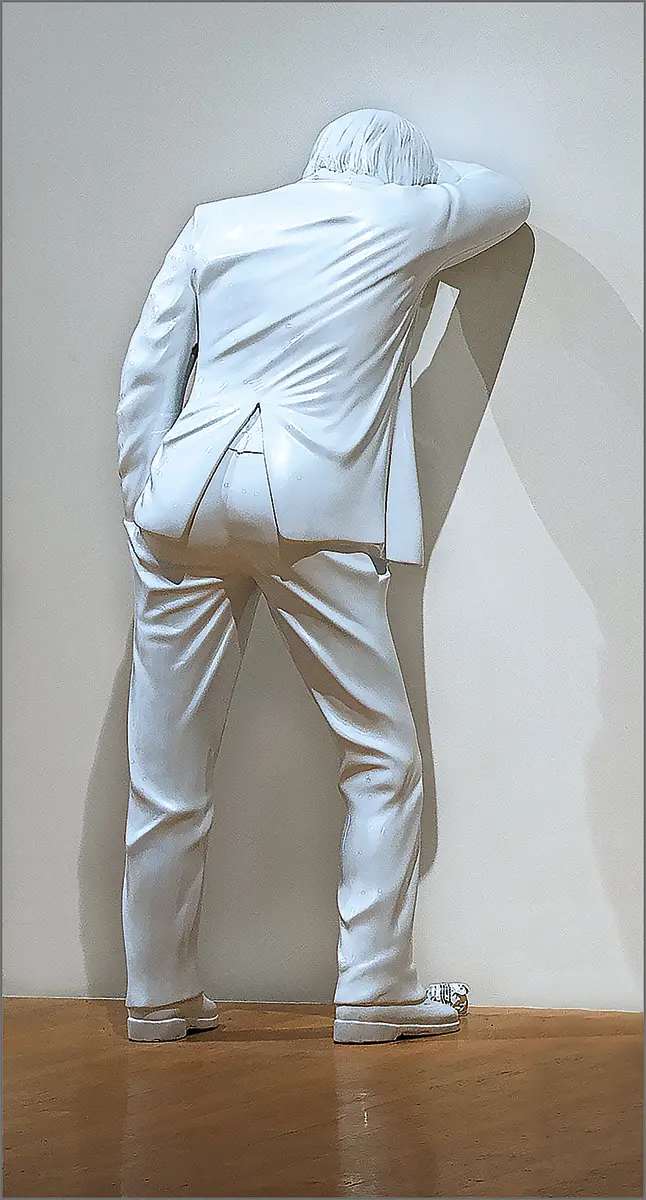
Although Saber Acomodar focuses on contemporary artists and workshops, it also features some important predecessors. From the Panduro family, representative of the Guadalajara tradition of clay modeling, the exhibition features a series of portraits (busts and full figures) created over more than six decades by founder Pantaleón Panduro, as well as by Timoteo and Rubén Panduro. Dated between 1890 and 1950, these works display significant stylistic continuity regardless of the subject, be it a hacienda owner, a society lady, or none other than Porfirio Díaz (ca. 1910). Alongside the clay items modeled in the academic manner we find non-traditional materials like fiberglass. Classical in its sculptural proposal and it positive resolution of volume, Gonzalo Lebrija’s El gran lamento (The Great Lament) is the figure of a man with his head buried in his arm, which leans against a wall. The ambiguity of the hidden face adds rich possibilities or meaning. Most striking of all is the clash between the naturalness of the pose and the artificiality of the fiberglass finish: a completely white polished surface.
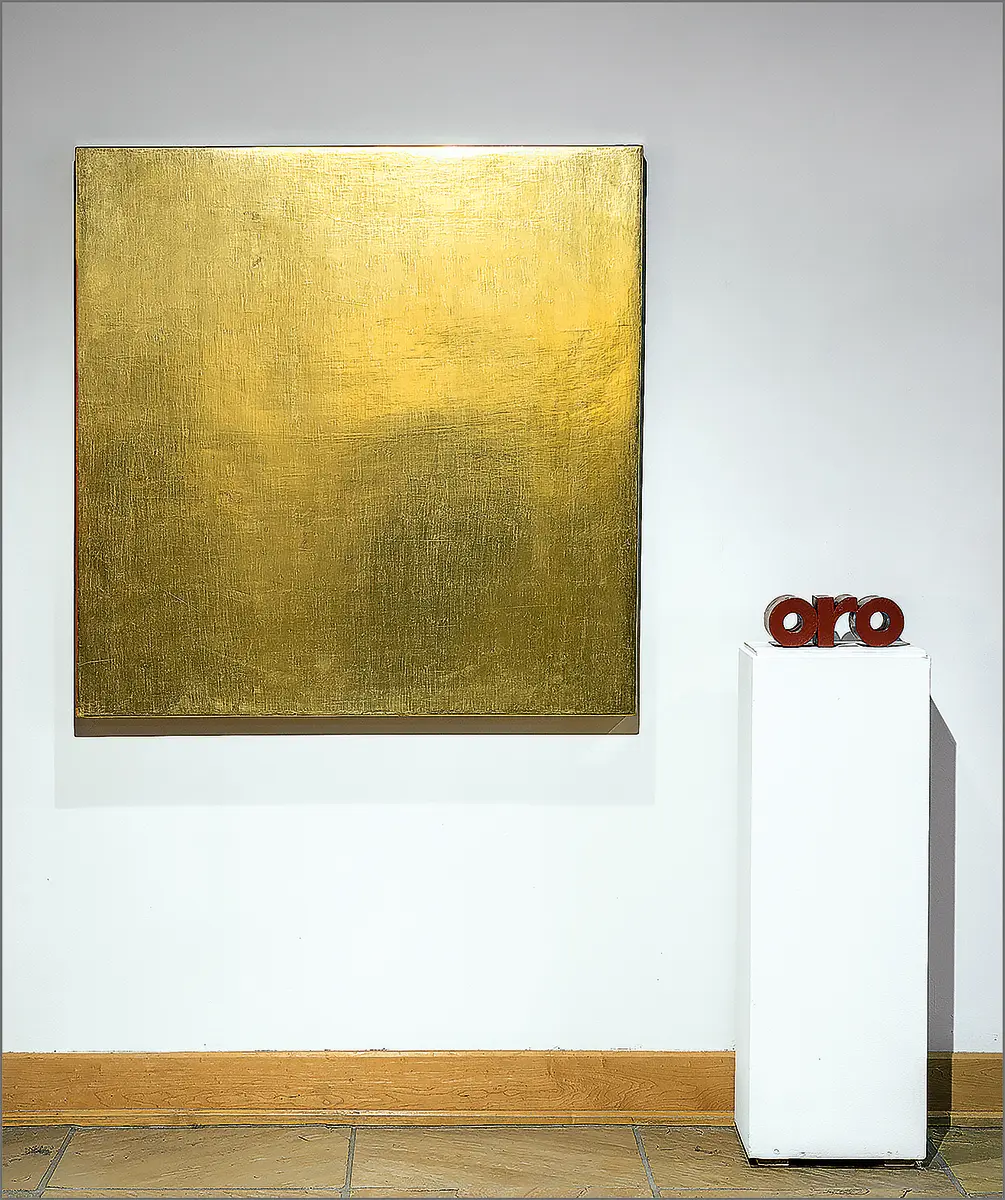
The narrative of this exhibition could have started with the well-known story about Mathias Goeritz dictating many of his paintings over the telephone and never touching them with his own hand. Justly renowned as one of Mexico’s most radical modern artists, Goeritz was also a pioneer in collaborating with the Guadalajara workshops, to the point of delegating many of his ideas to them. This is why Saber Acomodar features an excellent selection of his works, including a number of paintings made using perforated gold sheets, which he called Mensajes (Messages). Goeritz maintained an abstract language that surely changed the aesthetic expectations of the craftsmen he worked with, who would have been accustomed to a vision of art influenced by the epic of Mexican muralism.
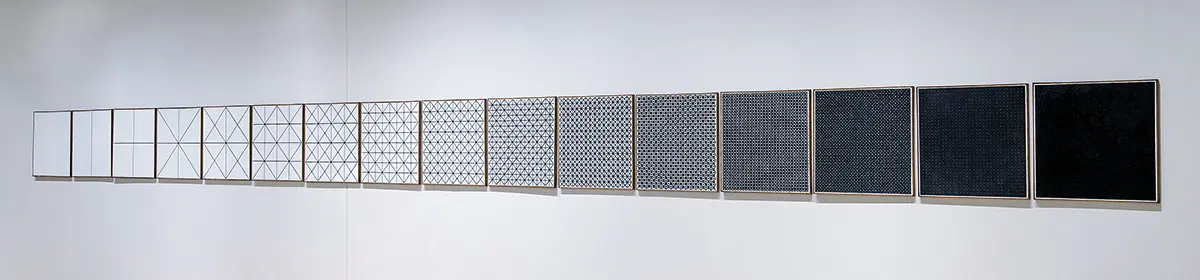
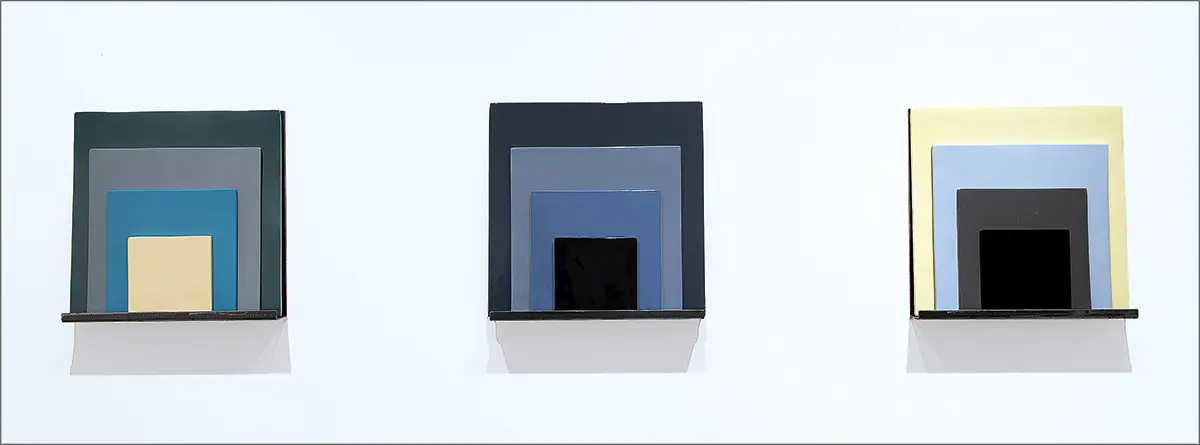
Eduardo Terrazas, who trained in architecture before opting for the visual arts, used the Huichol people’s nieli’ka as a starting point for her designs, including the logo for the 1968 Olympics, held in Mexico. The nieli’ka is an object created using hundreds of threads of yarn, beeswax, and pine tree resin on a flat surface. This technique comes from the Huichol communities of northern Jalisco. In the 1970s, Terrazas began to create designs that he then commissioned to Huichol craftsmen to be executed in the traditional manner. Crecimiento exponencial (Exponential Growth), a set of sixteen paintings, completes the tonal scale with an impressive display that is like a translation of the nieli’ka’s saturation of strands into acrylic on canvas in search of variations. More recently, José Dávila has continued exploring such pictorial translations into different techniques with his Homenaje al cuadrado (Homage to the Square), which takes Josef Albers’ well-known compositions as the starting point for its ceramic installations.
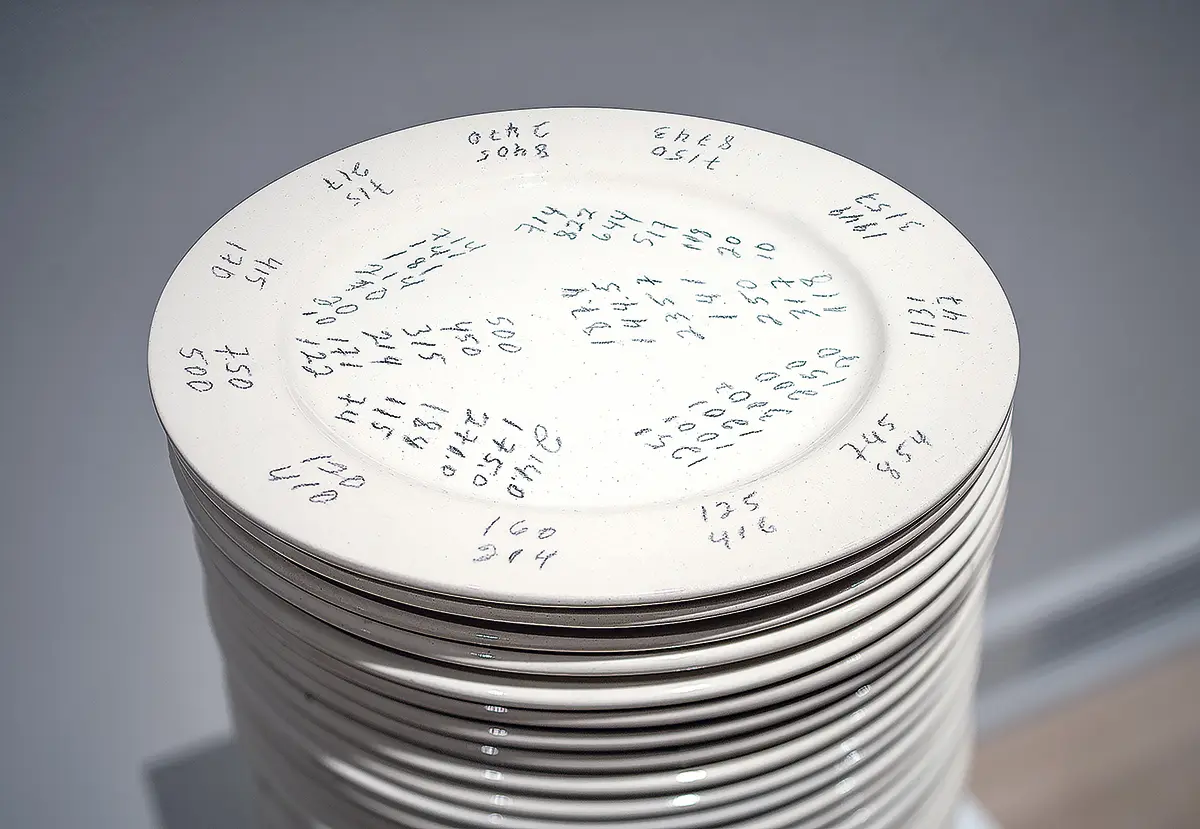
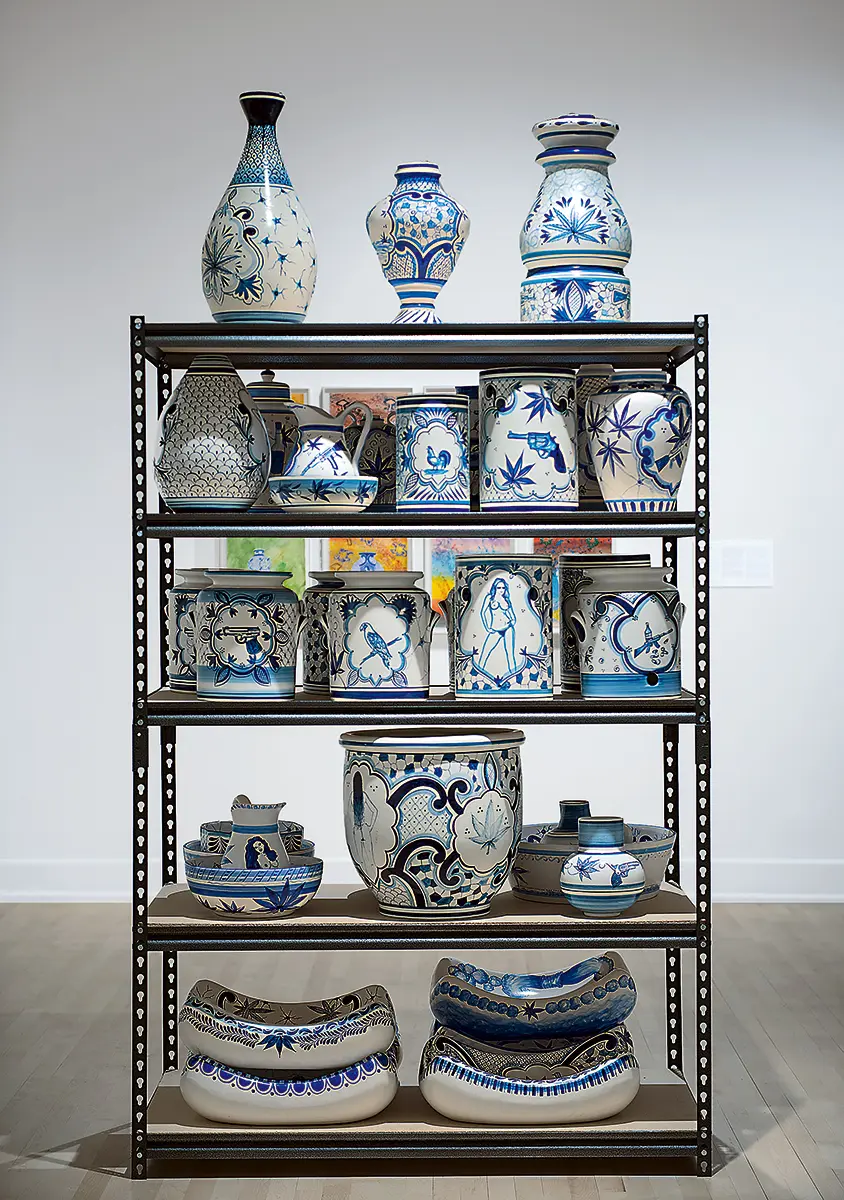
Clay and ceramics are the undoubted protagonists of this exhibition. Eduardo Sarabia uses pots and jars as supports for unconventional images he paints by hand. In Historia del mundo (consolidada) [History of the World (Consolidated)], Sarabia presents a collection of such objects compactly situated on a shelf. There we see firearms, eroticized figures, signs of public violence and insecurity, and drugs. Sarabia seems to be questioning the authenticity of such mass-produced merchandise when it doesn’t capture the reality around it like other folk expressions do (music, for example, to the point of having evolved the genre of narcocorridos.) For his part, Mario García Torres reproduces on Suro ceramic plates the formulas and notations that company employees use to define the color to be used in each section of an item before it is baked, be it vases, tiles, or pots. In this way, García Torres gives visibility to the hand of the worker, normally hidden in the final product. At the same time, it brings to the memory the annotations that Vasily Kandinsky made in the same vain on his canvases, before applying color.
Some of the works on exhibit are gestures of homage to the artisanal tradition in reference. Claudia Fernández revisits the idea of the ready-made that Marcel Duchamp first launched a century ago, when he proposed that industrial objects be understood as works of art. Fernández presents a selection of huaraches, the typical sandal-like leather footwear from Jalisco that is commonly hand made by local artisans. Unlike Duchamp, who added a fake signature to his sculpture, Fernández limits her role to the selection of objects and the provision of access to the legitimizing space of the museum in order to acknowledge the artness of these huaraches by unidentified authors. In turn, Daniela Aguilar finds inspiration in the craft of smithery. Aguilar studied jewelry design but has opted for using of lost-wax casting techniques in order to achieve larger formats in her sculptures of dolls, made with painstaking attention to detail.
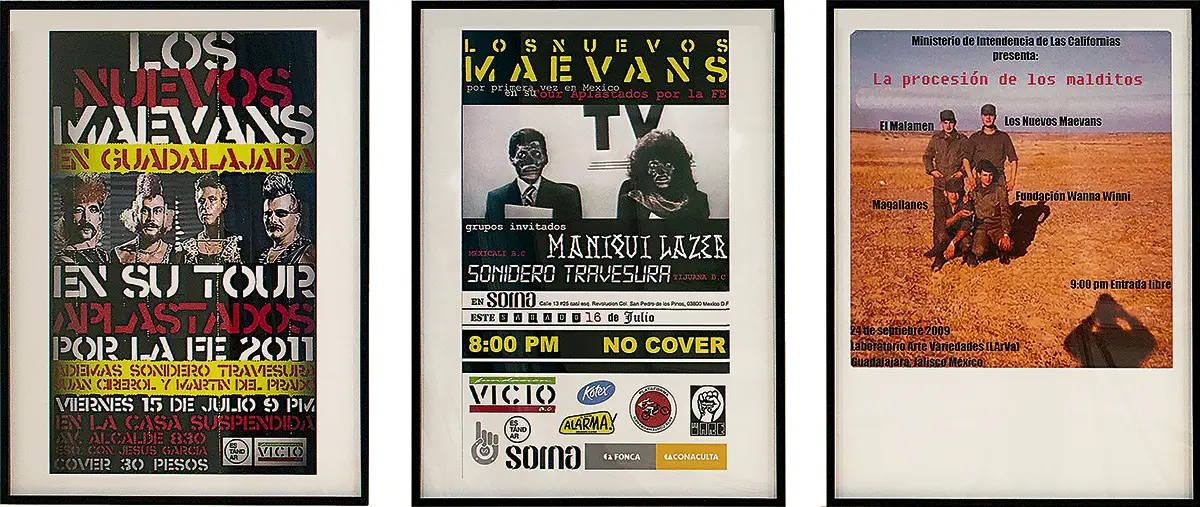
Guadalajara graphic design workshops also have well-deserved renown. The exhibition features many dynamically designed poetry and visual-arts publications produced by Taller Dittoria, established by Roberto Rébora in 1993. Also on display is a good selection of the Op Ed pages of the newspaper Milenio, with vignettes by its contributor José Ignacio Solórzano (JIS). As Charpenel reminds us, this political cartoonist has an inescapable precedent and reference in printmaker and engraver José Guadalupe Posada. In Christian Franco’s posters promoting concerts that were never held and appearances by invented bands. The uniforms worn by the members of Franco’s punk rock band, Los Nuevos Maevans, for which the artist is a non-singing vocalist, complement the sense of fakeness. In fact, the band only performs over a dubbed soundtrack and mimics playing their instruments.
Music is again the subject in one of two extraordinary tapestries representing the work of Taller Mexicano de Gobelinos, established in the 1960s by the Austrian artist Fritz Riedl following a Flemish tapestry-making method he had learned in Paris. Artist Fernando Palomar commissioned this atelier a large-format version of the cover of Genesis Live, the 1973 album by the iconic British progressive-rock band. On his part, Jorge Prado designed another tapestry with aquatic motifs, including schematically represented fish. The impressive range of hues achieved by the tapestry makers has situated this technique among the most coveted and prized in the marketplace.
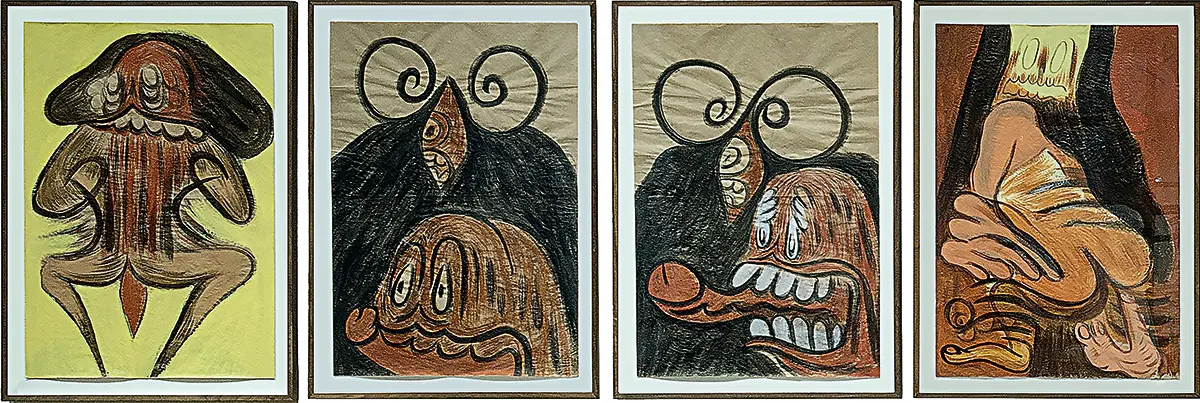
At the other end of the spectrum, Daniel Guzmán channels the spirit of outsider painting. He uses pastels, charcoal, and acrylic on paper. His compositions are notable for their iconic structure, where a central figure projected to the fore minimizes the importance of the ground. Deformed and with their contours emphasized, the figures allude to violence. But Guzmán’s gesture is chameleonic: he seems to lend his mastery of the craft as an avatar for outsider individuals in the lineage of Chucho Reyes.
Recognizing Guadalajara as a center for art production thanks to its handcraft traditions is a way to reformulate the dynamics between the local and the global, in the context of a growing influence of markets. To do this from the United States, now under the protectionism of the Trump administration, is a peculiar exercise, of interest to anyone interested in transcending border walls.
ELVIS FUENTES