Powerpaola was briefly a tropical virus before she was born. This was the diagnosis of an Ecuadorian doctor after dismissing a pregnancy as the cause of what was ailing the artist’s mother, suggesting that the issue was psychological in nature and could likely be connected to a “tropical virus,” a rather vague illness that would later become the title of Powerpaola’s first graphic novel, where she narrates the story of her life from birth and until leaving her parents’ home. Paola Gaviria (Quito, 1977) has been drawing continuously since a very young age. As result of this practice, she has created a two-dimensional universe that answers to its own physical, chemical, physiognomic, and ecological set of rules; a universe that is just beginning to expand and that is driven by the artist’s persona.
“I Hide Openly” is the title of her exhibition at the Museo La Tertulia. Curated by Andrés Fresneda and Juan Pablo Fajardo, from La Silueta (publisher), and Alejandro Martín, “I Hide Openly” seems to be a phrase taken from a conversation, one of those phrases that comes out unexpectedly and lingers in one’s mind for a long time until they become meaningful when incorporated into a story, when shaped by the narrative of one’s own life.
Conversations are a central aspect in the work by Powerpaola. Already in her film Virus tropical (Tropical Virus), based on the aforementioned graphic novel and screened in the cinematheque of the Museo La Tertulia throughout the duration of the exhibition, it is possible to see that from an early age she witnessed conversations between her mother and sisters while doodling and drawing on a piece of paper, participating in these conversations like the perfect witness of non-verbal nuances. Such non-verbal subtleties have to do with things unspoken and suggested, with playfulness, complicities, gestures, and fleeting emotions that are barely perceptible (like the phrases that linger in one’s mind). The drawing that Powerpaola creates based on these non-linguistic tones is rendered through the use of lines, the physical mutations of her characters, and landscapes full of mundane signs that do not attempt to erect fixed archetypes—despite being signs.
Some conversations even involve collaborations with other drawers. She sits with them at a table (in both the real world and in her graphic universe) and freely discusses any theme or question with them. In such instances, the conversations reach the highest level of purity, becoming ethereal and dissolving into digressions that connect to other thoughts, sparking a chain reaction that generates new meanings which do not necessarily have to be true. Powerpaola’s drawings are partial to play on words and every drawer is literally altered by their transforming power, for every person (character) possesses this ability to be transformed on paper. The table is perhaps both the message delivery vehicle and message itself, the support and bridge between planes of reality; a platform that supports the drawers’ papers while it also connects them to this other universe that also rotates around a table.
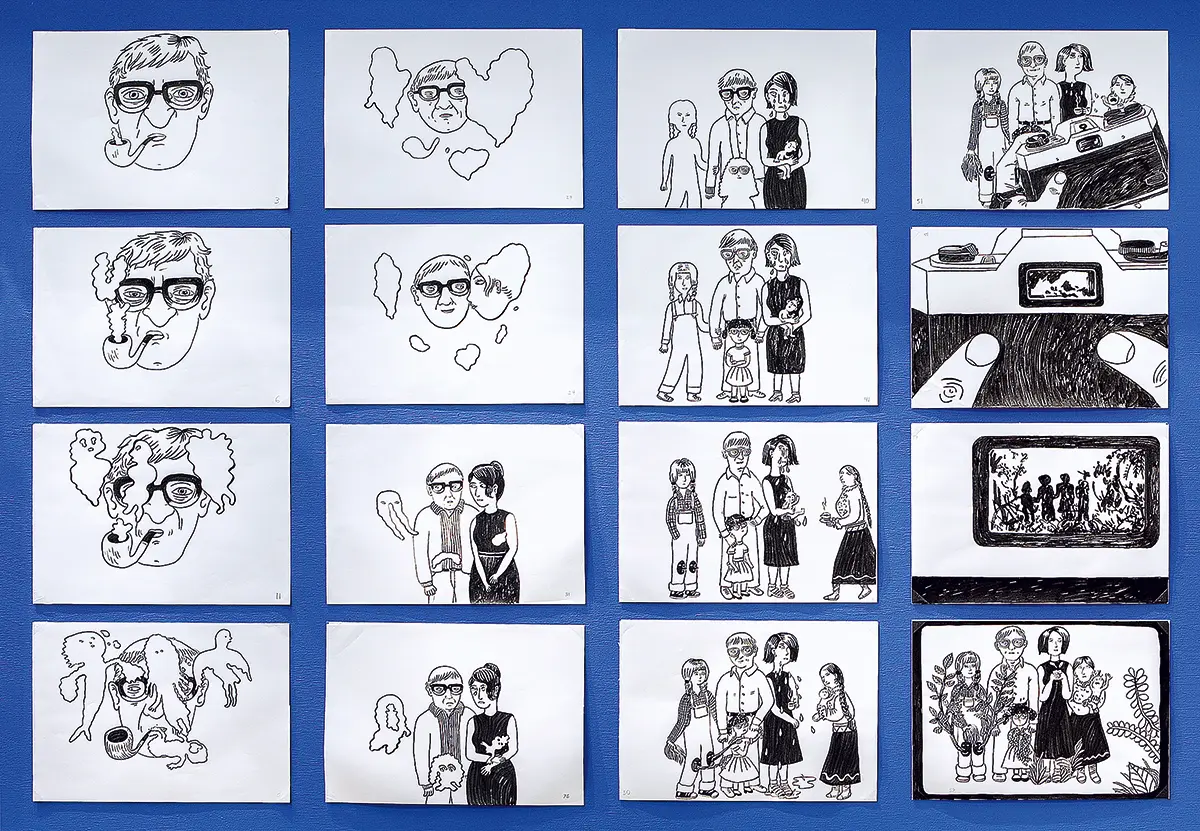
The exhibition is like a large book of drawings in which every space in the exhibition room (the Maritza Uribe de Urdinola Hall) is conceived like a vignette, like a sheet of paper; a reticle that transports viewers to different scales, to planes that can be observed from up close or others that must be read from afar. In this manner, the graphic pieces are displayed in wood modules like short chapters (drawings to be observed from up close). The multiple exhibition areas contain these modules like large portions of stories and anecdotes (devices to be read) as the museum is ultimately able to encapsulate Powerpaola’s graphic universe by complementing the small pencil-rendered works on paper with two large mural pieces (projects that require walking) and a learning room—the Sala Subterránea (Underground Room), which offers visitors tools to interact with the works and with Powerpaola’s creative approaches.
“I Hide Openly” becomes a phrase used to escape as well as an expression to confront. It overtly proposes the malleability of an artist who takes on a persona and a biography that reaches beyond the documentary realm and gradually becomes a script. Every story and every moment in the life of Paola Gaviria appear in the ink-rendered vignettes. Trying to frame her life through drawings is perhaps nothing more than a desperate attempt by another universe to exist; in other words, the entire group of drawings, stories, and characters created by Powerpaola were already there in her strange but fascinating drive to draw everything. Then, the drawings are not documentary records but rather fictions that wear the disguise of time to look like reality.
BREYNER HUERTAS