Pedro Motta defines himself as a visual artist. He uses photography as support for his works and relies on many different techniques. This year, Motta presented the exhibition titled “Silent Sinking” at the Bendana–Pinel Art Contemporain gallery in Paris.
Pedro Motta was born in 1977 in Belo Horizonte (Minas Gerais, Brazil) where he currently lives and works. He studied design at the Escola de Belas-Artes of the Universidade Federal de Minas Gerais (UFMG).
In “Silent Sinking,” Motta uses images as the basis for combining all the aspects involved in his cutouts created with paper or fabric. Viewers can recognize not only perforations that form figures on the floor but also the unequivocal and raw symbology of elements piercing like a bayonet. The excavations in the soil are not made by nature or by the flow of water that forms drawings. The subject matter allows for an endless number of language combinations that include folds, wrinkles, and bents. Motta’s aesthetic demonstrates an interest in understanding or sensing the internal motivations of something or someone, in being able to distinguish between appearance and reality, between futile and essential elements.
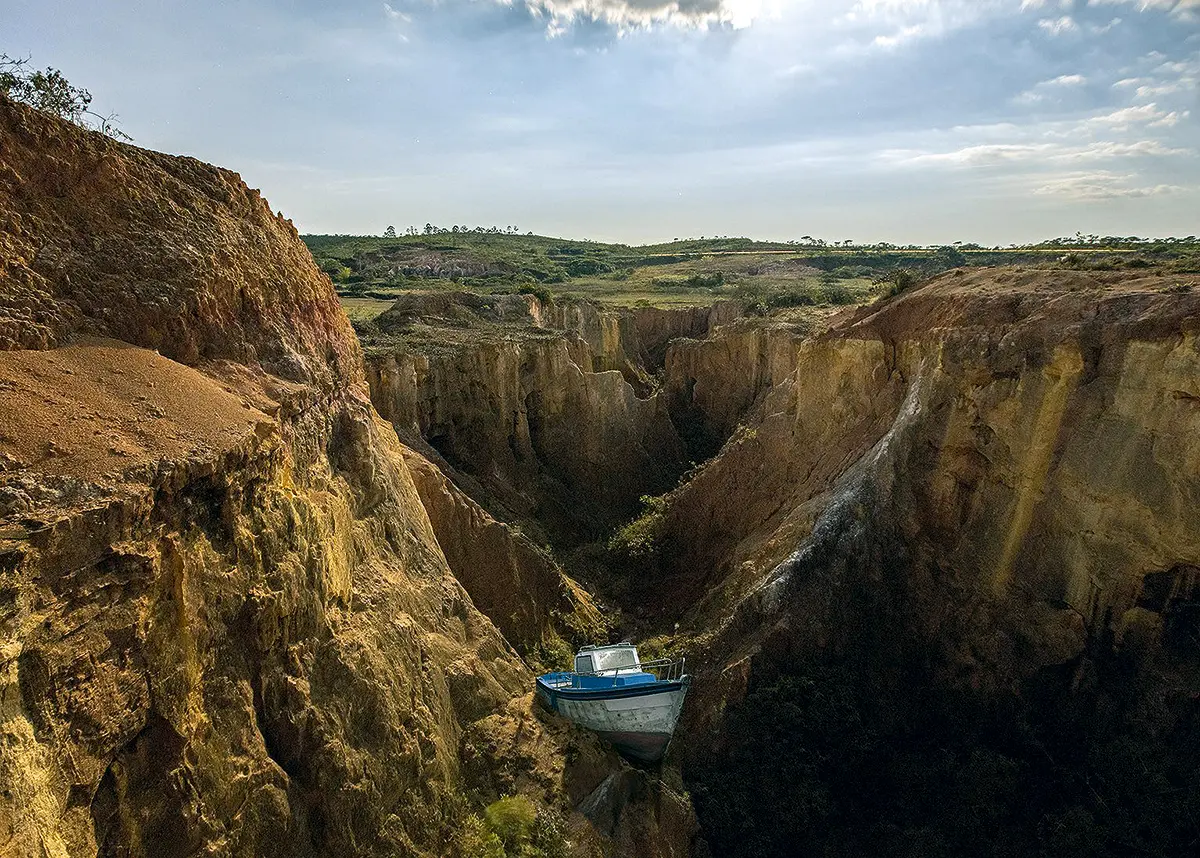
A review of Motta’s career for the purpose of determining the moment in which he matured as an artist is not necessary in this case, given that from early on he was able to translate a non-academic and original language. As he relies on landscapes as records of harsh social conditions, he successfully inserts the idea and practice of a total mutation in the dozen medium-size pieces included in the show. Even without knowing their titles, the pieces are able to convey a philosophy of exacerbation of opposites and a cultural identity crisis. In this manner, his vision of the landscape removes ideas not directly associated with its original semantic. Is it the present responsible for generating ambiguity? Or, is it that such ambiguity is also the result of the disinformation that we are all subjected to?
The land burns like the intense red in those photographs, which offers multiple ways of infusing Motta’s language with the red hot territories of Brazil. His are landscapes that appear like outbursts or calls from our individual or collective conscience. The ecological issue—the one theme that could perhaps encapsulate the complex experience offered by this artist—is always present in this work. Whether solidly positioned within the broad framework of conceptual art or Brazilian concrete art, the clear message and developed expression offered by Motta hide behind an apparent realism or in the landscape.
The idea is reproduced throughout the image like a fold with multiple layers, like the rugosities in the landscape. Freed from an initial exoticism, it once again infuses concepts and prejudices into the density of forest that dissolves as result of our invasion. Is it a cultural crisis generated by a lack of global answers? In any case, Motta masterfully deals with the antagonism that results from disinformation. He transfers the mechanisms of the landscape and culture from one frame to the next: from one extreme to the other. He is well versed in the symbolism of each culture: where all the elements are interconnected and nothing is anodyne. As if suspended, a small boat—that is also a symbol in popular culture—conveys a lightness that makes us forget its weight.
A formal analysis allows us to delve deeper and reinforce the significance of the structure used by Motta to construct the message. It is perhaps the influence of his training as a designer what allows him to successfully erase the boundaries pertaining to the surface and the superficiality of the representation, in order to reference the debate between high art and access to information as the message from the first vanguards. The totality of experiences and ecological preoccupations offered by this artist are not limited to a landscape of red territories. Pedro Motta uses intention as if it were a sharp object with which to pierce through the body of art. Having developed an international projection, some of his latest achievements and recognitions included, in 2015: a residency in FLORA ars+natura, Bogota (Colombia); the ICCo/SP-Arte Prize, São Paulo (Brazil), and the acquisition of his work by SESC and the collection of the Museu de Arte de São Paulo (Brazil).
SUSANA SULIC