Paula Scamparini presents Barco sobre lona (Boat on Canvas), an exhibition curated by Fernanda López at Aura gallery in São Paulo. The exhibition features photographs and installations, some previously seen at GEDOK Gallery in Munich, and other works that reveal the artist’s concern with the political polarization, segregation, and inequality that characterize contemporary society.
The works on exhibit also showcase Paula Scamparini’s views on matters related to the formation of collective and personal identities, among the social vulnerability of the city of São Paulo and the global phenomenon of migratory flows.
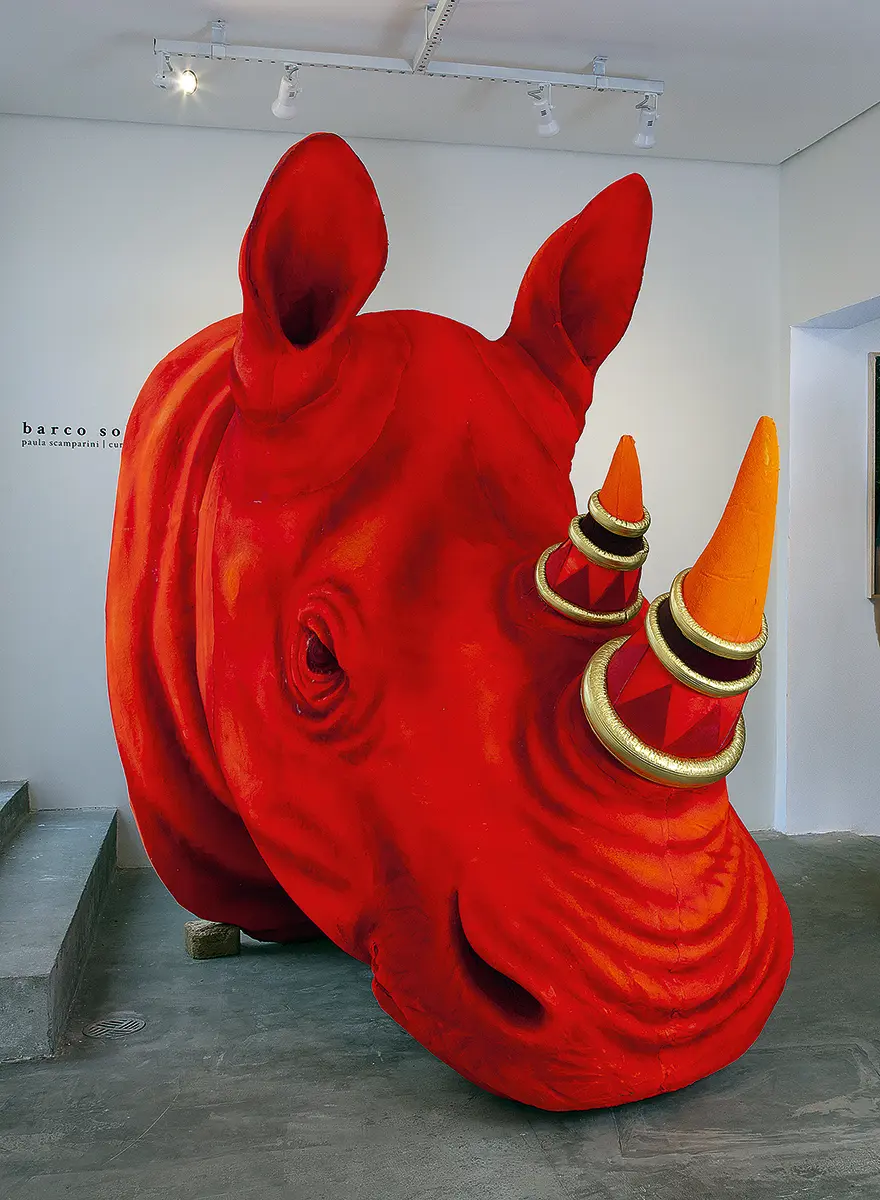
At the entrance to the show visitors find a large installation, the giant head of a red hippopotamus with golden rings in its horns. The strategy behind the placement of this installation is connected, according to the artist, with the visitor’s need to choose a path to follow into the exhibition, to the right or the left of the obstacle. In this way, the visitor, as an interlocutor, becomes the editor of the images on exhibit. Going in one direction they will find figurative images; choosing the other will prompt an encounter with the process.
In one of her works, Paula Scamparini installs inside the gallery a cement mattress, 250 kg in weight. In another work, a photographic series presents the register of performances in Munich, where female bodies, historically marginalized, are presented in monumental spaces to generate a tension between their scale and that of the sites in which they appear.
The artist’s and the curator’s main concern is connected to dialoguing with the viewer, who is free to choose and to reflect between the figurative and the process-oriented.
For almost fifteen years Scamparini has been presenting and giving new meanings to her interest in the idea of construction, which in her case necessarily implies a process that also takes into account the possibilities of deconstruction and reconstruction. Scamparini’s works from her earliest photographs to her most recent practice of actions, associations, and artist’s residences, are like challenges for the viewers to see, read, hear, and perceive. Scamparini poses these challenges initially for herself and only later presents it to the audience. On the basis of displacements that can be subtle or intense, conceptual or literal, Scamparini proposes—for herself and for others—the possibility of reinventing the perception of the world by means of the tension between reality and fiction (or staging), natural and artificial.
In Barco sobre lona, featuring photographic series made between 2014 and 2015, Scamparini proposes stage construction as a strategy for bringing into doubt the idea we have of reality. We find ourselves confronted with what seem to be photographic records, which is to say, the congealing of a past instant, yet we are unable to fully ascertain whether what we are seeing is reality or fiction. Scamparini’s most recent investigation renews and broadens her vision (and ours) in the direction of those subjects. A mattress and pieces of costumes and accessories used by Samba troupes, donated to the artist after the year’s parades, are at the same time material and character. Expanded polystyrene, feathers, sequins, irreplaceable in the materialization of the kings, queens, and distant worlds of carnival and yet so commonplace in their shape, now grab our attention with their disproportionate, misplaced, illusory, fantastic appearance, generating formal and conceptual noise inside the gallery. Scamparini reinforces in this exhibition the domain of her production as a site of doubt, and doubt as a power. What we see here are works of art that prompt thoughts about the construction of mages, but also about images as constructions. The construction of history, and history as construction. The construction of art, and art as construction.
The installation Estandarte (Standard) is comprised of a number of Salgueiro carnival costumes,1 sewn by the artist in Rio and brought in for the exhibition.
The installation Rinoceronte (Rhinoceros) is a metaphor for one of the film scenes that most powerfully impacted the artist: the ending of Federico Fellini’s E la Nave Va (1983) According to Scamparini, the catharsis arranged by Fellini in the movie’s last scene, with the ship beginning to sink after being bombarded, deeply shocked her. The gust of wind, making the scene even more dramatic, is so powerful that one of the camera operators found it difficult to keep his equipment securely in place. The chaos of the tragedy that up to that point mobilized our attention and our emotions is broken as the frame widens, to the point of revealing its structure. We see the scaffolding, a crane, light and sound equipment, part of the filming equipment, fans, and even the mechanical system used to simulate the motion of the sea in a sound stage. Back to the scene, we see two of the survivors: in a small boat are Orlando and a rhino. How was it possible for such a large animal to fit in such a small boat? This suggested Scamparini the idea for her Hipopótamos (Hippopotamus) for the exhibition under review. This work was collected from a Salgueiro shack after the 2018 parade, brought to São Paulo, and restored by the artist in the gallery.
NOTE
1. Salgueiro is one of Río de Janeiro’s escolas de samba, or samba troupes.
HÉLCIO MAGALHÃES