Connections between science, art, and political activism are established throughout the work of Brazilian visual artist Patricia Gouvêa (Rio de Janeiro, 1973), as evidenced in her first solo show at the Galeria Mercedes Viegas, in Rio de Janeiro. Entitled “Survival,” the exhibition featured a never before shown series of photographs and videos. The proposal explores nature’s ability to endure both in places where ecosystems are supposedly protected as well as in small spots in the city where miracles continue to occur despite the dominance of concrete.
The exhibition occupied the interior and exterior of the gallery located in a stretch of La Gávea neighborhood, in the Atlantic Forest, an area once destroyed by the sugar and coffee slave plantations that devastated the landscape of the state of Rio de Janeiro. Beginning in 1861, the area was reforested as result of the “ingenuity and tenacity” of Emperor Dom Pedro II of Brazil. The names of the five slaves that under the command of Mayor Archer planted more than one hundred thousand native trees during a period of thirteen years were never mentioned in the books and periodicals of the time.
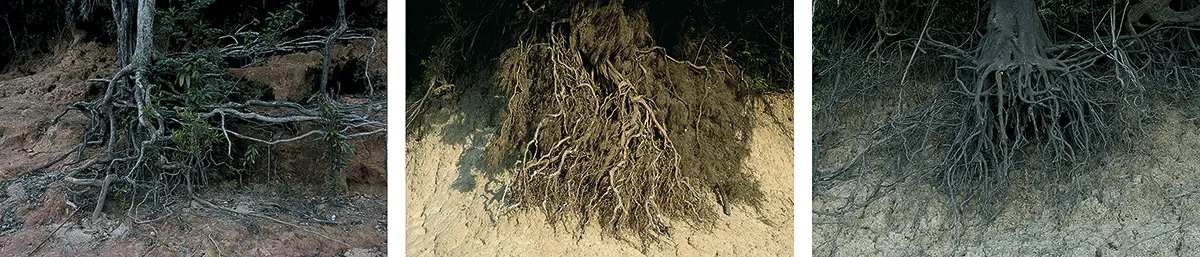
The works included in the series were created between 2017 and 2018 in the Adolpho Ducke Forest Reserve of the INPA (Instituto Nacional de Investigaciones Amazónicas), during Gouvêa’s completion of the LABVERDE residency, and in the Anavilhanas National Park, both in the Amazon rainforest; as well as in the cities of Belo Horizonte, Rio de Janeiro, and Fort Lauderdale (US). Faced with the contemporary process of accelerated destruction of the Amazon rainforest—the largest forest in the world, a “suspended ocean” that serves as a true environmental regulator for the planet—Gouvêa observed with amazement the survival strategies of the “green blankets” in response to the tragic reality of a country that has been implementing public policies very much like those from the dictatorship period.
According to Patricia Gouvêa, these policies are based on a vision that is very similar to the propaganda peddled by rich European countries. After destroying their own forests, they have invested in the pro-Amazonian discourse while also destroying its environment by establishing factories that do not respect local environmental protection laws. They have caused tragic accidents like the 2015 Samarco dam disaster in Mariana (Minas Gerais) and the 2018 disaster in Barcarena (Pará, Hydro Alunorte alumina refinery).
The exhibition “Survival” became a small inquiry into the possible connections between art, science, and politics that questions the increasing artificiality and objectification of nature, in a context of hyperactivity, environmental destruction, global warming, water scarcity, and human right abuses. The questions posed to the exhibition visitors are: Can contemporary artist intervene in this process? Can images convey a desire to change things and reach the status of activism?
In the case of Patricia Gouvêa’s work, the answers to these questions are affirmative. Her research, which for many years has as one of its core ideas the expansion of the temporalities of images, generated this new series as a political-poetic protest marked by aesthetic subtleties offered through apparently banal images and large audiovisual exhibitions. The poetic status in the work of this artist it is not expressed through a declared commitment. While they reiterate her indignation to the destruction of nature, her images affirm the critical power that is naturally inherent in art.
Patricia Gouvêa earned a degree in communications. In recent years she has been producing works that combine several actions that go beyond the works. Between 2005 and 2009, she was part of the group DOC (Obsessive Compulsive Disorder) that promoted dozens of actions in Brazil and abroad.
She is author of the following books: Membranas de luz: os tempos na imagem contemporânea (Light Membranes: Time in Contemporary Images), 2011, Azougue Editorial; Imagens posteriores (Posterior Images, 2012, Reptil Editora); and Banco de tiempo (Benches of Time, 2014, in association with artist Isabel Löfgren, published by the authors); and participated in many others. Alongside artist Isabel Löfgren, Gouvêa developed the long term research Banco de tempo (Benches of Time, site-specific exhibition and accompanying book independently published) and Madre negra (Black Mother, site-specific exhibition, publication). She was one of the founders of the Agencia Foto In Cena (1995-1998) and the Atelier de la Imagen (1999), a cultural space in Rio de Janeiro dedicated to research, reflection, and the production of images.
According to curator Luiz Alberto Oliveira, the meticulous poetry in the images by Patricia Gouvêa describes a “limitless horizon.” Her photographs and videos include a forest that has re-assimilated a house in ruins and floods the surface with its regenerated skin of moss. Images like this reveal her continuous interest in time. Is it weird to speak of something as temporary as politics in a territory as timeless as nature? No. Patricia Gouvêa’s activism seems to be emphasizing precisely that paradox between human time and natural time. While human beings assign names to everything, centralize, control, and destroy, nature, with its indestructible strength, shows us that finitude is not its forte; nature recycles, regenerates, and survives. Human beings come and go while nature remains. This is the poetic criticism by Patricia Gouvêa.
ALESSANDRA SIMÕES