The Venezuelan artist’s (Caracas, 1954) most recent solo exhibition in Paris is the closing event for Galerie Thessa Herold1, after forty-eight years of activity. Indeed, a gallery that so passionately fought for Latin American artists (Jorge Camacho, Wifredo Lam, Joaquim Ferrer, Manuel Álvarez Bravo, Alberto Gironella, José Luis Cuevas, Roberto Matta, Saúl Kaminer, and a long etc.) and collaborated with the greatest French and Latin American writers and critics (Yves Bonnefoy, Jean-Jacques Lebel, Georges Duby, Edouard Glissant, Serge Fauchereau, Zoé Valdés, etc.), ended its active life in July of 2018. It will be a sensible absence in a Parisian arts scene that has been unable to cultivate sustainable ties with the Latin American region in the way Thessa Herold did for so many years, and to protect with conviction the many painters and sculptors of every generation that made the French capital their home in their quest for freedom and modernity.
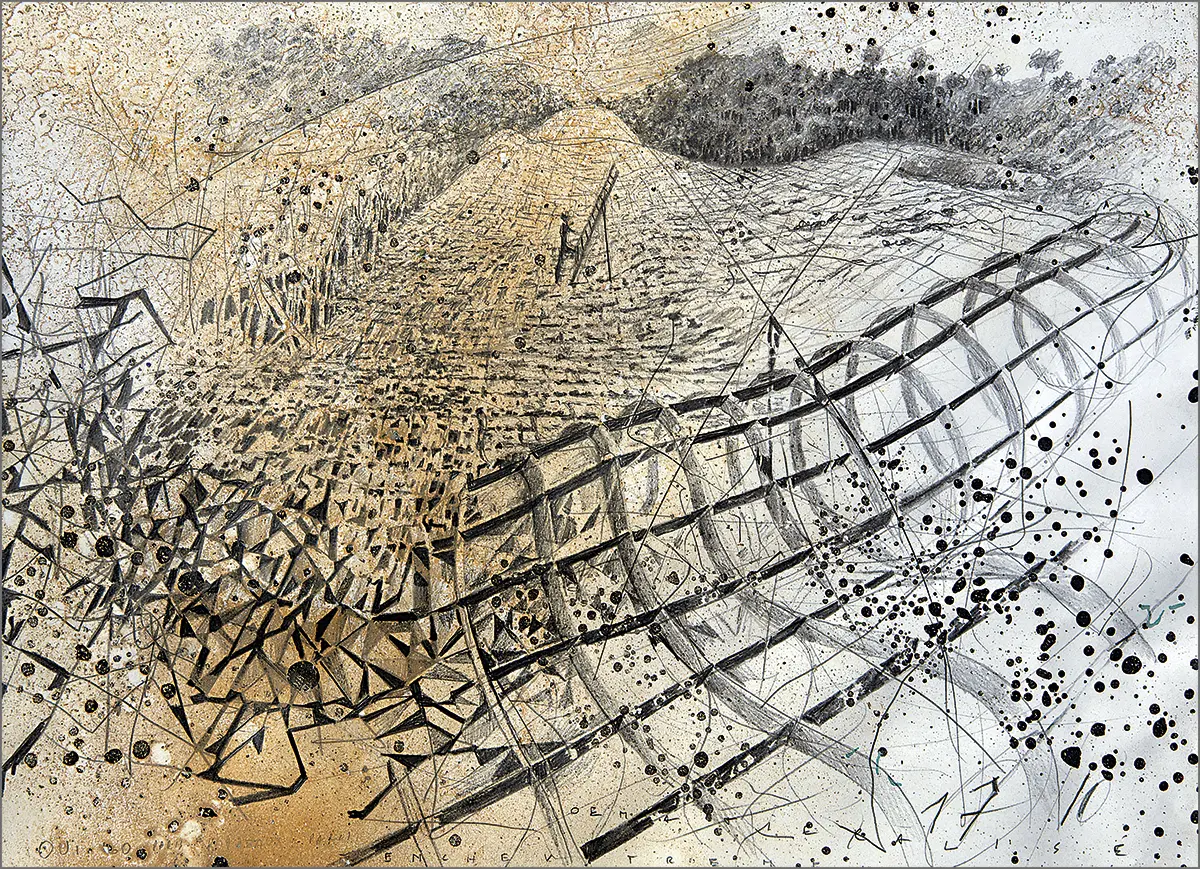
For his most recent exhibition, Pancho Quilici again brings to bear his unmatched talent as a draftsman. Quilici confirms his passionate yet controlled relationship with space, both in small and in large formats. We are also able to confirm in these recent works (several series on paper or canvas dated between 2016 and 2018) a substantial aesthetic shift connected with Quilici having set aside the computer he used for graphic support for a number of years. The freshness of his drawing, always thought out and controlled, is emphasized, while the previously indispensable mediation of the machine is attenuated. This solitary wanderer, enamored with nature in the wild, confronts the vertigo of the blank paper or canvas with seemingly inalterable pleasure. Lightness, fluidity, and transparency suffuse his “landscapes”, here the liquidity of air and clouds combines with the density of water and earth. Matter worked over, broken in, mashed down, are the slogans of this painting that always seems to escape from rational thought, wanting to evaporate or to detach itself from the real in order to better be part of the dimension of dreams, or perhaps a “daydream”, inducing peregrinations in the context of an imaginary nature.
But Quilici’s “battle” against the vertigo of emptiness takes us to nebulous depths, abysses, like cataclysmic prisms that irradiate and attract, as in Inquiétude des champs (Restlessness of the Fields). We are absorbed by a large dark opening, a kind of black orifice that devours and expels at the same time. Quilici’s painting is also a painting of precise gestures, be it random or controlled, voluntary and adventurous, cerebral and joyful, where risk and chance accompany the confidence of strokes born from a profoundly considered preparatory work: an intense meditation about matter and its unexpected accidents, about emptiness and nature, about the instability and uncertainty of the landscape governs every large painting by this artist. In particular, this is the case of the astonishingly beautiful and mysterious Lointaines proximités (Faraway Proximities), a kind of cobweb in spiral that—in an attempt to reproduce what occurs in nature—“coats” like an arachnid’s weaving the dark blot that Quilici describes as “somewhat chaotic.” Quilici’s work involves long times to allow the task to evolve, an extended process of “colonizing space structurally” through which the artist declares himself finally free of the computer. In Vers d’autres rives en fuite (Towards Other Edges in Flight), a new freedom takes shape, one where space is traversed by spillages of paint, zebra bands, lighting bolts, and arachnid alignments that pass through liquid and solid matter like magnetic waves, saturating it without ever dimming its original power.
In Influence des liens (The Influence of Ties), Evènements constructifs (Constructive Events), and Apparence déviée (Deviated Appearance), all series of a constructive bent, each object is comprised of a drawing with a superimposed geometric figure in transparent acrylic; the visual dynamism produced by this combination confirms the magic of the line suspended in space. Indeed, drawings to which a geometric “volume”, drawn and transparent, is superimposes, are read simultaneously, the drawing never dissociated from the acrylic structure, a differing “copy” that nevertheless reinforces it. The series Errances (Wanderings) is one of the best reflections of the close relationship Quilici maintains with nature, the land, and the landscape. These drawings, made randomly as the artist traveled on his motorcycle, are forceful constructive imbrications of blotches and lines that reveal—in their explosions, spirals, or whirlwinds—great freedom. Freedom for the artist to let his pencil skate on the paper, guided by his emotions and sensations; freedom for the land to be in motion, shifting, unreachable.
NOTE
1. Established in 1970 as Galerie de Seine, located on rue de Seine, in Paris’ Rive Gauche, the site of intense artistic activity at the time, the Thessa Herold gallery later moved, in 1993, to the Marais neighborhood, next to the Picasso Museum, where a significant portion of contemporary artistic production has relocated nowadays.
CHRISTINE FRÉROT