Omar Schiliro was an intense artist who died too soon. He was born in 1962 in a humble home in Villa Lugano, Buenos Aires. Abandoned by his father, he spent many years in the back of the house of the restaurant where his mother worked as a cook. In 1991, he was diagnosed HIV positive. Three years later, in 1994, Omar Schiliro died at the young age of 34. From the moment he learned of the irreversibility of his condition, he stopped working as a jeweler and passionately immersed himself into the art world, producing unique, brilliant, work that helped define the artistic scene of the 1990s in Argentina. According to Francisco Lemus, in one of the texts in the catalog published by the Colección de Arte Amalia Lacroze de Fortabat, “HIV radically transformed the lives of artists… activating and reorganizing different images that attest to survivals, aesthetic forms permeated by the reality at a time when the guarantees regarding the wellbeing of individuals were cancelled.”
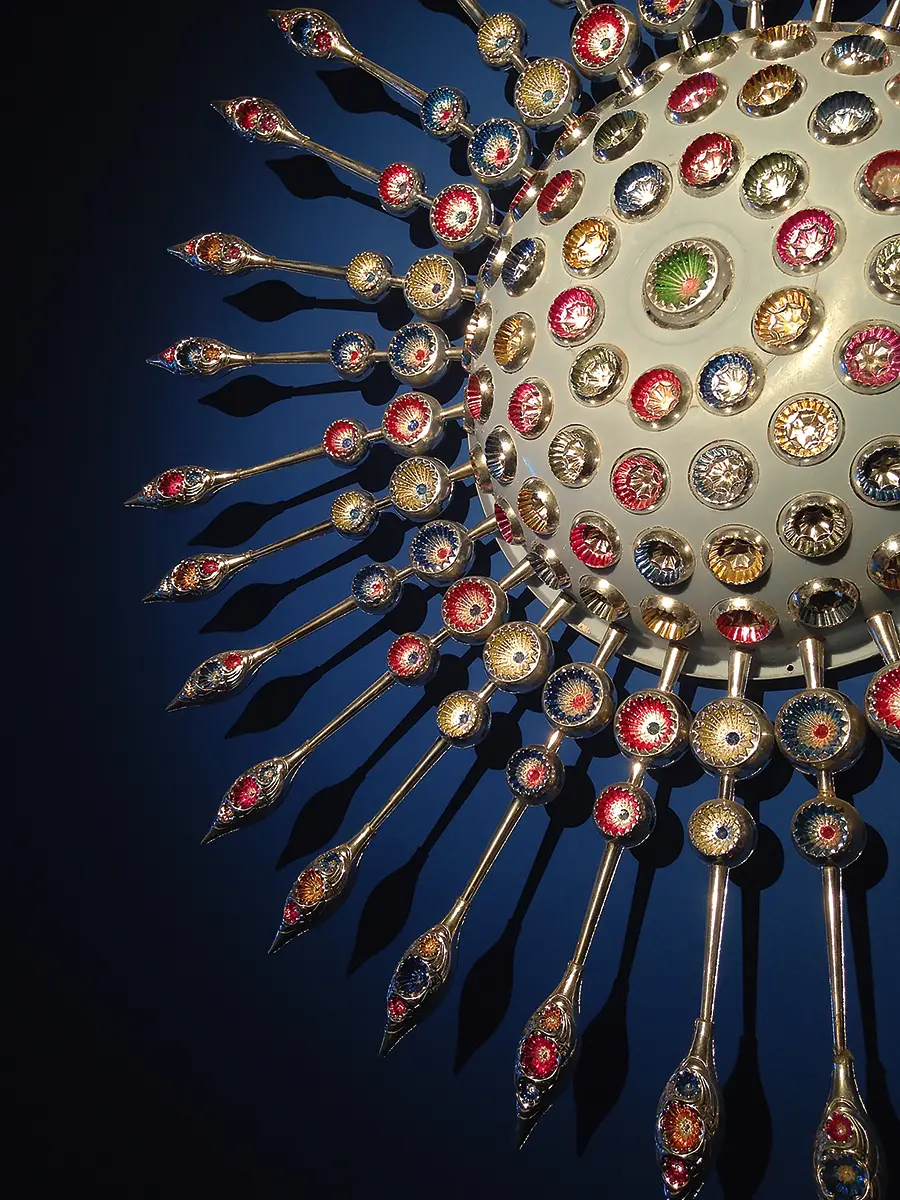
In 1991, depressed by his illness, Schiliro was invited by Jorge Gumier Maier to participate in the group exhibition “Welcome Spring” at the Centro Cultural Ricardo Rojas. A self-taught artist, he presented one of the early objects in which he began to combine two materials that will become constant elements in his oeuvre: plastic and glass, nature and culture. About this work, Schiliro said that it was “a cathartic vehicle for his angsts, for depressions that became spring-like… The overall intention was to convey the best.”
Many years have passed since Jorge Gumier Maier, artist, curator, and Schiliro’s partner, had the idea to present this project. It was he who also lovingly cared for Schiliro until his death.
“Now I Am Going to Shine” gradually developed as Schiliro’s first retrospective. The curators of the exhibition, Paola Vega and Cristina Schiavi, were entrusted with finding his production and recovering the numerous missing parts of some damaged and neglected works. Everything began in 2016. It was not easy finding the glass or plastic pieces from the 1990s. It took two years of hard work to allow Omar Schiliro to shine once again. “Through about thirty-five works, Schiliro left us a wonderful universe of colors, fantasy, and light,” wrote Paola Vega. In reference to the reconstruction of this body of work, Schiavi said: “I felt an overwhelming and obsessive desire to learn how his head made connections between these two materials, between the mundane nature of plastic found in bazaars and the refined nature of the crystals and curls of antique lamps.”
The truly emotional nature of this recovery of his work can be immediately felt, and it is contagious. Nené, a neighbor in Buenos Aires, donated a plant pot stand from her small garden so one of Schiliro’s works could be completed. She preferred that the object, which she inherited from her mother, continued to live in a work of art that transcended and acquired new meaning. This gesture is perhaps connected to Omar Schiliro’s intentions: “I am interested in all kinds of people,” he once said in an interview. He was opposed to elitism in art, and added: “My work is impulsive, I want it to be liked by everybody, it would please me very much if everybody likes my work.”
The visit to the exhibition is tinged with childhood expectations, as if it were about entering an amusement park that has been brought back to life after being dismantled. It contains a hidden tale that promises beauty and happiness. And like in any other amusement park, this one also had a wheel of fortune, his last work created in 1993. After climbing a small ladder and pushing a button, the options offered by the spoon-shaped pointer are always generous. Life is good in the small things that are intensely happy: “cozy home,” “delicious food,” “good luck,” “money,” “good friends,” and also the option that fate denied to Schiliro: “good health.” About plastic, Roland Barthes declared: “The hierarchy of substances is abolished.” And this idea becomes a certainty: here, plastic is not less important than glass; is not even less important than light. It is no longer an “unfortunate material.” Categories dissolve. According to the semiotician, “What best reveals plastic for what it is is the sound it gives, at once hollow and flat; its noise is its undoing.” But, what sounds could these marvelous objects produce? What extraordinary secrets could plastic conceal, this matter “powerless ever to achieve the triumphant smoothness of nature?” Omar Schiliro found a way to save plastic from its misfortune; he found in it the virtue of infinite transformation.
VIVIANA SAAVEDRA