
A photographer receives a grant from Havana Club 7 to travel to Cuba and document life in the island. Before seeing the results, one could speculate: Cuban men and women dancing along the Malecón; children smiling at the camera; tourists sipping rum. Musuk Nolte went in a different direction. This Peruvian photographer, although sponsored by the famous rum brand (in association with the Elliott Erwitt Fellowship), skirts the topic and only reaches for light from a spot in the shadows. Sombra de isla (Island Shadow) results, as he put it in the presentation of his show, part of the PhotoEspaña Festival, from approaching “each person as if he or she were an island.” But he does this in and from darkness, necessarily capturing the immediate present but also, in a phantasmagorical way, the past that still courses through the country. Musuk Nolte visited Cuba in 2016, the year of Fidel’s death, and every image his camera captured is imbued with a sensation of death and lethargy.
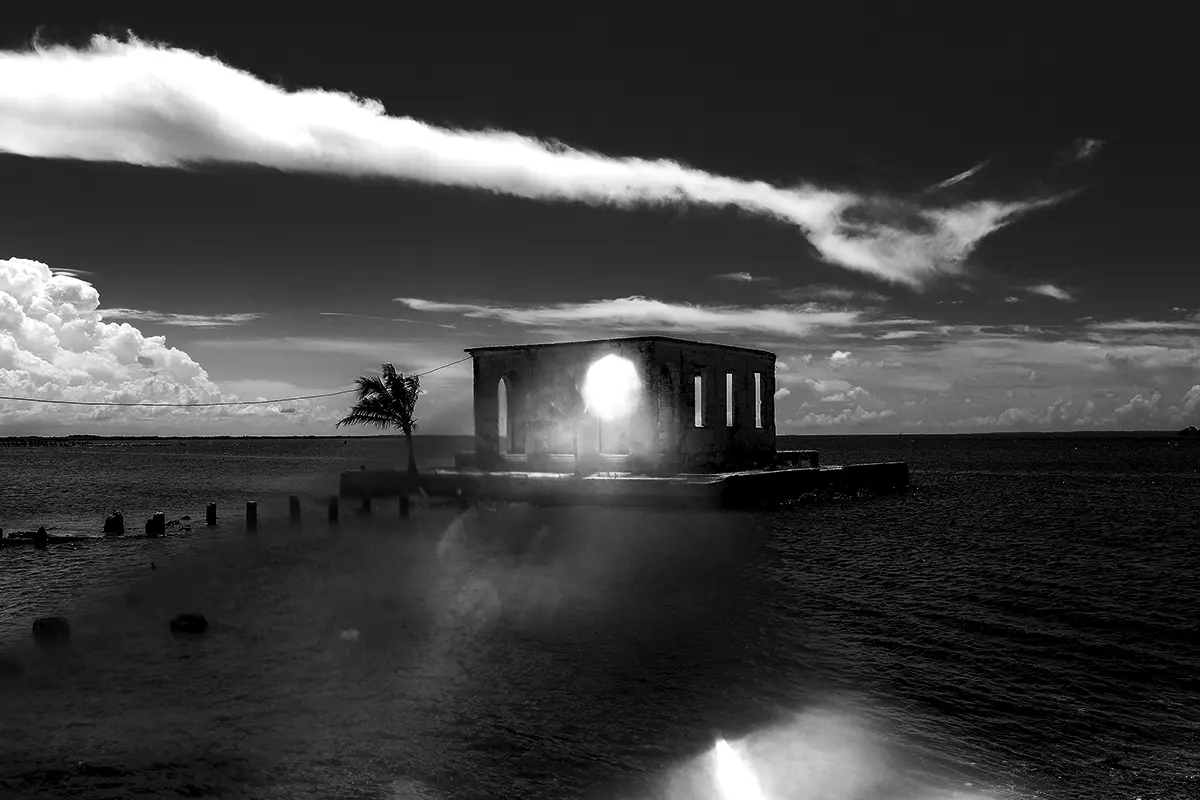
Nolte eschews stereotypes, but not identity: it is possible to see Cuba in his photographs of wrinkled hands, bottles hanging in the street, or walls bitten by the salty residue left by the ocean air. Some of his snapshots are more decisive than others, in terms of identity; for instance, one featuring a small figurine of a saint, or another one where ritualistic objects coexist with nature. Backlit figures are central, as are blotches, puddles, undefined and faded characters: concealment. The brightness of that which is illuminated in black and white is reinforced by the well-timed emergence of light, which reflects and reveals. In photographs such as that of an abandoned house in the municipality of Isabela de Sagua (Cuba), a microisland in the middle of the ocean, the ray of light traversing the building transforms a derelict space into a warning, beckoning beam, a perfect allegory of Nolte’s intention: a moment of bedazzlement that appeals to distracted, de-souled Cuban spirits. A small but significant curatorial footprint (Roderick van der Lee is the curator) turns a section of one of the walls at Casa América into an object photograph: an overhead light underscores the digital impression of a vertical flash on blackness. Given the limited number of works on exhibit, none large, in the medium-size gallery, it provides an enriching dimension.
Another image that also functions as a primordial point of origin for the exhibition. A disjoined group of Cubans wanders in a field, following an illogical choreography. In the foreground, in the shadows, a dog walks in an equally haphazard direction. Roaming about in an undefined location, this group does not seem to be following a script of any kind; it simply kicks about, going nowhere. It is perhaps a reading of post-Fidel Cuba, hanging on to its past, its specters, its shadows. While Musuk Nolte’s poetic intent is noticeable, some of his frames and scenes indicate his experience in photojournalism. Nolte worked for the El Comercio daily in Lima, where he focused on the periphery of the city, covering its daily struggles and human dramas. These skills come into play in Sombra de isla, which brings to the fore a different face of Cuba and proves that it is possible for a commercial firm to sponsor works of a less marketing-oriented nature, while also demonstrating that even when a subject threatens to become all-encompassing, it is still possible to capture the essence of a place and a time without recourse to stereotypes. Musuk Nolte’s Cuba is sullen, old, sad, rough and wrinkled; it is cracked and blurry, but the light it retains brings reality back to us.
JUAN JOSÉ SANTOS