With the title of Sinfonía del universo (Symphony of the Universe), Venezuelan artist Milton Becerra (Táchira, 1951) presents a site-specific monumental installation and a series of drawings that seek to establish a symbolic bridge between the present and the (pre-Columbian) past, approached through the notion of energy and the idea of its cosmic resonance.
The site-specific installation that gives its name to the exhibition consists of nylon thread of different colors (blue, red, yellow, and green) that have been anchored on the walls of the exhibition rooms and tied to a rock suspended in the middle of the gallery. In the installations in which he uses thread, Becerra usually alludes to ancestral weaves. But in Sinfonía del universo a more timely reference seems to be at play. The rock used for the installation is a reddish boulder taken from the Supe River in Caral, in the province of Barranca (124 miles north of Lima), cradle of the oldest civilization in America. In their constructions, the inhabitants of this ancient settlement used shicras, small baskets woven with natural fibers that were filled with rocks and placed at the base of the buildings to give them stability. Taking into account this reference, it could be argued that the suspended boulder held with threads of different colors in Becerra’s installation, is the core that holds the museum walls in their place. But while this is actually not true, the boulder is however the nucleus of the installation from which the multicolor fibers seem to irradiate—like rays surrounding their source of energy.
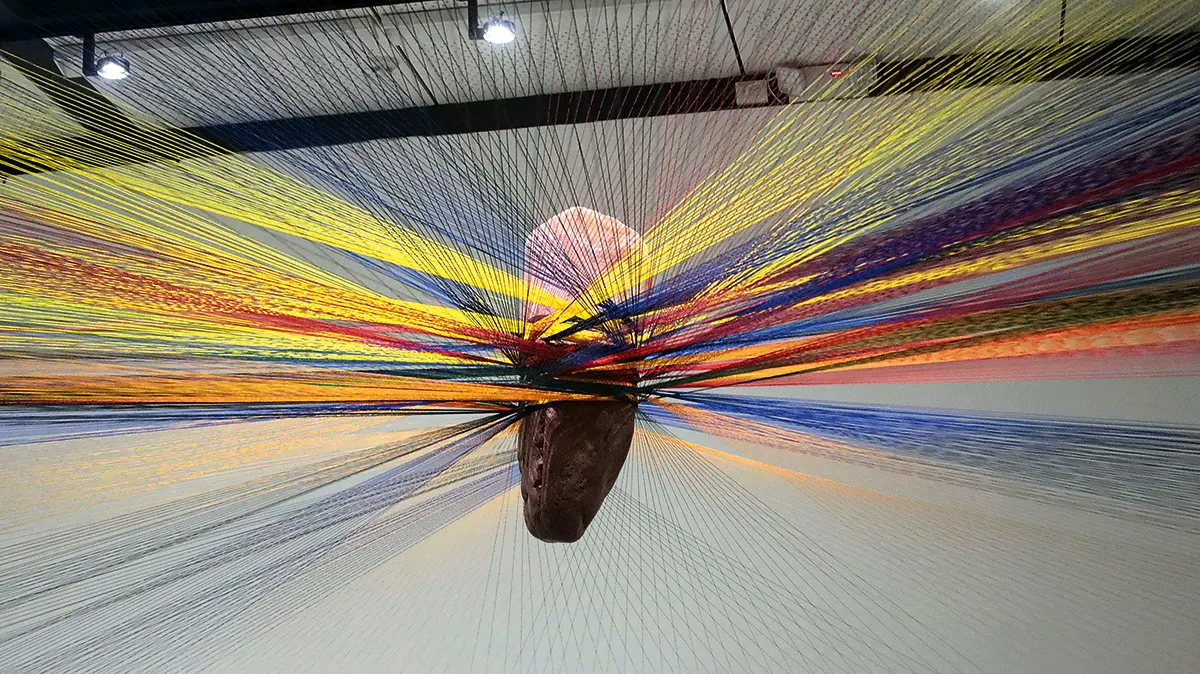
The anchors of the threads on the exhibition room wall are distributed in such a way so the cords render virtual planes across the space. The eyebolts in the back wall form an x, creating two intersecting planes that run almost parallel to the lateral walls and bend from top to bottom, and vice versa, until converging in the center of the space where the boulder is located.
The tension maintained by the rock suspended in the air is not only evident, but also underscores the key, and yet invisible, role of gravity in the installation—which reinforces the idea of energy as a central theme in the work by Milton Becerra. The piece stresses the contrast between the flexibility of the thread and the rigidity of the boulder, as well as the straightness of the plane and the line that is formed. In this sense, the point (the stone, but also the anchors on the wall to fasten the cords), the line (the different color threads), and the plane (virtually formed by the lines) are the operative elements in the installation used to produce the optical effect of vibration as visitors move in the space. As far as their virtual nature, the planes are partially perceived and, most importantly, cast different shadows of color across the exhibition area. The colors change according to our place in the space.
The threads “vibrate” as we move in the spaces as result of an optical effect that gradually stops when we observe the threads that are closer to the immovable floating boulder. The lines get gradually closer to each other until forming thick bands of color around the rock.
The exhibition is accompanied by a series of square drawings titled “Sized Drawings.” Created with pencil on paper, these drawings show geometric figures formed with lines and shading, but also with low relief marks, incisions on paper, and pencil erasing. The palpitating edges of these erased lines produce the sensation of flows of energy around the forms and volumes. But the energy is also contained in the operation of drawing and erasing, a process that can be observed through the repetition of the creative act in the parallel lines, which outline geometric designs that are reminiscent of both scientific and pre-Columbian forms.
In this work Becerra also plays with the ideas of two-dimensionality and three-dimensionality through the use of linear patterns that emphasize the plane and rely on geometric perspective—which creates the illusion of volume—as well as through cuts in the paper that effectively break the two dimensions, creating elements that stand out from its surface.
In his first exhibition at the Museo de Arte Contemporáneo in Lima, Milton Becerra clearly establishes his connection to kinetic art—one of the most emblematic and internationally accepted creative lines of inquiry in Venezuelan art—but also takes this exploration of color and form to other territories. Somehow, his installation associates fundamental questions about the cosmos (celestial forces, the laws of matter) with inquiries about our past (ancient civilizations and their way of life), which are interwoven around curiosity and wonder.
MAX HERNÁNDEZ CALVO