La Casita is an artistic space that sprung from the collection of Simón and Maritza Chehebar. It is located a few blocks north of the San Felipe neighborhood that in recent years has become the Art District of Bogota, not only because it concentrates nearly twenty art spaces—including galleries, exhibition spaces, foundations, and independent venues—but also as result of the countless art studios located in it. Since its creation, La Casita operates through the commission of art projects specifically conceived for the first floor of the the gallery to establish a dialog with a piece from the collection of the founders of the space, permanently exhibited on the second floor.
Paris-based Colombian artist Miguel Böhmer (Cali, 1968) began studying visual arts in the 1990s and exhibiting his work very early in his career. Large-scale drawings and the analysis of animal iconography have been two recurrent interests in his work. The conception “Colõrem Echinometra,” the exhibition project presented from April to June of this year at La Casita, was based on an analysis of marine fauna. Upon entering the space, viewers encountered more than two thousand resin covered photographs of marine mollusks mounted and outlined like small circles, forming a mosaic that spanned the entire first wall. A corridor, located behind the mosaic, allowed for a walk through several chromatic environments—containing several optical illusions created with the help of mirrors—that led to a larger white space containing four large circular drawings and a sculpture that alluded to the image of a marine snail.
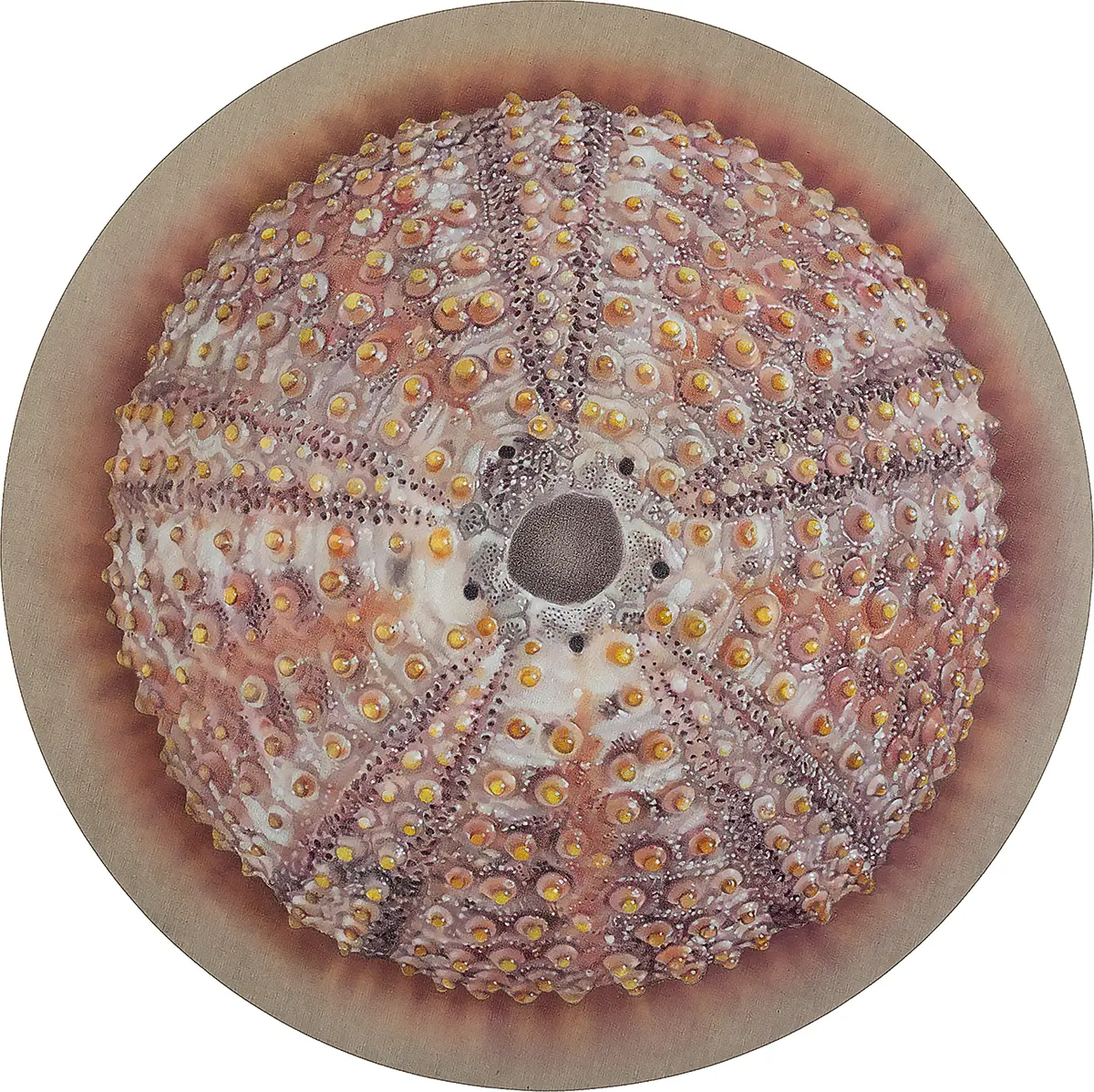
The different tones used through this walk seemed to have emerged from the colors used in the drawings, while the images in them seemed to have emerged from the initial photographic mosaic. These four drawings and the sculpture were accompanied by an untitled work from 1972 created by Álvaro Barrios, with the idea of starting a dialogue between the project “Colõrem Echinometra” and the Chehebar collection, the watermark of the exhibitions at La Casita. To exit this exhibition room, visitors had to go through a new chromatic space where Böhmer installed a pair of drawings, created on parchment paper several years back, whose images reinforced the dialogue between the new project and the work by Barrios.
Imaginary illusions have been a key element throughout Miguel Böhmer’s artistic career. They seem to serve as a trap for the viewer’s gaze. A widely known account by Pliny the Elder described a contest staged by painters Zeuxis and Parrhasius (who lived in the 5th century B.C.) to determine which one of the two was the best artist. According to the story, Zeuxis created a painting of grapes so realistic that birds flew down to peck at them. Then Zeuxis asked Parrhasius to remove the veil that covered his painting so they could establish which work was the most realistic. But much to Zeuxis’s dismay, the veil itself turned out to be the painted illusion. While the birds were deceived by what is on the canvas, human beings are deceived by what is behind it.
Before an illusionist image, in the conventional sense expressed in the aforementioned example, we can safely assume that what we observe through a window shows us the reality behind the work. But Böhmer maintains a tension through images that tend to seem translucent and opaque at the same time. Despite the sophisticated way in which his pieces are rendered, their supports are often revealed as artifices. For this reason, we are able to view them as projections that exist somewhere between the surface of the works and our bodies. It is there where we immerse ourselves in the experience of differentiating the animal world, with all its implications, from our cultural universe, which can seem totally separated from the former. In this sense, it could be said that we see like birds do. The spatial configuration of the project “Colõrem Echinometra” functioned like a corporal translation of what his drawings proposed, because it had the power to elicit reflections on the equivalencies between the bodies of those animals and our own bodies.
JAIME CERÓN