The exhibition Aria, curated by Salvatore Elefante, features a selection of forty-seven photographs by María Teresa Hamon. Since her first solo exhibition, in 2015, Hamon has participated in a number of group outings, and between 2016 and 2017 she was chosen for a residence in the Terra Gráfica project, organized by the Taller de Artistas Gráficos Asociados (TAGA), where she completed her training in the graphic arts.
Aria is a topic that the artist has developed over the course of two years, presented now in a selection of digital prints on cotton paper, in an edition of 5 + 2 P/A. The precedent for these works is One and One is One, where Hamon explored human psychology and emotions, exhibited in 2015 at Galería Tres y 3, in Caracas. Hamon developed One and One is One on the basis of self-observation and observation of her surroundings, producing a visual discourse dominated by an atmosphere of contemplation and perception. In this process of study, the relationships between the images and their sources became blurred, less tangible. This technical intervention, added to the subject of the body and identity, was the first problematization Hamon encountered in her inquiry, and the results are present in Aria.
The artist uses the body as a basis for the construction of processes of identification through intangible and incorporeal elements. For Hamon, one arrives at the body via a sensorial approach to the corporeal, and to all that exists in the universe of objects around her: eroticism, passion, loneliness, pain, taboos. Identifying the origin of these images is not what matters most, because what is suggested becomes the referent. Photography does not reveal truth; rather, it builds it, functioning like a mirage, like a metaphor. On display are self-portraits, fragments of the body, objects, and landscapes enveloped in a halo of subtle lyricism and great symbolic content. On occasion, the glazings or the cuts of the images foster a certain reserve, a certain mystery that makes it difficult to properly discern what is being narrated, opening the possibility of reaching what lies behind or what is missing.
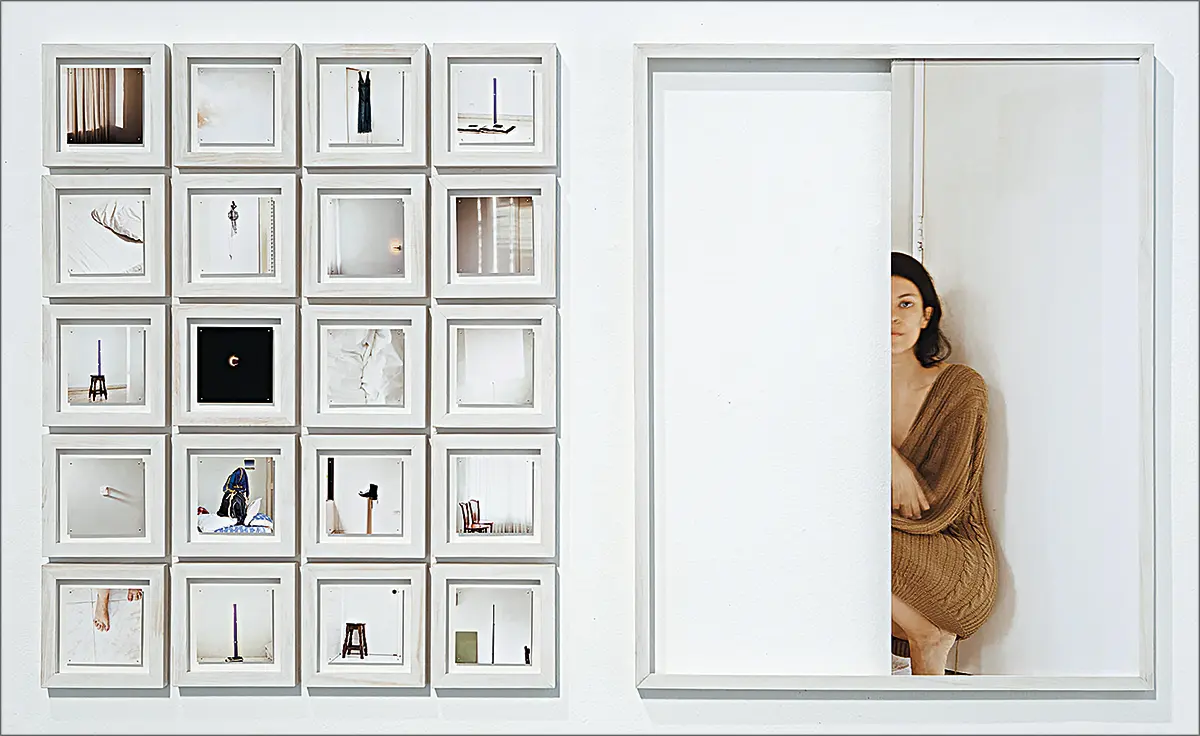
The rhythm of the placement of the artworks on the wall produces visual tensions and permanent dialogs by means of associations, polarities, and ambiguities. The trajectory begins with (Il falso Scopo) Hypothesis of a photo of the self-made by someone else and the self (2018), a diptych comprised of a group of small images and a larger portrait of the artist, reproduced in half. In the small images we see details of private spaces, curtains, costumes, lights, shadows, furniture, presented almost as if on a theater set with an aesthetic of perfect finishings. This staging prompts endless readings and pushes the gaze beyond the limpid and the well-ordered. The sequence of self-portraits continues with Índigo (2017) and Este es mi cuerpo, dónde está mi cuerpo (This Is My Body, Where Is My Body, 2016). The latter work has been grouped with Eye movement storm, a digital projection of a landscape; Nervio (Nerve); and Spine, all from 2016; and Irreversible (mecánicas del silencio) (Irreversible [Mechanics of Silence], 2017): a small box on which the shadow of a hand rests, a small red capsule with expanded pigment, and a fish open up unending possibilities for approaching what is therein suggested. What is shown of the landscapes is a detail that intensifies the density of its properties—water, dense foliage, serene winds, or details of fruits and sparks illuminating the darkness, as in 2 Rot (2015), Anahata (2016) and Guayabal (Guava Tree Grove) or Pulso (Pulse), the last from 2017. These works give rise to a sensorial dimension that “speaks of the body from the non-body, from the metaphor.”
The same occurs with another group of works featuring portraits, flows, objects, and parts of the body, on the basis of which the narrative is recomposed, always with the symbolic space that images provide in connection with the sensations they arise. Hamon penetrates and brings to light the questions, delicately compels viewers to observe what lies behind the evident. Some examples in which she pieces together a puzzle with details of shadows, objects, and fluids are Bird Giving Tree (2016), Oclusión (Occlusion, 2015), and Flujos en torbellinos, flujos lentos, sincopados (Flows in Whirlwinds, Slow, Syncopated Flows, 2017). Hamon presents androgynous characters of almost hidden women, as in Ilem Sonet (2016), Scie (2015), Axioma de unicidad (paralelismos) (Axiom of Uniqueness [Parallelisms], 2017), Nazuna (2018). In Three Blackbirds (2017) she contrasts the image of an adult woman tugging at one of her teeth, a scene accompanied by the pleasant colors of flowers. Aria proposes a visuality that ranges from femininity to identity, roles, indifference, flagellation, and silence.
ANNY BELLO